
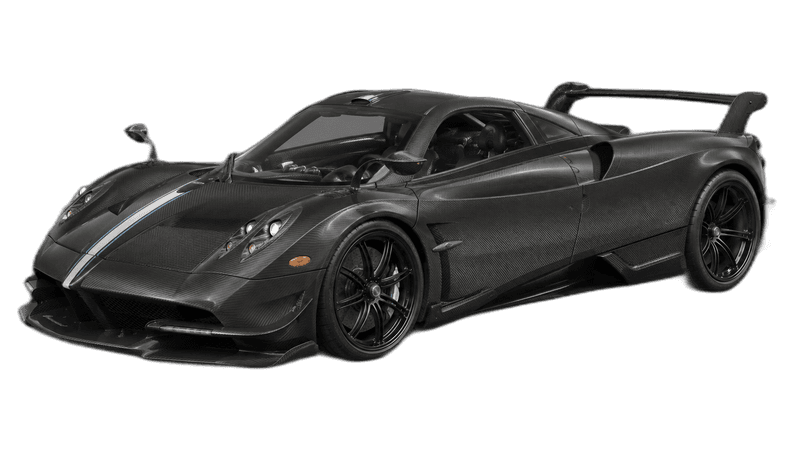
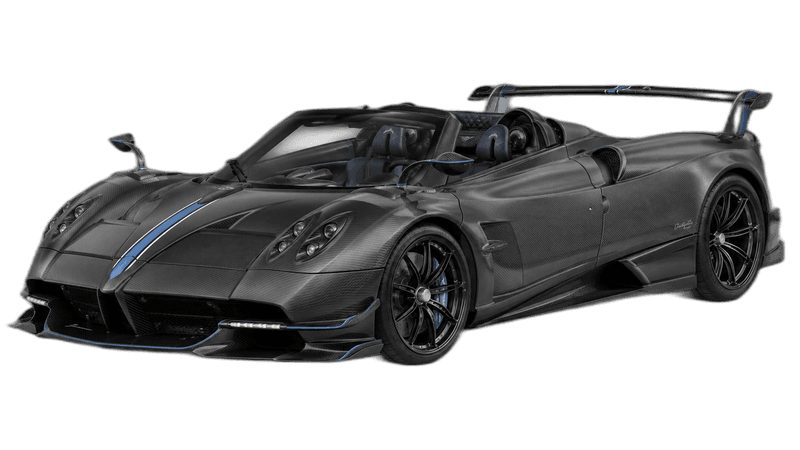
Pagani Huayra BC
£3,100,000
usedIndicative market price, updated periodically.
754bhp
Power
2.8s
0-100 km/h
354km/h
Top Speed
£3,100,000
Price Used
The Pagani Huayra BC produces 754 bhp, reaches 100 km/h in 2.8 seconds and has a top speed of 354 km/h. A representative example is worth about £3,100,000.
How hard it pulls.
Peak g-force the instant you bury the throttle, estimated from the car's 0–100 time and drivetrain.
Pagani Huayra BCEstimated peak launch g from the 0–100 time and drivetrain: an honest approximation, not a measured figure.
Dream Car Garage Editorial · Edited by José Teo Lorente Vallecillos · Last updated 2 November 2026
Overview
We have not driven this car. This review is based on published specifications and the sources listed below.
Scope of this guide
This guide is scoped to the Pagani Huayra BC coupe, the two-door, mid-engine, rear-wheel drive, carbon-bodied car with the Mercedes-AMG-built 6.0L twin-turbo V12 petrol (5980 cc) engine, revealed at the Geneva show in 2016 and sold as a limited run of about 20 cars. It is not a guide to the standard Huayra coupe, the Huayra Roadster, or the Huayra BC Roadster, which is a separate open car with its own entry. Where those cars differ we say so below, so that you can tell which car an advert really describes.
We have not driven this model for this article. Everything here comes from three cited sources: the manufacturer's own Huayra BC page on pagani.com, PistonHeads' launch article by Matt Bird (28 February 2016), and the government recall checker. We also read an evo launch drive by Jethro Bovingdon (1 March 2016), an RM Sotheby's catalogue entry for one car, a Wikipedia summary and an AUTO BILD Geneva report, and we flag every point that rests on them. Where sources disagree we say so instead of picking a winner quietly. Prices are history, not valuations.
The figures at a glance
- Engine: 6.0L twin-turbo V12 petrol (5980 cc), built by Mercedes-AMG, 36 valves, mounted behind the cabin.
- Power: 754 bhp. Pagani's own page lists 764 CV (metric horsepower, PS) at 6200 rpm, and 764 x 0.98632 is about 753.6, which we round to 754 bhp. Wikipedia also prints 754 hp, citing the same Pagani page.
- Torque: 1000 Nm, which Pagani lists at 4000 rpm. PistonHeads gives 737 lb ft, and 737 x 1.3558 is about 999, so the two agree.
- 0-100 km/h: 2.8 seconds. This is evo's estimate, printed as 0-62 mph, and we treat 0-62 mph as 0-100 km/h. Pagani's page gives no acceleration time at all.
- Top speed: 354 km/h. This is evo's estimate of 220 mph (220 x 1.609 is about 354), and evo says Pagani had not confirmed it. Pagani's page gives no top speed.
- Drive: rear-wheel drive, through a seven-speed automated manual gearbox with an electronic mechanical differential, developed and built by Xtrac.
- Weight: 1218 kg, a figure that Pagani, PistonHeads, evo and AUTO BILD all print. PistonHeads calls it a kerbweight while Wikipedia calls it a dry weight, so ask what any given figure includes.
What the Huayra BC is
The BC is named for Benny Caiola, the first person to buy a Pagani, and PistonHeads describes the car as a tribute to him. It is a lighter, more powerful and more track-focused development of the Huayra coupe, with a carbo-titanium monocoque, a new aerodynamic package developed with Dallara and inspired by the Zonda R, and a new gearbox. Wikipedia says the dry weight was reduced by 132 kg compared with the standard car, and AUTO BILD prints 1350 kg for the standard Huayra against 1218 kg here, which is a similar gap. The car stays road legal. The price at launch, according to evo, was 2.35 million euros plus local taxes, with all the cars already sold. That is a history figure, not a current price.
Why the quoted power and torque vary
This is the trickiest part of reading adverts. Pagani's page prints 764 CV and describes the car as having more than 750 horsepower. PistonHeads prints more than 750hp. RM Sotheby's prints 753 hp. AUTO BILD printed 800 PS and 1000 Nm after the Geneva reveal, and evo printed around 800 bhp and 811 lb ft (about 1100 Nm) in its spec table, from a Sicily test car that evo said was only about 60 per cent finished. Both of those were launch-period figures, and they do not match the maker's own page.
Metric horsepower (PS or CV) and brake horsepower differ by about 1.4 per cent, so 764 PS is 754 bhp and 800 PS would be about 789 bhp. The 754 bhp we use is the figure that the manufacturer's page supports once converted. Torque is also quoted at different engine speeds by different sources, so treat any single rpm figure with care. A car advertised at 800 PS or 1100 Nm is quoting the launch claim, not the figure on Pagani's current page, and the seller should say which they mean.
How many were built
Pagani said it would build 20 cars, and evo says that all 20 were already sold at launch for 2.35 million euros each. RM Sotheby's repeats that Pagani stated that just 20 examples would be built. Wikipedia, however, lists 29 in its infobox and also says Pagani produced 30 instead of the promised 20, tagging that claim as needing a citation. We have not seen a Pagani statement that confirms more than 20. We use 20 because it is the announced run and the figure two independent sources repeat, and we say plainly that the true build count may be higher. If a seller quotes a chassis or build number, ask Pagani to confirm it.
Drivetrain, gearbox and chassis
The car is rear-wheel drive with a longitudinal, central rear engine, in Pagani's own words. The gearbox is a next-generation automated manual with seven speeds plus reverse, made by Xtrac. PistonHeads says Pagani describes the unit as about 40 per cent lighter than an equivalent dual-clutch gearbox, and evo says it is still a single-clutch, paddle-operated design. evo describes it as a bit clunky at low speeds and notes turbo lag from the engine. Tyres are Pirelli P Zero Corsa, on 20-inch front and 21-inch rear forged wheels, with a track option of Pirelli Trofeo R tyres on wheels one inch smaller. The brakes are Brembo carbon ceramics and the dampers are four-way adjustable Ohlins units, according to evo. We have not tested any of this and report it as the sources' account.
Running costs
We have no manufacturer or PistonHeads data on service prices, insurance, parts or tyre costs for this car, and we will not guess. A car of this kind needs specialist work, so whoever services it, whether Pagani or an independent, should be able to show specific experience on the BC and a written record of what was done. Ask for written quotes before you commit. The one maintenance detail in our sources is that the RM Sotheby's car was serviced by Pagani in August 2019 at 1,550 kilometres. Carbon ceramic discs, specialist tyres and a single-clutch gearbox are all consumables on a track-focused car, and the sources give no life figures for any of them.
The Pacchetto Tempesta upgrade
PistonHeads (6 August 2021, by Becky Wells) reports the Huayra BC Pacchetto Tempesta, a package that adds a new front splitter and dedicated intake, a new rear wing, a six-pipe exhaust and upgraded suspension, while still quoting more than 750hp and 737 lb ft. RM Sotheby's says its car was returned to the factory for that upgrade and prints 827 horsepower for it, which does not match PistonHeads' unchanged figure. If an advert says a car has been brought to Tempesta specification, ask for the factory work order, because it changes what the car is compared with the figures in this guide.
Recalls and the DVSA check
We did not run the government checker, because it needs a registration number or the manufacturer, model and year of manufacture, and we are not looking at a specific car. The page says the MOT checking service shows outstanding safety recalls for a car with a registration, and that non-safety recalls come from the manufacturer directly. In our search we found a US NHTSA campaign, 18V-175 (March 2018), that covers 16 cars, Huayra BC coupes and Roadsters built between October 2016 and August 2017, for battery management software that could leave the 12V battery short of power, with the remedy a replacement battery. We read that only through a search summary, so check the original report. A US campaign does not prove that a UK or European car was affected, so ask Pagani whether the work was done on any car you consider.
How the BC differs from other versions
The standard Huayra coupe was built from 2011 in a run of about 100, with less power and a heavier body. The Huayra Roadster is an open car with a different build. The Huayra BC Roadster is a separate model, with 40 cars, 791 hp and a 1,250 kg dry weight in PistonHeads' report of 27 February 2020, and a launch price of 3.36 million pounds. If an advert mentions a roof-less body, 791 hp or 40 cars, it describes a different car from the one in this guide.
What to check before buying
- Confirm the chassis number and that it is a BC coupe, with Pagani's confirmation of its position in the run.
- Ask for the full Pagani service history, with dates and distances for every visit.
- Ask whether the Tempesta package has been fitted and, if so, for the factory paperwork.
- Check that the 2018 battery software work was done, if the car was built in the affected window.
- Drive or ride in the car at low speed to judge the gearbox, and ask the seller what it needed.
- Check the age and wear of the tyres and the brake discs, and ask what they cost to replace.
- Confirm import, registration and tax status, because at least one example in our sources was held on a temporary import bond.
- Run any registration through the government recall checker.
Verdict
The Huayra BC coupe is 754 bhp, 1000 Nm, an estimated 2.8 seconds to 100 km/h and an estimated 354 km/h, rear-wheel drive and mid-engine, in a run of about 20 cars that weighs 1218 kg. The power and torque come from the maker's page, while the speed figures are press estimates that Pagani has not confirmed. It rewards a buyer who treats every claim as something to document and who budgets for specialist work. If you are shopping for one, confirm the exact car, insist on a full service and recall history, and have a specialist inspect it. We have not driven it, so use the sources and a proper inspection to decide.
Specifications
| Engine | 6.0L twin-turbo V12 petrol (5980 cc) |
|---|---|
| Displacement | 6.0L |
| Power | 754 bhp |
| Torque | 1000 Nm |
| 0-100 km/h | 2.8s |
| Top Speed | 354 km/h |
| Drivetrain | RWD |
| Country | Italy |
| Body Style | 2-door coupe |
| Years | 2016–2019 |
| Production | 20 |
| Price Used | £3,100,000 |
Specifications are manufacturer-published figures.
Frequently Asked Questions
What is a Pagani Huayra BC worth?
A representative example is worth about £3,100,000. Actual values vary with specification, condition and history.
How much power does the Pagani Huayra BC have?
The Pagani Huayra BC produces 754 bhp and 1000 Nm of torque.
How fast is the Pagani Huayra BC from 0 to 100 km/h?
The Pagani Huayra BC accelerates from 0 to 100 km/h in 2.8 seconds.
What is the top speed of the Pagani Huayra BC?
The Pagani Huayra BC has a top speed of 354 km/h.
What engine does the Pagani Huayra BC have?
The Pagani Huayra BC uses a 6.0L twin-turbo V12 petrol (5980 cc).
How many Pagani Huayra BC were made?
Pagani produced 20 units of the Pagani Huayra BC.
When was the Pagani Huayra BC built?
The Pagani Huayra BC was built from 2016 to 2019.
Is the Pagani Huayra BC all-wheel drive?
No. The Pagani Huayra BC is configured with rear-wheel drive.
More from Pagani


Featured in Carpedia
Monza: The Temple of Speed
Autodromo Nazionale Monza has been defining outright speed since 1922. Its long straights reward horsepower above all else, yet its three chicanes and the Parabolica demand braking precision and mechanical balance. These are the fastest production cars ever recorded on the most storied circuit in motorsport.
What Cars Should I Put in My Dream Garage?
A comprehensive guide to building a dream garage at every budget. Five balanced 5-car garages, from under GBP 100K total to unlimited, each covering daily driving, weekends, track days, road trips, and special occasions.
The 25 Rarest Cars in the World by Production Numbers
The 25 rarest production and limited-run cars ranked by total units built. From one-off commissions to 40-unit production runs, these are the cars that most collectors will never even see in person.
The 10 Greatest V12 Engines Ever Made
A celebration of the twelve-cylinder engine, the most intoxicating configuration ever devised, and the ten units that defined it.
What Your Dream Garage Says About You
The cars you choose when money is no object say everything about who you are, and nothing about what you drive.