
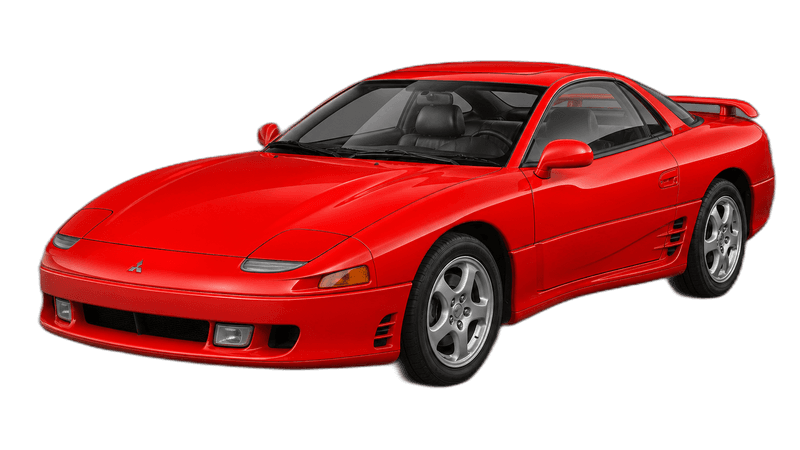
Mitsubishi 3000GT VR-4
£25,000
usadoIndicative market price, updated periodically.
282cv
Potencia
5.9s
0-100 km/h
250km/h
Velocidad Máxima
£25,000
Precio Usado
Cómo empuja.
La fuerza g máxima en el instante en que pisas a fondo, estimada a partir del 0–100 y la tracción del coche.
Mitsubishi 3000GT VR-4G de salida estimada a partir del 0–100 y la tracción: una aproximación honesta, no una cifra medida.
The Mitsubishi 3000GT VR-4 is a 3-door 2+2 hatchback coupe by Mitsubishi, with 282 bhp, 407 Nm of torque, a 0-100 km/h time of 5.9 seconds and a top speed of 250 km/h. Indicative used value: approximately £25,000. Actual values vary with specification, condition and history.
Dream Car Garage Editorial · Edited by José Teo Lorente Vallecillos · Last updated 2 November 2026
Visión General
We have not driven this car. This review is based on published specifications and the sources listed below.
Scope of this guide
This guide is scoped to the UK and European-market Mitsubishi 3000GT VR-4, the three-door 2+2 hatchback coupe with the 3.0L twin-turbo V6 (2972 cc) and all-wheel drive that Mitsubishi sold in Britain and the rest of Europe. It is not a guide to the Japanese GTO, to the American 3000GT VR-4 or Dodge Stealth R/T Twin Turbo, to the naturally aspirated cars, or to the 1995-96 Spyder, and we say below where they differ so you can tell which car an advert is really describing.
We have not driven this model for this article. Everything here comes from a Mitsubishi Motors heritage page for the 1990 car, a PistonHeads feature written about the 3000GT in general, and the government recall checker. We also read a second PistonHeads page, a specification database, an encyclopaedia entry and a buying guide from Auto Express for the European power, torque and years, and we flag those points in the text.
The figures at a glance
- Engine: 3.0L twin-turbo V6 (2972 cc), 24 valves, twin intercoolers.
- Power: 286 PS (210 kW) at 6,000 rpm, which is 282 bhp after conversion.
- Torque: 407 Nm at about 3,000 rpm, quoted as 300 lb ft.
- Gearbox: five-speed manual on the earliest cars, a six-speed manual on the later ones, with some sources disagreeing about when the change came.
- Drive: permanent all-wheel drive, with four-wheel steering.
- 0-100 km/h: 5.9 seconds in one specification database, with PistonHeads quoting under six seconds for 0-60 mph.
- Top speed: 250 km/h, which is about 155 mph.
- Weight: roughly 1,700 kg, which PistonHeads calls a 1.7-ton car.
- Body: three-door hatchback coupe with two seats in the front and two small ones behind.
Why the quoted power and torque vary
The first thing to know is that this car has no single power figure. PistonHeads, in a 2009 feature, says the VR-4 made between 280 bhp and 320 bhp depending on who you believed. That is a fair summary of the paperwork. Mitsubishi's own heritage page for the 1990 launch gives 280 PS for the intercooled twin-turbo V6, and the Japanese GTO is rated at the same 280 PS. The American 3000GT VR-4 and Dodge Stealth were rated at around 300 hp in the early years and 320 hp on later cars, according to an encyclopaedia entry we read.
The European car sits in between. The database and encyclopaedia figures we read give 286 PS and 210 kW, and PistonHeads prints 286hp and 300 lb ft for a 1998 UK car on a separate page. Converting 286 PS gives 282.1 bhp, and converting 210 kW gives 281.6 bhp, so we publish 282 bhp. That is a conversion made by us. It is also not a different car from the 286hp that PistonHeads prints, only a different label.
Torque follows the same pattern. The same sources give 407 Nm for Europe, and 300 lb ft converts to about 407 Nm, so they agree. American and later Japanese twin-turbo cars are quoted at 417 to 427 Nm. We use 407 Nm for the European car and treat 427 Nm as a figure for other markets and later cars.
An earlier catalogue entry of 320 bhp and 427 Nm therefore describes the late American-specification car, not the one scoped here. Do not expect a European car to match it, and treat any advert that does as a cue to ask for evidence of tuning.
Performance claims and what they mean
PistonHeads says the VR-4 was good for 155 mph and a 0-60 mph time of under six seconds. On a separate page it quotes 5.8 seconds to 60 mph for a 1998 car and adds that many people suspected the 286hp rating was conservative. A specification database gives 5.9 seconds to 100 km/h and 250 km/h, and Auto Express lists 5.9 seconds to 60 mph and 160 mph. These are manufacturer or magazine claims, they come from different sources and different standards, and they do not quite agree.
We use 5.9 seconds for 0-100 km/h and 250 km/h for top speed, and we regard both as claims. 155 mph converts to 249.4 km/h, which rounds to the 250 km/h we publish. An earlier catalogue entry of 5.0 seconds and 266 km/h was not supported by any source we read, and we have corrected it. Some Japanese and American road tests quote faster times for the more powerful cars, which is another reason not to mix markets.
Model years and availability
Mitsubishi launched the car in Japan in October 1990 as the GTO, and the Mitsubishi heritage page lists it as the 1990 3000 GT (GTO). It was sold elsewhere as the 3000GT, and in North America as the Dodge Stealth too. We use 1990 as the start of the model.
UK and European sales began later, and our sources disagree. Auto Express says UK sales began in 1991 and ended in 1999, with only the twin-turbo VR-4 on offer. The encyclopaedia entry says European cars went on sale in autumn 1992. PistonHeads says the UK list price was over 35,000 pounds in 1992 and getting on for 45,000 pounds by the end of production in 2001. Production ended in Japan in 2000 on the sources we read, with a handful of cars sold as 2001 models, so we use 2000 as the end of production. We could not confirm the exact last UK registration date.
Production numbers are not confirmed for the European VR-4. The encyclopaedia entry gives a total of roughly 86,000 3000GTs and 65,000 Stealths across all versions and markets, which does not help with a UK count, so we publish no production figure.
How the markets and facelifts differ
- Japan: the GTO Twin Turbo is rated at 280 PS, and Japanese cars carry GTO badging rather than 3000GT.
- United States: the 3000GT VR-4 and Dodge Stealth R/T Twin Turbo are rated at about 300 hp early and 320 hp later, and the Stealth ended in 1996.
- 1994 facelift: the Japanese facelift was shown in 1993 and reached other markets over the following years. Fixed headlamps replaced the pop-ups, and a six-speed Getrag gearbox arrived on the twin-turbo car. Exact UK timing is not clear from our sources.
- Mid-1990s de-contenting: PistonHeads says Mitsubishi removed the electronic suspension, the active aerodynamics and the pop-up headlamps from the mid-1990s onwards. Auto Express dates the suspension change to 1995 and the active aero to 1996, and says 18-inch wheels became standard in 1995.
- 1997 and later: the encyclopaedia entry says a planned major 1997 facelift was dropped, leaving a new front bumper and a revised rear wing, with a larger facelift in 1999 on some cars. Check the exact specification, not the year alone.
Engine and drivetrain
The V6 is a 24-valve twin-cam unit with a turbocharger on each bank and twin intercoolers. PistonHeads says a stock bottom end may be at risk above about 400 bhp and that tuned cars can reach about 800 bhp, so a heavily tuned car is a different proposition from a standard one.
Auto Express says the engine and gearbox control units are known to fail and are expensive and hard to reach. PistonHeads agrees, saying a new engine ECU cost about 1,000 pounds and that gearbox ECU failure can damage the transmission at a repair cost of about 2,500 pounds in 2009. Either failure could lead to a write-off in the PistonHeads view.
The same sources warn about transfer cases and output shafts on manual cars, and about the many hoses under the bonnet that can blow off, especially on chipped cars. PistonHeads gives a clutch replacement cost of about 1,000 pounds, again in 2009 money. Do not read these as current prices.
Chassis, steering and electronics
PistonHeads lists all-wheel drive, all-wheel steering, all-wheel ABS and electronically controlled suspension as part of the original specification, together with a tuneable exhaust and active spoilers that deploy at 80 km/h and retract at 50 km/h. Mitsubishi's heritage page also mentions a variable rear spoiler and an Active Exhaust System.
The active spoiler motors have microswitches and plastic gears that PistonHeads says fail. Auto Express says few owners repair them. The ABS control unit sits in the front inner wing, and PistonHeads says much of the front end has to come off to reach it. PistonHeads also says suspension struts and steering racks can fail, along with pulleys, gaiters and belts. Auto Express adds that suspension bushes wear regularly.
On the road, a 2017 PistonHeads piece on a 1998 UK car says the weight hurts near the limit, that the steering gives little feedback and that the car understeers. It also says the car felt secure within eight-tenths of its potential. That is one writer's view of a modified car, and we have not tested it.
Running costs and practicality
None of our sources gives reliable fuel consumption, insurance, road tax or servicing costs for the European VR-4, so we publish none. A 2017 PistonHeads listing quotes 19.9 mpg, and Auto Express quotes 26.4 mpg, which tells you how far apart sources can be. A car this heavy with two turbochargers will not be frugal.
PistonHeads valued a good unmodified car at between 5,000 and 6,000 pounds in 2009, with a very good late low-mileage car at about 7,000 pounds. In 2017 it listed a 1998 car with 145,000 miles for 7,950 pounds. Auto Express gives a range of 9,000 to 15,000 pounds for a good late car, with higher-mileage older cars at around 6,000 pounds. These are dated figures from different sources and we cannot say what a car is worth now.
What to check before buying
- Confirm it is a European-market VR-4 with 286 PS, not an imported Japanese GTO or an American car with badges changed, using the V5C, the VIN and the compliance paperwork.
- Count the gears on a test drive and check which gearbox the car has, since sources disagree on the five-speed and six-speed cars.
- Ask for evidence of engine and gearbox ECU history, and any replacements.
- Check turbo and intercooler hose clips are intact, and look for signs of raised boost or a remap.
- Test the suspension, steering and four-wheel steering for knocks, and look for worn bushes and leaking struts.
- Check that the active aero and the electronic suspension work if the car was supplied with them, and ask what a fix would cost.
- Look for service records and regular fluid changes in the transfer case, gearbox and differentials.
- Run a full history check, particularly on imports, and look at the underbody for corrosion.
- Be wary of heavily modified cars, since PistonHeads says many tuned cars end up damaged and repairable.
- Confirm every recall is closed, using the check below.
Recalls and the DVSA check
We did not find a recall list for the European 3000GT VR-4 in the sources we read. Auto Express mentions an early recall for transfer case problems but gives no campaign details, and we could not verify it. That does not mean there are no others. Run the registration through the vehicle recall check on GOV.UK, and ask a Mitsubishi dealer or specialist about the VIN, since a car that was not sold new in Britain may not appear in the same records.
Verdict
The 3000GT VR-4 is a heavy, complicated, all-wheel drive and four-wheel steering coupe with a strong twin-turbo V6, and it is worth buying only if you accept the electronics. For the European car, use 282 bhp, 407 Nm, 5.9 seconds and 250 km/h as published ratings with the caveats above, and do not assume the 320 bhp quoted for later American cars. We have not driven it, so use the sources, a specialist inspection and the service history to decide.
Especificaciones
Motor
3.0L twin-turbo V6 (2972 cc)
Cilindrada
3.0L
Potencia
282 cv
Par Motor
407 Nm
0-100 km/h
5.9s
Velocidad Máxima
250 km/h
Tracción
AWD
País
Japan
Carrocería
3-door 2+2 hatchback coupe
Años
1990–2000
Precio Usado
£25,000
Specifications are manufacturer-published figures.
Más de Mitsubishi
Preguntas Frecuentes
What are the specifications of the Mitsubishi 3000GT VR-4?
The Mitsubishi 3000GT VR-4 is a 3-door 2+2 hatchback coupe by Mitsubishi, with 282 bhp, 407 Nm of torque, a 0-100 km/h time of 5.9 seconds and a top speed of 250 km/h. Indicative used value: approximately £25,000. Actual values vary with specification, condition and history.
How much does a Mitsubishi 3000GT VR-4 cost?
Indicative used value: approximately £25,000. Actual values vary with specification, condition and history.
What drivetrain does the Mitsubishi 3000GT VR-4 use?
The Mitsubishi 3000GT VR-4 is configured with all-wheel drive.
What type of car is the Mitsubishi 3000GT VR-4?
The Mitsubishi 3000GT VR-4 is a sports cars manufactured by Mitsubishi in Japan. Production ran from 1990 to 2000.