
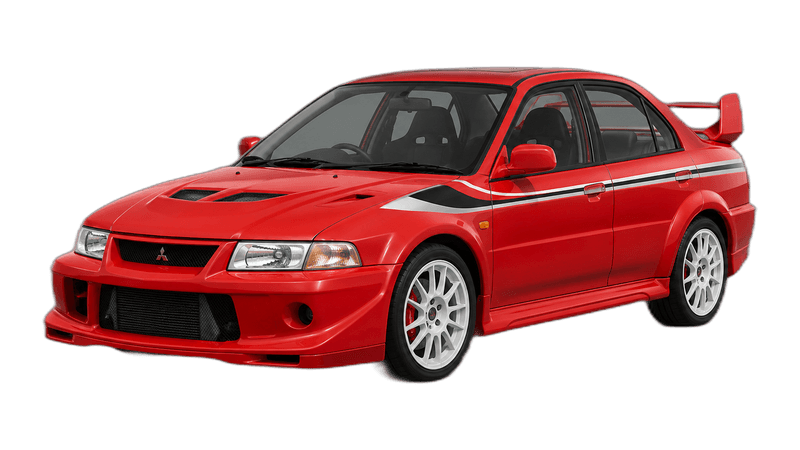
Mitsubishi Lancer Evolution VI Tommi Makinen
£55,000
usedIndicative market price, updated periodically.
276bhp
Power
4.4s
0-100 km/h
240km/h
Top Speed
£55,000
Price Used
How hard it pulls.
Peak g-force the instant you bury the throttle, estimated from the car's 0–100 time and drivetrain.
Mitsubishi Lancer Evolution VI Tommi MakinenEstimated peak launch g from the 0–100 time and drivetrain: an honest approximation, not a measured figure.
The Mitsubishi Lancer Evolution VI Tommi Makinen is a 4/5 seater sedan/saloon by Mitsubishi, with 276 bhp, 373 Nm of torque, a 0-100 km/h time of 4.4 seconds and a top speed of 240 km/h. Indicative used value: approximately £55,000. Actual values vary with specification, condition and history.
Dream Car Garage Editorial · Edited by José Teo Lorente Vallecillos · Last updated 2 November 2026
Overview
We have not driven this car. This review is based on published specifications and the sources listed below.
Scope of this guide
This guide is scoped to the Mitsubishi Lancer Evolution VI Tommi Makinen Edition, the 2.0L twin-scroll turbo 4G63 inline-4 petrol saloon with a five-speed manual gearbox and all-wheel drive. It is not a guide to the base Evolution VI GSR or to the competition-minded RS cars in general. We say below where those cars differ, so you can tell which one an advert is really describing.
We have not driven this model for this article. The facts here come from a Mitsubishi story dated 20 May 2000 that is reproduced on The Car Enthusiast website, a PistonHeads buying guide for the Evo VI, and the government recall checker. That is thinner than a full manufacturer press archive, and the PistonHeads guide covers the Evo VI as a whole rather than the Tommi Makinen Edition alone. Where a figure in our catalogue could not be confirmed word for word, we say so. We also saw Japanese-language reports of the model's launch dates, and we mark those as unconfirmed because we do not list them as a source.
The figures at a glance
- Engine: 2.0L twin-scroll turbo 4G63 inline-4 petrol, 1,997 cc according to PistonHeads. Our catalogue rounds this to 1997 cc.
- Power: 276 bhp at 6,500 rpm. The Japanese rating was 280 PS, which converts to about 276 bhp (280 x 0.9863).
- Torque: 373 Nm in our catalogue, which is the Japanese 38.0 kgm converted. PistonHeads gives 274 lb ft at 3,000 rpm, about 371 Nm.
- Gearbox: five-speed manual only.
- Drive: permanent all-wheel drive with a centre viscous coupling and Active Yaw Control.
- 0-100 km/h: 4.4 seconds in our catalogue, with the caveat explained below.
- Top speed: 240 km/h in our catalogue, from a quoted 150 mph.
- Body: four-door saloon, 4,350 mm long and 1,405 mm high according to PistonHeads.
Why the power and torque numbers vary
The catalogue says 276 bhp and 373 Nm. Those are conversions, not numbers printed on a Mitsubishi page that we could read. The Japanese rating for the car was 280 PS and 38.0 kgm. We converted 280 PS to brake horsepower and 38.0 kgm to newton metres, which gives about 276 bhp and 373 Nm. The Mitsubishi story reproduced on The Car Enthusiast quotes 276 bhp at 6,500 rpm and does not state torque. PistonHeads writes 276hp and calls it modestly claimed, adding that around 300hp is widely accepted for a standard engine.
PistonHeads gives torque in pounds-feet, not newton metres. Its 274 lb ft at 3,000 rpm is about 371 Nm, close enough to 373 Nm to be the same rating rounded differently. Treat all of these as ratings from a document, not measurements of a car on a forecourt.
Performance claims and what they mean
The 4.4 seconds we carry is not a 0-100 km/h time. PistonHeads gives 4.4 seconds for 0-60 mph for the Evo VI generally. A 0-60 mph run is slightly shorter than a 0-100 km/h run, because 100 km/h is about 62 mph, so 4.4 seconds flatters the car as a 0-100 claim. The Mitsubishi story says under five seconds for 0-62 mph, which does not contradict it but does not confirm it either. We found no official 0-100 km/h time for the Tommi Makinen Edition on a page we could read, so we call 4.4 seconds a catalogue value, not a manufacturer figure.
Top speed is a claim as well. Both sources quote 150 mph, which is about 241 km/h, and our catalogue rounds that to 240 km/h. PistonHeads adds that many Japanese imports were limited to 112 mph, about 180 km/h, and tells buyers to check whether the limiter has been removed. A grey import may therefore never have been run to the claim, and a tuned one may have gone well beyond it.
Model years and UK availability
Our catalogue says 1999 to 2001. That is the span of the Evolution VI generation: PistonHeads says UK sales began in 1999 and that the Evo VII replaced the car in March 2001. The Tommi Makinen Edition itself came late in that run. The Mitsubishi story is a May 2000 UK launch. Japanese-language reports we read but do not list put the Japanese announcement in December 1999 and sales from January 2000, which we have not confirmed. A 1999 build is therefore possible, but a 2000 or 2001 car is more likely. We have not confirmed an exact first or last build date for the edition, and the catalogue span is the generation, not a date range for this edition alone.
Where other versions differ
- Base Evo VI GSR: PistonHeads describes a quicker steering rack on the Tommi Makinen Edition than the GSR's 2.6 turns lock to lock, plus a front suspension brace and a ride height lowered by 10 mm all round. The guide does not give a number for the faster rack.
- Engine hardware: PistonHeads says the Tommi Makinen Edition had a high-response turbo with a smaller compressor wheel. The Mitsubishi story says the same in different words and calls it a titanium turbocharger. A titanium-alloy turbine is described as an Evo VI change in general, so check what the particular car has.
- RS cars: PistonHeads says RS models have thinner-gauge panels and thinner glass, saving 100 kg, and were built mainly for competition. We also understand that Makinen-badged RS cars were sold in Japan. They are outside this guide.
- Other limited editions: PistonHeads names the RS2, RS Sprint and Extreme, and says 26 Extremes were built. None of them is covered here.
- Inconsistency: the first page of the PistonHeads guide says the only difference it gives for the Tommi Makinen Edition is an optional sticker pack. Its later pages list mechanical and bodywork changes. We follow the later pages.
Engine and gearbox
The Evo VI engine is a 2.0-litre, 16-valve, intercooled turbocharged four-cylinder, with a bore and stroke of 85.0 mm by 88.0 mm according to PistonHeads. PistonHeads lists a larger intercooler and oil cooler, new pistons, revised cooling passages and upgraded sump baffles for the generation. The twin-scroll and 4G63 wording comes from our catalogue and from general knowledge of the engine family. Neither source we read prints it, so treat it as unverified here.
PistonHeads recommends servicing every 4,500 miles, mostly oil and filter changes, and a cambelt every four years or 40,000 miles. It warns about cold tappet noise from the lash adjusters, a coolant reservoir cap that seals poorly, and gearbox whine that usually means worn input shaft bearings. The five-speed is described as stronger than the later six-speed. A careful driver may get about 30,000 miles from a standard clutch, and several hard standing starts can destroy one.
PistonHeads says a stage 1 tune can reach about 380hp, and that about 400hp is the limit for a stock engine before reliability suffers. Ask any seller of a tuned car for the dyno sheet, the mapping history and the parts list.
All-wheel drive, chassis and brakes
The car has permanent four-wheel drive with a centre viscous coupling and Active Yaw Control. PistonHeads says the transmission fluid and the AYC pumps and clutches need new oil every two years or 9,000 miles. GSR owners sometimes swap the AYC for the RS limited-slip rear differential, which removes AYC servicing but can feel too aggressive on the road.
The front suspension is MacPherson struts with inverted dampers and the rear is multi-link. PistonHeads says the Tommi Makinen Edition sits 10 mm lower, with front and rear tracks of 1,510 mm and 1,505 mm. It warns that the geometry must be set up very carefully, or the car will handle poorly and wear its tyres. Creaks usually mean worn struts or bushes.
The brakes are Brembo ventilated discs front and rear, which PistonHeads gives as 320 mm and 300 mm. PistonHeads says warped discs are not uncommon and pads are expensive, so feel for judder through the pedal or wheel.
Wheels and tyres
The Mitsubishi story lists 17-inch ten-spoke alloys styled like the works car and 225/45 ZR17 tyres. PistonHeads says the Tommi Makinen Edition wore Enkei wheels and that the original tyre it lists was a Bridgestone S-01. Quality replacements are expensive, so check the tyres and the age on the sidewall. PistonHeads also says the front wheelarch extensions can be damaged on cars fitted with 18-inch wheels and are costly to replace.
Running costs
PistonHeads quotes an owner who says mid-20s mpg is possible with sensible driving, with costs climbing mainly when the car is modified. It suggests refuelling about every 200 miles. The fuel gauge reads erratically because of the tank shape, and PistonHeads says it can drop from full to a quarter in a few miles, so use the odometer. The sources do not give insurance, tax or MOT costs and we give no figures. PistonHeads prices are from 2012 and the Mitsubishi story is from 2000, so we do not reproduce them. Get current quotes from a specialist.
Interior, equipment and practicality
The Mitsubishi story describes a black dashboard with red lettering, Recaro bucket seats in black and red fabric carrying the Tommi Makinen logo, and a Momo steering wheel, gear lever and boot with red stitching. Airbags for the driver and front passenger were standard. PistonHeads says the seats hold you well but the recline mechanism is fragile, and that the rear bench is a standard Lancer item seating three abreast. That is why our catalogue says 4 or 5 seats.
PistonHeads warns that the speedo can read wrongly or not at all, often because of a faulty connector at the gearbox drive, and that a badly fitted mph speedo on an imported car can cause the same fault. The air conditioning can smell after a few years because of a dirty evaporator.
What to check before buying
- Confirm it is the Tommi Makinen Edition and not a GSR with stickers: look for the redesigned bumper, black door handles, amber front indicators and the Tommi Makinen Recaro seats.
- Check for rust behind the plastic wheelarch extensions, around the rear chassis legs and the fuel filler neck, in the floor pans and on the door bottoms. PistonHeads says rust is a big problem on these cars.
- Ask whether it is a UK car or a grey import, and ask for the import and undersealing history.
- Look for worn paint where the boot lid rubber meets the rear panel.
- Listen for a whining gearbox, cold tappet noise and clutch judder, and ask when the AYC and gearbox oil last changed.
- Feel for brake judder and check the dampers for abuse and the tyres for uneven wear.
- Test the speedo, air conditioning and every recline lever.
- Ask for the cambelt date and the full service history.
- Confirm recalls using the check below.
Recalls and the DVSA check
PistonHeads does not list any recalls for the Evo VI, and the Mitsubishi story does not mention any. We have not found a recall list for this edition and have not run the check on any car. The GOV.UK checker shows unfixed safety recalls for a car you enter by registration number. It does not show non-safety recalls, and the page says nothing about imported cars, so a grey import may not return a useful result. Run the check, then ask a Mitsubishi dealer or an Evo specialist about any older campaigns.
PistonHeads says Mitsubishi never officially sold these cars and that Ralliart imported and converted them, while the Mitsubishi story says the Tommi Makinen Edition was sold with a one-year warranty through Mitsubishi dealers. Those two statements do not agree. Ask for the paperwork on the exact car you are buying.
Verdict
The Tommi Makinen Edition is a fast, involving all-wheel drive saloon with a strong engine and a known list of ageing problems. Choose carefully, inspect for rust, check the drivetrain servicing and recalls, and treat the 276 bhp, 373 Nm, 4.4 seconds and 240 km/h figures as published or converted ratings with the caveats above. We have not driven it, so rely on the sources and a proper inspection.
Specifications
Engine
2.0L twin-scroll turbo 4G63 inline-4 petrol
Displacement
2.0L
Power
276 bhp
Torque
373 Nm
0-100 km/h
4.4s
Top Speed
240 km/h
Drivetrain
AWD
Country
Japan
Body Style
4/5 seater sedan/saloon
Years
1999–2001
Price Used
£55,000
Specifications are manufacturer-published figures.
More from Mitsubishi
Featured in Carpedia
Frequently Asked Questions
What are the specifications of the Mitsubishi Lancer Evolution VI Tommi Makinen?
The Mitsubishi Lancer Evolution VI Tommi Makinen is a 4/5 seater sedan/saloon by Mitsubishi, with 276 bhp, 373 Nm of torque, a 0-100 km/h time of 4.4 seconds and a top speed of 240 km/h. Indicative used value: approximately £55,000. Actual values vary with specification, condition and history.
How much does a Mitsubishi Lancer Evolution VI Tommi Makinen cost?
Indicative used value: approximately £55,000. Actual values vary with specification, condition and history.
What drivetrain does the Mitsubishi Lancer Evolution VI Tommi Makinen use?
The Mitsubishi Lancer Evolution VI Tommi Makinen is configured with all-wheel drive.
What type of car is the Mitsubishi Lancer Evolution VI Tommi Makinen?
The Mitsubishi Lancer Evolution VI Tommi Makinen is a super saloons manufactured by Mitsubishi in Japan. Production ran from 1999 to 2001.