
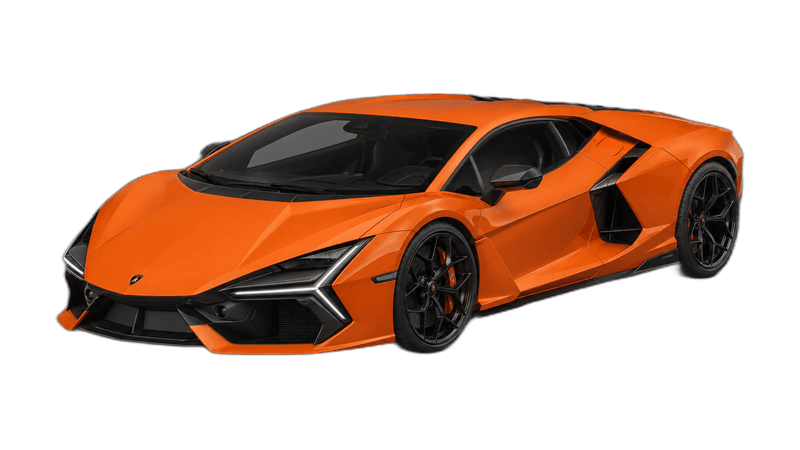
Lamborghini Revuelto
£550,000
usadoIndicative market price, updated periodically.
1001cv
Potencia
2.5s
0-100 km/h
350km/h
Velocidad Máxima
£550,000
Precio Usado
The Lamborghini Revuelto produces 1001 bhp, reaches 100 km/h in 2.5 seconds and has a top speed of 350 km/h. A representative example is worth about £550,000.
Cómo empuja.
La fuerza g máxima en el instante en que pisas a fondo, estimada a partir del 0–100 y la tracción del coche.
Lamborghini RevueltoG de salida estimada a partir del 0–100 y la tracción: una aproximación honesta, no una cifra medida.
Dream Car Garage Editorial · Edited by José Teo Lorente Vallecillos · Last updated 29 October 2026
Visión General
We have not driven this car. This review is based on published specifications and the sources listed below.
The hybrid V12 flagship
The Revuelto arrived in 2023 as the replacement for the Aventador and the first hybrid Lamborghini series production car. Its powertrain pairs a 6,498 cc naturally aspirated V12, the L545, with three electric motors for a combined catalogue figure of 1001 bhp and 725 Nm, all-wheel drive and a new eight-speed dual-clutch transmission mounted behind the engine, which itself was turned one hundred and eighty degrees compared with the Aventador layout. The catalogue performance is 2.5 seconds to 100 km/h and 350 km/h. The carbon monocoque and body keep dry weight to a quoted 1,772 kilograms, heavier than the Aventador yet, by the accounts of those who have driven it, noticeably more agile.
We have not driven this model for this article. This desk-researched ownership guide relies on Lamborghini's official Revuelto page, the PistonHeads first-drive review of the Revuelto and the DVSA vehicle recall service. The PistonHeads source is a launch review rather than a used buying guide, which reflects how early in this model's life we are; treat its observations as character reference points, not as long-term ownership data.
How the hybrid system works
The V12 produces 814 bhp on its own and revs to 9,500 rpm, an extraordinary figure for a production engine, with finger-follower valve actuation of the kind associated with motorcycle racing. One electric motor sits behind the engine to fill torque and support the transmission, while two more drive the front axle, giving the car its all-wheel-drive capability without a mechanical front driveshaft. Total system output is the quoted figure. The driving modes are the ownership story: Città runs electric-only for short urban distances, Strada softens everything, Sport opens the exhaust and permits curated drift, and Corsa unleashes the full system. Regenerative braking doubles as a traction-management layer, a genuinely novel integration in this class.
What early ownership looks like
With the first two years of production sold before the first customer delivery, the used market is only just forming, and nearly every car will be low-mileage with a main-dealer file. That shapes the diligence: the car's history will be short but should be spotless, with every software update and inspection recorded. The hybrid battery system is warrantied as part of the powertrain, and storage discipline matters, since high-voltage batteries prefer regular use and maintained charge to long dormancy. The eight-speed dual-clutch is the other headline: it replaces the single-clutch ISR unit of the Aventador and, on early evidence, transforms low-speed behaviour as much as it sharpens shifts.
The electric layer and charging reality
Unlike the plug-in hypercars it competes with, the Revuelto is not charged from a wall socket: the compact high-voltage battery is replenished by regeneration and by the V12 itself, which is why Città mode is intended for short urban hops rather than long electric running. This is a deliberate engineering choice that keeps weight down and the V12 at the centre of the experience, but it asks the owner to understand the system. Storage discipline matters more than charging infrastructure: a car kept on a maintenance regime with regular exercise is kinder to its battery than one that sleeps for seasons, and the dealer battery health readout is the single most important document at purchase time.
Practicalities and character
The Revuelto is more usable than its predecessor, with a cabin that accepts helmets, a passenger display and the daily civility the Aventador SVJ deliberately lacked. It is also forgiving: the review consensus describes a car that works with the driver rather than demanding heroics. Running costs are hypercar-appropriate, with servicing at main dealers and insurance reflecting both the performance and the scarcity; carbon-ceramic brakes and the bespoke Pirelli tyres are the consumables that matter.
Buying considerations
For a buyer appearing this early, the car will effectively be bought from its first owner, and provenance will be short but should be immaculate: allocation history, specification and delivery condition. The checks are those of any modern Lamborghini plus the hybrid layer: battery health readout from the dealer, recall status through the DVSA check, and confirmation that every campaign and update has been applied. Nothing about the early record suggests systemic concern; the diligence is about completeness of file. It is also, given how few have changed hands, about access: the best early cars tend to move through networks of existing Lamborghini customers before they reach the open market, so the buyer's relationship with the marque can matter as much as the search itself.
We have not driven this model for this article. No present valuation, investment assurance or universal failure rate is offered. The Revuelto's value as an ownership proposition is that it carries the V12 into the electrified era without diluting the formula, with a dual-clutch gearbox and a hybrid system that add reach rather than weight of complication. Early buyers are paying for the latest chapter of the flagship story, and the discipline is the same as any halo car: file completeness and battery care. The buyers who thrive with early examples are those who treat the dealer network as a partner rather than a vendor, because the car's history is still being written by its first owners. Long-term values remain genuinely unwritten, which the first owners know and accept; what is documented is that the formula, a screaming naturally aspirated V12 augmented rather than replaced by electrification, has arrived with the engineering depth to back its claim.
Especificaciones
| Motor | 6.5L (6498 cc) naturally aspirated V12 hybrid petrol |
|---|---|
| Cilindrada | 6.5L |
| Potencia | 1001 cv |
| Par Motor | 725 Nm |
| 0-100 km/h | 2.5s |
| Velocidad Máxima | 350 km/h |
| Tracción | AWD |
| País | Italy |
| Carrocería | 2-door coupe |
| Años | 2023–present |
| Precio Usado | £550,000 |
Specifications are manufacturer-published figures.
Preguntas Frecuentes
What is a Lamborghini Revuelto worth?
A representative example is worth about £550,000. Actual values vary with specification, condition and history.
How much power does the Lamborghini Revuelto have?
The Lamborghini Revuelto produces 1001 bhp and 725 Nm of torque.
How fast is the Lamborghini Revuelto from 0 to 100 km/h?
The Lamborghini Revuelto accelerates from 0 to 100 km/h in 2.5 seconds.
What is the top speed of the Lamborghini Revuelto?
The Lamborghini Revuelto has a top speed of 350 km/h.
What engine does the Lamborghini Revuelto have?
The Lamborghini Revuelto uses a 6.5L (6498 cc) naturally aspirated V12 hybrid petrol.
When was the Lamborghini Revuelto built?
Production of the Lamborghini Revuelto began in 2023.
Is the Lamborghini Revuelto all-wheel drive?
Yes. The Lamborghini Revuelto is configured with all-wheel drive.
Más de Lamborghini
Destacado en Carpedia
Ferrari SF90 Stradale vs McLaren 765LT vs Lamborghini Revuelto
The SF90, the 765LT, and the Revuelto represent three incompatible answers to a single question: what should a supercar of the highest order feel like? Torque vectors, flyweights, and twelve-cylinder symphonies, the answer depends entirely on what you value.
The 25 Fastest Cars from 0-100 km/h, Ranked
The 25 fastest production and limited-production cars ranked by 0-100 km/h time. From the 1.81-second Rimac Nevera to the 2.5-second Chevrolet Corvette E-Ray, every car backed by verified data.