
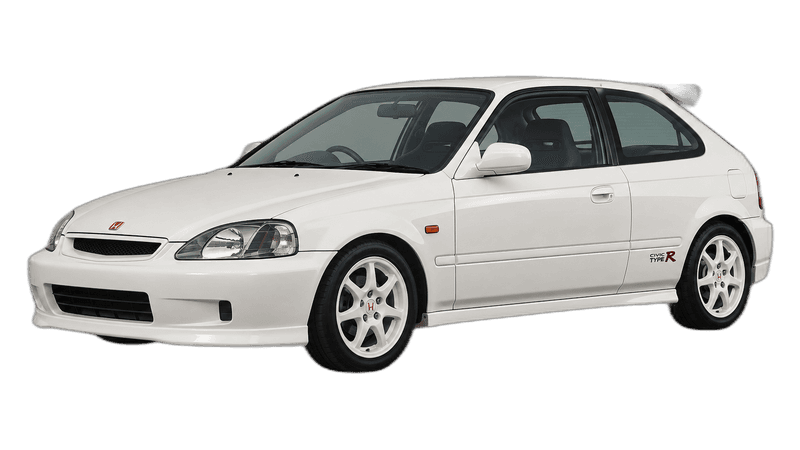
Honda Civic Type R (EK9)
£25,000
usadoIndicative market price, updated periodically.
182cv
Potencia
6.7s
0-100 km/h
225km/h
Velocidad Máxima
£25,000
Precio Usado
Cómo empuja.
La fuerza g máxima en el instante en que pisas a fondo, estimada a partir del 0–100 y la tracción del coche.
Honda Civic Type R (EK9)G de salida estimada a partir del 0–100 y la tracción: una aproximación honesta, no una cifra medida.
The Honda Civic Type R (EK9) is a 3-door hatchback by Honda, with 182 bhp, 160 Nm of torque, a 0-100 km/h time of 6.7 seconds and a top speed of 225 km/h. Indicative used value: approximately £25,000. Actual values vary with specification, condition and history.
Dream Car Garage Editorial · Edited by José Teo Lorente Vallecillos · Last updated 30 October 2026
Visión General
We have not driven this car. This review is based on published specifications and the sources listed below.
The first Civic Type R has a narrow identity
The EK9 is where the Civic Type R became a distinct car rather than a trim level. Honda describes a Japan-only three-door based on the sixth-generation Civic SiR, with a hand-finished 1.6-litre VTEC engine, close-ratio five-speed gearbox, helical limited-slip differential, seam-welded shell and red Recaro seats. We have not driven this model for this article. This is a desk-researched ownership guide using Honda's Type R history, the JDM Buy Sell EK9 buyer guide and the DVSA recall service. Their evidence is useful for forming an inspection plan, not for certifying an individual imported car.
Our catalogue uses the initial Japanese specification: a 1595 cc B16B inline-four naturally aspirated petrol engine, 182 bhp, 160 Nm, 0 to 100 km/h in 6.7 seconds and a 225 km/h maximum, with front-wheel drive. Honda quotes about 15,900 cars over the first two years, while the specialist guide says no settled production total exists. Treat an exact derivative count with caution unless a factory document supports it. The more useful question is whether the car in front of you retains the original engine, transmission, differential and chassis identity.
Match the engine, gearbox and differential together
The B16B is defined by high-revving VTEC operation. JDM Buy Sell records 185 PS at 8200 rpm, an 8400 rpm limit and about 160 Nm at 7500 rpm. Honda's own Type R history describes hand-ported cylinder heads and the close-ratio gearbox. Those details matter because EK9s are frequent subjects of engine swaps, gearbox exchanges and differential changes. Ask for the engine number, chassis plate, gearbox code and differential behaviour to be checked as one package rather than accepting a badge or a single stamped component as proof.
Listen for a clean VTEC transition and inspect for blue smoke, uneven idle and evidence of prolonged low-oil running. Timing-belt records are essential, but the belt itself is only the beginning. The guide also points to accident repair, gearbox condition and the correct torque-sensitive helical limited-slip differential. A short road test should show the differential helping traction without axle tramp, judder or noisy operation. If the seller cannot explain the engine and driveline history, the saving against a documented car may be illusory.
Rust decides whether the lightweight idea survives
The EK9's low weight and rigid shell are central to its appeal, so corrosion is not a cosmetic side issue. JDM Buy Sell identifies arches, underneath, boot carpet and concealed structural areas for close inspection. Specialist EK9 guidance checked during research describes corrosion commonly appearing around the underside frame and suspension components, with extreme cases reaching the rear hatch lower floor or engine bay. A painted underside can hide old repairs as easily as it can protect metal.
Inspect the suspension mounting points, subframe areas, rear quarters, sills, floor pans and boot floor with the trim removed where possible. Fresh underseal should prompt a question about what was covered, not automatic reassurance. Surface preparation, welded repairs and panel alignment all belong in the negotiation. A straight, well-documented shell with average paint is usually easier to understand than a freshly refinished car with no photographs of the metal before coating.
Check the cabin without overlooking theft and repair clues
The red Recaro driver's seat, titanium shift knob and Momo wheel are part of the EK9 identity, but they are also wearable and replaceable. Look for a collapsed driver's seat base, cracked trim, damaged dashboard areas and aftermarket gauges or audio parts fitted with more enthusiasm than care. Poorly installed gauges and stereos can damage the dash. Modifications are common; turbocharger kits and major internal changes should be treated as full-engine projects requiring invoices, tuning evidence and a compression or leak-down assessment.
Imported paperwork needs equal care. Check the Japanese export certificate, UK registration status, mileage history where available, and whether the identity of the donor shell is clear. The DVSA recall service can be used by registration, and Honda or a specialist should be asked to confirm relevant campaigns for the car's market and year. Do not rely on a clean MOT alone to prove structural health; a roadster-free hot hatch can hide corrosion behind interior panels and under sealant.
Use a strict pre-purchase sequence
Start with the paperwork before the bodywork distracts you. Check the Japanese export and registration documents, MOT history where available, invoices and identity numbers. Confirm that the VIN, engine number, registration record and chassis plate agree, then ask a Honda specialist to interpret the gearbox code and differential type. Only after that should the paint, seats and wheels set the emotional tone.
At inspection, put the car on a lift and photograph the underside before cleaning is discussed. Check seam welds, floor panels, rear quarters, suspension mounting points and the boot floor. A compression or leak-down test is useful when blue smoke, uneven idle or unknown engine work is present. Test the clutch, every gear, VTEC transition and differential traction after a full warm-up. If the seller resists lifting, cold-start checks or professional inspection, treat the refusal as information. The EK9 rewards patience because the correct car is a matched mechanical and structural package, not a collection of desirable parts.
Buy the condition and the records, not the myth
Values for an EK9 depend heavily on provenance, rust condition, matching mechanical components and the quality of previous work. The useful comparison is not simply the asking price against another EK9. It is the cost of this car plus timing service, tyres, suspension work, rust repair and any missing documentation. The absence of a universally accepted production count should not be filled with a confident internet figure. Honda's approximate two-year figure and the specialist guide's caution both point to provenance mattering more than a rounded number.
The best car is the one whose shell, engine, gearbox, differential and paperwork all tell the same story. If any one of those elements is missing, adjust the price for investigation and correction rather than hoping the model's reputation will absorb the risk. This guide combines Honda's historical specifications and the sources listed below. It assigns no exact production count to the initial Japanese derivative.
Especificaciones
Motor
1.6L B16B inline-4 naturally aspirated petrol (VTEC)
Cilindrada
1.6L
Potencia
182 cv
Par Motor
160 Nm
0-100 km/h
6.7s
Velocidad Máxima
225 km/h
Tracción
FWD
País
Japan
Carrocería
3-door hatchback
Años
1997–2000
Precio Usado
£25,000
Specifications are manufacturer-published figures.
Más de Honda
Preguntas Frecuentes
What are the specifications of the Honda Civic Type R (EK9)?
The Honda Civic Type R (EK9) is a 3-door hatchback by Honda, with 182 bhp, 160 Nm of torque, a 0-100 km/h time of 6.7 seconds and a top speed of 225 km/h. Indicative used value: approximately £25,000. Actual values vary with specification, condition and history.
How much does a Honda Civic Type R (EK9) cost?
Indicative used value: approximately £25,000. Actual values vary with specification, condition and history.
What drivetrain does the Honda Civic Type R (EK9) use?
The Honda Civic Type R (EK9) is configured with front-wheel drive.
What type of car is the Honda Civic Type R (EK9)?
The Honda Civic Type R (EK9) is a hot hatches manufactured by Honda in Japan. Production ran from 1997 to 2000.