Caterham Seven 310R
£35,000
usadoIndicative market price, updated periodically.
152cv
Potencia
4.8s
0-100 km/h
204km/h
Velocidad Máxima
£35,000
Precio Usado
The Caterham Seven 310R produces 152 bhp, reaches 100 km/h in 4.8 seconds and has a top speed of 204 km/h. A representative example is worth about £35,000.
Cómo empuja.
La fuerza g máxima en el instante en que pisas a fondo, estimada a partir del 0–100 y la tracción del coche.
Caterham Seven 310RG de salida estimada a partir del 0–100 y la tracción: una aproximación honesta, no una cifra medida.
Dream Car Garage Editorial · Edited by José Teo Lorente Vallecillos · Last updated 3 November 2026
Visión General
We have not driven this car. This review is based on published specifications and the sources listed below.
Scope of this guide
This guide is scoped to the Caterham Seven 310R, the track-orientated version of the 310 with the 1.6L naturally aspirated inline-4 petrol (Ford Sigma) engine and 152 bhp, a front-engined, rear-wheel drive, two-seat open car on Caterham's narrow S3 chassis. It is not a guide to the road-biased 310S, which shares the engine but not the equipment, to the 135 bhp 270, to the 2.0 litre 360 and 420 cars, or to the later 310 Encore, a run of 25 cars built in 2025 to mark the end of Sigma power at Caterham. Where those cars differ we say so below, because an advert that says only "Caterham 310" can describe more than one specification. We have not driven this model for this article. Everything here comes from the published sources listed at the end, and where they disagree we say so rather than choose a number quietly.
The figures at a glance
- Engine: 1.6L naturally aspirated inline-4 petrol (Ford Sigma), catalogue displacement 1596 cc (PistonHeads prints 1,598cc)
- Power: 152 bhp, although PistonHeads prints 154 hp in one specification box and 155 hp elsewhere; we use the 152 bhp that matches our catalogue
- Torque: 168 Nm, the metric equivalent of the 124 lb ft at 5,600rpm that PistonHeads prints
- 0-100 km/h: 4.8 seconds, but see the note below, because the published time is for 0-62 mph
- Top speed: 204 km/h, a conversion of the 127 mph quoted by Caterham; some road tests print 126 mph
- Drivetrain: rear-wheel drive, five-speed manual as standard
- Weight: about 540 kg, quoted by PistonHeads
- Years: launched in August 2016, with the standard 310 range dropped around September 2021
The acceleration figure needs a plain explanation. The 4.8 seconds in our catalogue is a time to 62 mph, which is 100 km/h within rounding. Goodwood and Caterham's own later material print 4.9 seconds to 60 mph, and evo printed 4.8 seconds to 60 mph, so the sources do not quite agree on the mile-per-hour figure either. Treat 4.8 seconds as a manufacturer-style claim for a good day with a skilled driver, not a measurement we have repeated.
How the 310 came about
Caterham launched the 310 in August 2016 as a step between the 270 and the 360, and the contemporary reviews describe it as the successor in spirit to the older R300. It grew out of a race package: Caterham ran a 310R championship, and the road car began as an engine upgrade over the 270. The Sigma 1.6 gained different camshafts, a new air filter, new spark plugs, a revised breather and fresh ECU mapping, which lifted it from 135 bhp to 152 bhp. Nothing about that is exotic, and that is part of the appeal: this is an old-fashioned small petrol engine tuned to breathe better, not a turbocharged or supercharged motor with a long list of ancillaries.
The result is a very light car with modest power. At about 540 kg, 152 bhp gives a power-to-weight figure that the sources quote differently (evo gave 250 bhp per tonne in 2016, while Caterham's later Encore material gives 281 per tonne), so check which kerb or dry weight a figure assumes before comparing cars.
What the R means
Caterham sells most Sevens in an S specification, set up for the road, and an R specification, set up for the track. On the 310R the track pack is the reason to choose it over the 310S. The sources describe a limited-slip differential, a lightweight flywheel, an adjustable rear anti-roll bar, uprated brakes and suspension, a wider front track, Avon ZZS tyres on 13 inch Apollo wheels, composite seats with harnesses and a carbon dash. Not every used car carries every item, and owners add and remove parts, so read the original build specification and compare it with what is on the car in front of you.
There is no ABS and no traction control, which evo noted in its review. That is part of the character and also a responsibility: the car will do exactly what the driver asks of it, including the wrong thing.
On the road and on the track
The reviews we read are consistent. The car is light, direct and quick to respond, the engine likes to be revved towards its limit, and the steering and chassis give a lot of information. Top Gear, evo and Goodwood reviewed it favourably on those grounds, and the common thread is that the car has little enough power for the chassis to cope with. PistonHeads put a 310R alongside a Super 1600 and a 620S in 2021 and its conclusion was that the 310 is hard to fault and keenly priced, although the writers added that the ideal Seven would be a blend of several cars.
Owners also report the less romantic side. PistonHeads' long-term and used-car pieces describe a car that gets hot in the footwell, is noisy at speed, idles with a lump, and has a five-speed gearbox that feels slightly short for motorway work. An optional six-speed gearbox was offered at roughly 2,495 to 2,500 GBP when new, so check which gearbox a used car has. None of this is a defect; it is the price of a car that was built to be driven, not to be commuted in.
How the 310R differs from its siblings
- The 270 has 135 bhp and the same basic body. It is a gentler car, and the 310 was built as an uprated alternative.
- The 310S has the same engine but road-focused equipment, so it will not have the limited-slip differential, adjustable rear bar and track tyres that define the R.
- The 360 and 420 use Ford's 2.0 litre Duratec engine, with 180 bhp and 210 bhp, and ride on wider 8 inch tyres. The 420 is quoted at 3.8 seconds to 60 mph, which is a different class of performance.
- The Super 1600 uses the same capacity engine in a milder state of tune with about 137 bhp, a different character again.
- The 310 Encore of 2025 is the last Sigma Caterham, in a run of 25 cars, and is a separate model with its own price and paperwork.
Prices are history, not guidance
Contemporary figures give a sense of the car's position but should not be used as a valuation. In 2016 evo quoted the kit at 21,995 GBP and Goodwood quoted the factory-built car at 24,995 GBP. PistonHeads' 2017 fleet piece gave a list price of 23,495 GBP and a test car at 38,930 GBP with options. Between 2018 and 2021 PistonHeads' used-car pieces show 310Rs advertised between 28,995 and 38,995 GBP. We do not give a current value because we have not verified one, and market prices move.
What to check before buying
- Build type and paperwork: Caterhams are sold both as kits that the first owner assembles and as factory-built cars. Ask how the car was built, who built it, and see the build records and the registration documents.
- Specification: confirm whether the car is a genuine 310R with the R pack, or an S with parts added, or an older car that has been changed. Check for the limited-slip differential, the brakes and the tyres.
- Track use: ask for a record of circuit days, because a car that has been used hard needs closer inspection of the chassis, wishbones, rose joints, brakes and tyres.
- Engine: listen for a lumpy idle that is normal for this tune against one that hints at a worn engine, check for oil leaks, and confirm the cooling system works well, as the sources say the car runs hot.
- Chassis: look for signs of a previous accident, bent tubes, repaired panels or poor welding, and have the car inspected by a Caterham specialist.
- Gearbox: confirm whether the car has the five-speed or the optional six-speed, and feel for notchy shifts or a worn clutch.
- Safety equipment: check the harnesses for date and condition, the seats for fit and the roll-over hoop mounts.
- Documents: the MOT history, service record, insurance valuation and any modification declarations your insurer would need.
Recalls and the DVSA check
The DVSA vehicle recall check at gov.uk lets you search by registration number, or by manufacturer, model and year if you do not have the registration. By registration it shows safety recalls that have not been checked or fixed, and the car's MOT history. For a serious safety defect the manufacturer writes to the registered keeper.
Be realistic about what that tells you for a car like this. The check only lists recalls that have been recorded in the DVSA system. It cannot tell you whether a low-volume or kit-built car was assembled correctly, whether parts have been replaced or modified, whether a service bulletin that is not a formal recall was carried out, or whether the car on the page is the specification it is advertised as. A kit-built car may also have been registered differently from a factory-built one, so ask the seller to explain the history. We did not find a safety recall for the 310R in the sources we read, but that is not the same as checking the DVSA database against a specific car, so run the check yourself and keep a record of the result.
About the photograph
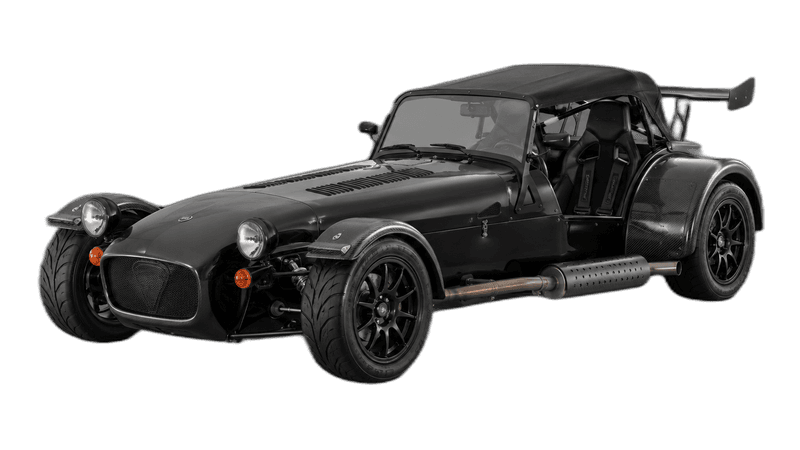
The picture at the top of this page is a black Caterham Seven photographed in September 2023 by Calreyn88 and published on Wikimedia Commons as "2021 Caterham Seven 310R 1.jpg" under the Creative Commons Attribution-Share Alike 4.0 licence. We cropped and resized it and blurred the registration plate, and made no other change. The Commons description says only "Caterham Seven"; the 310R in the file name is the uploader's label, so we cannot confirm the exact specification from the image and we use it only to show the shape of the car, not any particular car for sale.
Verdict
The Caterham Seven 310R in this guide is the 1.6L naturally aspirated inline-4 petrol (Ford Sigma) car: 152 bhp, 168 Nm, 4.8 seconds to 62 mph, 204 km/h, rear-wheel drive, with a track-orientated equipment list and a weight of about 540 kg. It is a simple, light and engaging car, and the lack of power is a feature rather than a flaw. The risks are not in the numbers but in the history: how it was built, how hard it was used, and whether the specification matches the advert. If you are shopping for one, ask for the build records, view the car with a specialist, run the DVSA recall check and treat every figure above as a published claim. We have not driven it, so use the sources and a proper inspection to decide.
Especificaciones
| Motor | 1.6L naturally aspirated inline-4 petrol (Ford Sigma) |
|---|---|
| Cilindrada | 1.6L |
| Potencia | 152 cv |
| Par Motor | 168 Nm |
| 0-100 km/h | 4.8s |
| Velocidad Máxima | 204 km/h |
| Tracción | RWD |
| País | UK |
| Carrocería | 2 seater roadster |
| Años | 2016–2021 |
| Precio Usado | £35,000 |
Specifications are manufacturer-published figures.
Preguntas Frecuentes
What is a Caterham Seven 310R worth?
A representative example is worth about £35,000. Actual values vary with specification, condition and history.
How much power does the Caterham Seven 310R have?
The Caterham Seven 310R produces 152 bhp and 168 Nm of torque.
How fast is the Caterham Seven 310R from 0 to 100 km/h?
The Caterham Seven 310R accelerates from 0 to 100 km/h in 4.8 seconds.
What is the top speed of the Caterham Seven 310R?
The Caterham Seven 310R has a top speed of 204 km/h.
What engine does the Caterham Seven 310R have?
The Caterham Seven 310R uses a 1.6L naturally aspirated inline-4 petrol (Ford Sigma).
When was the Caterham Seven 310R built?
The Caterham Seven 310R was built from 2016 to 2021.
Is the Caterham Seven 310R all-wheel drive?
No. The Caterham Seven 310R is configured with rear-wheel drive.