

Caterham Seven 420R
£42,000
usedIndicative market price, updated periodically.
210bhp
Power
3.8s
0-100 km/h
219km/h
Top Speed
£42,000
Price Used
How hard it pulls.
Peak g-force the instant you bury the throttle, estimated from the car's 0–100 time and drivetrain.
Caterham Seven 420REstimated peak launch g from the 0–100 time and drivetrain: an honest approximation, not a measured figure.
The Caterham Seven 420R is a 2-seater roadster by Caterham, with 210 bhp, 203 Nm of torque, a 0-100 km/h time of 3.8 seconds and a top speed of 219 km/h. Indicative used value: approximately £42,000. Actual values vary with specification, condition and history.
Dream Car Garage Editorial · Edited by José Teo Lorente Vallecillos · Last updated 2 November 2026
Overview
We have not driven this car. This review is based on published specifications and the sources listed below.
A 210 bhp Seven for road and track
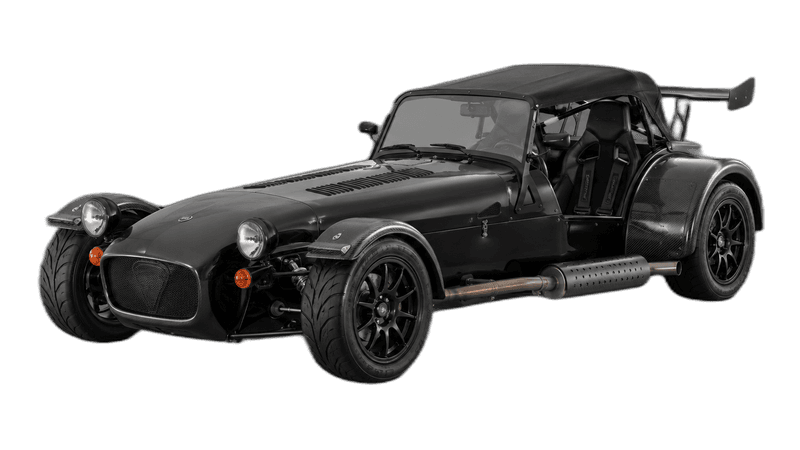
The Caterham Seven 420R is the naturally aspirated, Ford Duratec-powered Seven with the R pack: a firmer chassis set-up, race harnesses and a track-minded specification, in a car that Goodwood says still mimics the Lotus Seven it descends from. It has a 2.0-litre four-cylinder engine, rear-wheel drive, a tubular steel spaceframe with a De Dion rear axle, and a published kerb weight of about 560 kg. There is no radio and, on the evidence of the reviews we read, no driver aids at all. This guide is scoped to the Caterham Seven 420R with the 2.0-litre Ford Duratec naturally aspirated engine. It is not the 360, the 420S road-pack car, the supercharged 620R, the small turbocharged 170 or the 1.6-litre 275, and it is not the separately listed 420R Race Package.
This is a desk-researched guide. We have not driven this model for this article. Everything below comes from Caterham's own model and listing pages, a PistonHeads used buying guide by Tony Middlehurst dated 4 January 2020, and published reviews from Auto Express (April 2016), Goodwood Road & Racing and Motorverso (a 2018 car). Where those sources disagree we say so, and we point out what we could not confirm.
Caterham builds the Seven in small numbers, and the 420 is sold either as a kit that the owner assembles or, as an option, as a factory-built car. Caterham's own 420 page shows a kit or factory selector and does not say which is standard. The reviews we read describe factory-built cars. We found no official production total, so our catalogue leaves the production count blank, and we did not find an official first or last model year for the 420R, so the catalogue leaves the year range blank too.
Checking the figures
Caterham's current Seven 420 page prints 210 bhp at 7,600 rpm and 203 Nm at 6,300 rpm. Our catalogue uses those figures: 210 bhp and 203 Nm. Auto Express in 2016 and Motorverso in 2018 print the same numbers.
A note on units, because they are easy to muddle. Caterham prints bhp and does not print a PS figure. Goodwood prints 213 PS (157 kW) in its specification box, and 212 PS in its text. The conversion is straightforward: 213 PS multiplied by 0.9863 is about 210 bhp. If you meet a listing that says 210 PS, that is nearer 207 bhp, so check which unit the seller means. Caterham's published figure is 210 bhp.
For acceleration, Caterham and Auto Express give 0 to 60 mph in 3.8 seconds, and Goodwood and Motorverso give 0 to 62 mph in 3.8 seconds. Because 100 km/h is about 62 mph, we have used 3.8 seconds as the 0 to 100 km/h figure. None of the pages we fetched printed a 0 to 100 km/h time in those exact words, so treat it as a close equivalent and not a separately measured number. Some dealer listings quote slightly different times, and those figures should not be trusted over the manufacturer's.
Top speed is 136 mph on Caterham's page and in the reviews, which is about 219 km/h. Caterham's range page also lists 130 mph for the 360 with 180 bhp, 149 mph for the supercharged 620 with 310 bhp, and 105 mph for the 170 with 84 bhp, so do not borrow figures from those cars. Caterham quotes 375 bhp per tonne for the 420, which follows from 210 bhp and 560 kg, but it describes the weight as dependent on specification. Caterham says the weight depends on specification.
Engine and gearbox
The engine is the 1,999 cc Ford Duratec four-cylinder, naturally aspirated, with a dry sump as standard on the current car. PistonHeads describes the chain-driven Duratec as equally biddable as the smaller Ford Sigma 1.6 and says that ancillary parts for both Ford engines are easy to source. It does not list Duratec-specific failure points or service intervals, and neither did any of the other pages we read, so we are not going to invent any. Ask for a documented service record and an engine oil change history, because the guide stresses regular oil checks and changes given the cornering forces a Seven can generate, and it discusses dry-sump and swirl-tank options.
The gearbox needs care. Caterham's current 420 page lists a five-speed manual. The 2018 Motorverso test describes a six-speed manual on the car it drove, and the PistonHeads guide from 2020 says that most modern Sevens use the Focus-derived IB5 five-speed and that the 420 uses a Caterham six-speed. Caterham's US R pack page lists a Mazda five-speed manual, with a six-speed sequential gearbox as the supercharged option. In short, the 420R has been offered with different gearboxes at different times, and we cannot map them to years from the sources we have. Check exactly what is fitted to the car you are viewing.
On the five-speed, PistonHeads says the IB5 has a good reputation for longevity, but that heavy track use can wear the road-spec synchromesh and make reverse hard to engage. It warns that differential bearings may fail at around 70,000 to 80,000 miles. It also says the six-speed's ratios are very short, so it is not more relaxing at speed. Caterham lists a limited-slip differential and lightweight flywheel as R pack items, and PistonHeads says the S pack has no limited-slip differential, so confirm that an advertised R pack car actually has them.
Chassis, brakes and wheels
The 420R has a space frame with double wishbone front suspension and a De Dion rear. PistonHeads describes the De Dion design as semi-independent and more comfortable than a live axle on bumpy roads. Caterham lists rack and pinion steering with 1.93 turns lock to lock and a choice of standard or large chassis size. Auto Express says the R pack brings firmer springs and dampers, and Goodwood describes the sports suspension as bracing on smooth tarmac and harsh on rutted roads. Expect a rigid ride and a car that tells you about every surface.
Caterham's 420 page lists solid front discs with twin-piston calipers as standard, an uprated brake master cylinder as part of the R pack, and ventilated front discs with quad-piston calipers as an option. PistonHeads says front pads and discs are inexpensive to replace, and that a four-pot big-brake kit improves pedal feel. Its wheel notes say that R pack cars come with lighter 15-inch alloys, while Caterham's current page lists 14-inch alloys for the R pack, with 13-inch and 15-inch options. Caterham's 2027 new-car listing shows 13-inch Black Apollo alloys. Wheel and tyre specifications evidently vary by year and by what the first owner ordered, so verify them against the car, and check tyre age and condition if the car wears semi-slick rubber such as the Toyo R888R or Avon ZZS tyres mentioned in the sources.
PistonHeads also warns that the powder-coated steel chassis can perforate over time and should be inspected, and that the aluminium skin is part of the stressed structure. It says passengers who use the windscreen as a grab handle can crack the glass or bend the frame, and that suspension set-up matters a great deal to enjoyment. Check for crash repair, uneven wear and any sign of a bent frame, and look at the geometry settings on a car that has been used on track.
Body, interior and electronics
Body panels are aluminium and glassfibre, so rust in the conventional sense is not the concern, though PistonHeads reminds buyers that even aluminium oxidises. Caterham's new-car listing shows carbon-fibre front cycle wings, and the reviews describe carbon seats on the cars they tested. Goodwood calls the carbon bucket seats not exactly comfy, with heated seats as the only real luxury, and says the harnesses are a pain for daily road use. Motorverso lists carbon fibre seats, an Alcantara dashboard, a Momo steering wheel, a rocker switch in place of an indicator stalk and basic dials, and notes there is no air conditioning, radio or clock. It adds that there are two detachable roofs, a full roof and a half roof, and that the doors can be removed, though that means losing the wing mirrors. The pedals are closely spaced, so try your own shoes. PistonHeads says the full hood is a bit of a pain to erect and that tall roll bars may stop the standard hood from fitting.
On electronics, Motorverso mentions an immobiliser that has to be disabled with the key before starting, a red electric kill switch on the side of the car, and a sequential shift light. Caterham lists a battery master cut-off switch as an option and shows it on the new car it advertises, along with LED daytime running lights. PistonHeads warns that rear lights can fail unnoticed because of wiring faults, a broken brake light switch or muddy connectors, and recommends a trickle charger for cars that are not used regularly. Check every light, the switchgear and the battery isolator.
On safety equipment, this is a very basic car. Auto Express says outright that there is no ABS or stability control, with race harnesses and a composite bucket seat, and Goodwood says there are no driver aids to speak of. Motorverso lists no driver assistance systems. The sources we fetched did not mention airbags, so we make no claim either way. Caterham lists a painted roll bar on both packs, four-point harnesses with the R pack, and options for a roll cage, a track-day roll bar and a plumbed-in fire extinguisher. Auto Express adds that you still have to watch it in the wet, and Goodwood notes that the rear wheels spin up easily with a dab of throttle.
Recalls and history
We did not find a recall list for the 420R in any source we could read. That does not mean no campaign exists, only that we cannot name one. If the car is registered, enter its registration in the DVSA vehicle recall service and ask Caterham or a Caterham dealer to check the chassis number for open campaigns.
Registration history needs more attention than usual. PistonHeads says that building a kit takes an estimated 80 to 100 hours and that a kit car must pass the IVA test, formerly known as SVA, and be registered, whereas Caterham sells new, ready-to-go cars that avoid the build and testing process. If a used car was self-built, ask who built it, what parts were used, whether the build was documented with photographs and receipts, and how it was registered. Ask whether the engine and gearbox are the original ones, whether the chassis has been repaired or replaced, and what the car has been used for. A car that has lived on circuits will have different wear patterns from one that has been mostly driven on the road, and in our view R pack cars are likely to have seen track use.
PistonHeads also recommends a book of receipts, recent upgrades and an enthusiast owner. The Caterham range page lists a 420R Race Package separately from the road car, so confirm that a car described as a 420R is the road-going Seven and not a race-specification build.
Buying decision
Auto Express called the naturally aspirated 420R something of a sweet spot below the supercharged 620 cars, and said there was little that could match the raw thrills on offer. Goodwood put it second only to the 620 among Sevens. PistonHeads' verdict is that for track work the 620 is the obvious pick, with the 420R close behind. The 420R is also the car to choose if 310 bhp sounds like more than you want to manage in the wet, because it is faster than most drivers will ever use and easier to approach than the supercharged cars.
In our view this is a car to buy for the way it drives and not for any practical case. It has only a basic hood and side screens, harnesses and seats that suit track days better than commuting, and it offers none of the electronic help of a modern road car. Before you buy, confirm the build route and registration paperwork, the gearbox type, whether the limited-slip differential is really fitted, the wheel and tyre specification, the chassis condition and the service record. Compare current adverts and get a specialist to inspect the car instead of relying on any price quoted here.
Specifications
Engine
2.0L naturally aspirated Ford Duratec inline-4 petrol
Displacement
2.0L
Power
210 bhp
Torque
203 Nm
0-100 km/h
3.8s
Top Speed
219 km/h
Drivetrain
RWD
Country
UK
Body Style
2-seater roadster
Price Used
£42,000
Specifications are manufacturer-published figures.
More from Caterham


Featured in Carpedia
Frequently Asked Questions
What are the specifications of the Caterham Seven 420R?
The Caterham Seven 420R is a 2-seater roadster by Caterham, with 210 bhp, 203 Nm of torque, a 0-100 km/h time of 3.8 seconds and a top speed of 219 km/h. Indicative used value: approximately £42,000. Actual values vary with specification, condition and history.
How much does a Caterham Seven 420R cost?
Indicative used value: approximately £42,000. Actual values vary with specification, condition and history.
What drivetrain does the Caterham Seven 420R use?
The Caterham Seven 420R is configured with rear-wheel drive.
What type of car is the Caterham Seven 420R?
The Caterham Seven 420R is a track focused manufactured by Caterham in UK.