

TVR Sagaris
£72,000
usedIndicative market price, updated periodically.
406bhp
Power
3.7s
0-100 km/h
298km/h
Top Speed
£72,000
Price Used
How hard it pulls.
Peak g-force the instant you bury the throttle, estimated from the car's 0–100 time and drivetrain.
TVR SagarisEstimated peak launch g from the 0–100 time and drivetrain: an honest approximation, not a measured figure.
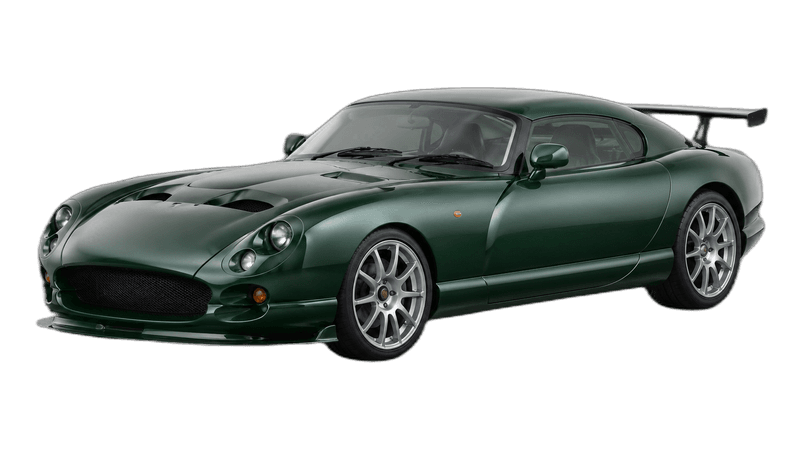
The TVR Sagaris is a 2-door coupé by TVR, with 406 bhp, 473 Nm of torque, a 0-100 km/h time of 3.7 seconds and a top speed of 298 km/h. Indicative used value: approximately £72,000. Actual values vary with specification, condition and history.
Dream Car Garage Editorial · Last updated 2 November 2026
Overview
We have not driven this car. This review is based on published specifications and the sources listed below.
Scope of this guide
This guide is scoped to the standard TVR Sagaris 4.0 litre fixed-head coupe, the two-seat, front-mid-engined, rear-wheel drive road car with the 4.0L Speed Six straight-six petrol (3996 cc) engine, built by TVR Cars Ltd in Blackpool, Lancashire from 2005 to 2006. It is not a guide to the seven GTF race cars built in 2006, to the race-track (RT) shells sold for a racing series, to the Sagaris 2 prototype shown in 2008, or to cars that have been fitted with a larger engine or a different one since. We say below where those differ, so that you can tell which one an advert really describes.
We have not driven this model for this article. Everything here comes from three cited sources: the TVR Cars Ltd press information for the Sagaris, version 1.1 dated 4 March 2005 (a copy of the original hosted by the TVR Car Club), PistonHeads' used buying guide, and the government recall checker. We also read a Wikipedia article on the car and we flag each point that rests on it. Where sources disagree we say so rather than pick a winner quietly. Prices are history or ranges, not valuations.
The figures at a glance
- Engine: 4.0L Speed Six straight-six petrol (3996 cc), all-aluminium, four valves per cylinder, double overhead camshafts, dry sump, naturally aspirated.
- Power: 406 bhp at 7,000 to 7,500 rpm. TVR's own release prints bhp, so no conversion is needed. A Wikipedia article gives 412 PS, which is the same figure in metric horsepower.
- Torque: 473 Nm at 5,000 rpm. TVR and PistonHeads print 349 lb ft, and we converted it (349 x 1.3558 is about 473.2). Wikipedia also gives 473 Nm.
- Acceleration: 3.7 seconds for 0-60 mph, a TVR claim. This is not a 0-100 km/h time, and neither TVR nor PistonHeads prints a 0-62 mph figure. TVR also claims 0-100 mph in 8.1 seconds.
- Top speed: 298 km/h, which is TVR's claimed "+185 mph" converted by us (185 x 1.609 is about 297.7).
- Drive: rear-wheel drive, front mid-engine, a five-speed manual gearbox, a twin-plate clutch and a Hydratrak limited-slip differential.
- Weight: 1,078 kg in the press release, with 560 kg on the front axle and 518 kg on the rear.
- Size: 4,057 mm long, 1,850 mm wide including mirrors, 1,175 mm high, on a 2,361 mm wheelbase.
- Redline: 7,800 rpm maximum engine speed.
What the Sagaris was
The press release explains that the Sagaris began as a plan to enter the T350 in GT racing, which led to a body 50 mm wider and 25 mm lower, tested in a wind tunnel and given a 4.0 litre Speed Six engine. The prototype first appeared at the MPH2003 show in London in November 2003, and a pre-production car followed at the 2004 Birmingham Motor Show. Production was due to start in 2004, but Nikolai Smolenski bought TVR from Peter Wheeler in July 2004 and a quality improvement programme paused production while development cars were sent to extreme climates for testing. TVR says the first production cars reached dealers on 2 March 2005.
The release positions the car as the road-racing "hero" of the T350 series, with the aim of an ultimate trackday car in road trim. It states that no exterior body panel is shared with the T350. The driver's side of the roof is raised to take a helmet, the front and rear carry splitters and spoilers, and the vents on the wings are closed. The price in the release was 49,995 pounds including VAT, and PistonHeads gives just under 50,000 pounds. Both are history, not current values.
Why the quoted figures vary
The power figure is the easiest to settle. TVR prints 406bhp at 7,000 to 7,500 rpm, PistonHeads prints 406 hp over the same band, and Wikipedia prints 406 bhp, 412 PS and 303 kW. These agree, so the catalogue figure of 406 bhp stands. Torque is also consistent once converted, but our starting figure of 475 Nm was a little off. Both TVR's 349 lb ft and Wikipedia's 473 Nm point to 473 Nm, so we use 473.
Acceleration is where the sources part. TVR claims 3.7 seconds for 0-60 mph. PistonHeads gives 3.9 seconds for the same sprint and attributes it to a press test with the optional close-ratio gearbox. These are different measurements, a maker claim and a magazine test, so treat both as approximate. Weight needs the same care. TVR and PistonHeads both give 1,078 kg, Wikipedia gives 1,078 kg in its infobox but 1,075 kg in its specification section, and PistonHeads says a magazine test car weighed about 100 kg more with air conditioning fitted. PistonHeads itself warns that weight and power data for this car are hard to pin down.
Production numbers also disagree. PistonHeads says 211 cars were built and that production stopped in 2006, whereas Wikipedia gives 213. We have not reconciled them, so we do not print a single count. PistonHeads lists the car as on sale from 2005 to 2007, which probably reflects cars sold after the last were built, but that is our reading, not something either source says.
Engine and gearbox
The Speed Six is an all-aluminium straight-six with forged aluminium pistons, forged steel connecting rods, individual throttles and a dry-sump oil system with a cooler, according to TVR. PistonHeads says valvegear wear was a known issue but was reportedly sorted by the time of the Sagaris, and recommends checking the tappets every two years or 12,000 miles, noting that access is poor so the job is easy to skip. Oil loss can be as simple as a loose sump washer or as serious as a front crank seal. Clonks and rattles usually come from crumbling engine mounts on the exhaust-manifold side, and the engine should be warm before it is worked hard.
The gearbox is a five-speed manual with a twin-plate AP Racing clutch of 215 mm diameter. PistonHeads describes it as a Borg Warner T5 that some owners find agricultural, says reverse has no synchromesh, and warns that clutch slave cylinders can leak. Difficulty engaging first or reverse suggests wear. A close-ratio gearbox was an option, listed at 1,530 pounds new in the TVR price list. Upgrades mentioned by PistonHeads include a 4.3 litre conversion at around 8,500 pounds, a Chevrolet LS V8 swap at over 20,000 pounds, and a later MBE engine control unit. Any of those means the car no longer matches the figures in this guide.
Chassis, brakes and body
The chassis is a powder-coated tubular steel backbone with an integral roll cage and independent double wishbones at both ends. PistonHeads says the spring rates were about twice as stiff as earlier TVRs and that the Bilstein dampers can be replaced with well-regarded Gaz units. Steering is an electro-hydraulic rack at 2.0 turns lock to lock, though PistonHeads says the steering lock is poor. Brakes are 322 mm ventilated discs with four-piston calipers at the front and 298 mm discs at the rear, and PistonHeads notes there is no ABS, so it advises cadence braking.
The powder coating is the chassis's main protection against corrosion, and PistonHeads says any breach lets water in, so inspect it carefully. The body is hand-laid composite. Some shells suffered bubbling in the paint and at least one needed a full factory repaint, according to the guide, and rear side windows could pop out because of poor gluing. Ground clearance is 85 mm in the press release, and the front splitter is easy to scrape. PistonHeads also says the body panels are not shared with the T350 or Tamora, and that some rubber door caps are hard to find.
Running costs and ownership
TVR's service interval is 6,000 miles according to PistonHeads. The guide quoted fixed prices of 475 pounds plus VAT for a 6,000-mile service and 785 pounds plus VAT for a 12,000-mile service at a Thame specialist in 2023, and those are old figures now. Fuel economy is poor. PistonHeads lists an official combined figure of 21.7 mpg and says owners report 20 to 25 mpg, but suggests about 15 mpg with spirited use and quotes a magazine's 10 mpg in town and 8 mpg at the track. The fuel tank holds 57 litres, which PistonHeads gives as 12.5 gallons. The guide also lists CO2 at 406 g/km.
The original warranty was three years or 36,000 miles, and it has long since ended. TVR is no longer in business as a maker, and PistonHeads names Powers Performance and Racing Green (formerly TVR Power) as parts sources, with 3D printing helping with items that are hard to find. We give no current tax, insurance or valuation figures, because none of the cited sources provides them for a given year.
Buying notes
PistonHeads called the Sagaris the best-built TVR in its October 2023 guide and put values at about 35,000 pounds in 2013, 65,000 pounds in early 2021 and from 70,000 pounds in October 2023, with the dearest of seven listed cars at just under 90,000 pounds. It said roughly three in four built were still registered or declared off the road in the United Kingdom, with fewer than 150 left at the start of 2023. Those are old asking prices and an estimate, not valuations, and we have not tracked the market since. Ask what has been done to the engine, since the conversions above change both the power and the character of the car.
What to check before buying
- Confirm the VIN, registration and build date against the V5C, and ask which engine is fitted.
- Confirm it is the standard 4.0 litre coupe and not a converted, race or track-shell car.
- Ask for the service history, including tappet checks, and for any sign of oil loss at the sump or front crank seal.
- Look at the engine mounts on the exhaust-manifold side for crumbling rubber.
- Test the clutch, first gear and reverse, and ask whether the slave cylinder has been replaced.
- Inspect the chassis for breaches in the powder coating, and look at the body for bubbling or repaint.
- Check the rear side windows for loose bonding and the front splitter for scrapes.
- Test the electrics, including windows, headlights and the temperature gauge, since PistonHeads describes the dash wiring as haphazard.
- Look at the age and size of the tyres: 255/35 R18 in the press release, with 18 or 19 inch wheels according to PistonHeads.
- Run the registration through the recall check described below.
Recalls and the DVSA check
We did not find a recall list for the Sagaris in the cited sources, and neither TVR's release nor PistonHeads mentions one. We did not run the government recall checker ourselves, because it needs a registration or vehicle identification number. TVR no longer trades as a manufacturer, so a dealer cannot be relied on to confirm anything open. Run the registration through the DVSA vehicle recall check on GOV.UK, and treat the absence of a result as a reason to ask a specialist, not as a guarantee.
Verdict
The standard Sagaris is 406 bhp, 473 Nm, 3.7 seconds to 60 mph, 298 km/h and rear-wheel drive, in a lightweight composite two-seater built in a run of about 211 to 213 cars. It rewards an owner who accepts specialist servicing, an ABS-free brake pedal and fuel stops that arrive quickly. If you are shopping for one, confirm which engine is fitted, insist on a full history, and treat the published figures as claims with the caveats above. We have not driven it, so use the sources and a proper inspection to decide.
Specifications
Engine
4.0L Speed Six straight-six petrol (3996 cc)
Displacement
4.0L
Power
406 bhp
Torque
473 Nm
0-100 km/h
3.7s
Top Speed
298 km/h
Drivetrain
RWD
Country
UK
Body Style
2-door coupé
Years
2005–2006
Price Used
£72,000
Specifications are manufacturer-published figures.
More from TVR


Frequently Asked Questions
What are the specifications of the TVR Sagaris?
The TVR Sagaris is a 2-door coupé by TVR, with 406 bhp, 473 Nm of torque, a 0-100 km/h time of 3.7 seconds and a top speed of 298 km/h. Indicative used value: approximately £72,000. Actual values vary with specification, condition and history.
How much does a TVR Sagaris cost?
Indicative used value: approximately £72,000. Actual values vary with specification, condition and history.
What drivetrain does the TVR Sagaris use?
The TVR Sagaris is configured with rear-wheel drive.
What type of car is the TVR Sagaris?
The TVR Sagaris is a sports cars manufactured by TVR in UK. Production ran from 2005 to 2006.