

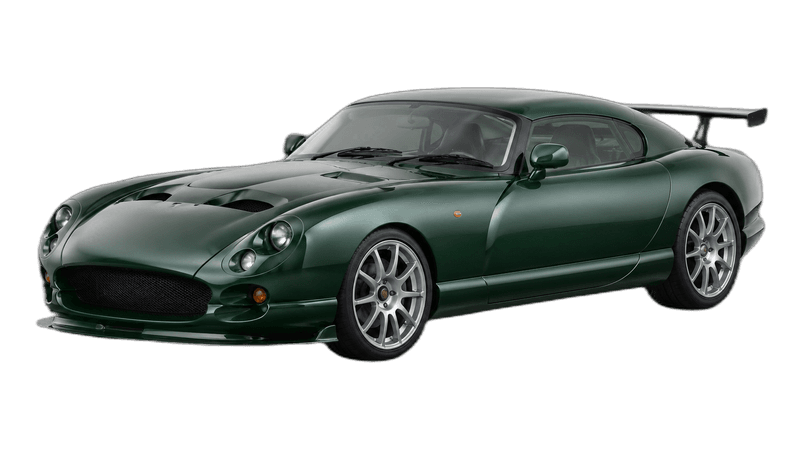
TVR Cerbera 4.5
£28,000
usedIndicative market price, updated periodically.
420bhp
Power
3.9s
0-100 km/h
298km/h
Top Speed
£28,000
Price Used
How hard it pulls.
Peak g-force the instant you bury the throttle, estimated from the car's 0–100 time and drivetrain.
TVR Cerbera 4.5Estimated peak launch g from the 0–100 time and drivetrain: an honest approximation, not a measured figure.
The TVR Cerbera 4.5 is a 2-door coupe by TVR, with 420 bhp, 515 Nm of torque, a 0-100 km/h time of 3.9 seconds and a top speed of 298 km/h. Indicative used value: approximately £28,000. Actual values vary with specification, condition and history.
Dream Car Garage Editorial · Edited by José Teo Lorente Vallecillos · Last updated 3 November 2026
Overview
We have not driven this car. This review is based on published specifications and the sources listed below.
Scope of this guide
This guide is scoped to the TVR Cerbera 4.5, the road car with the 4.5L V8 naturally aspirated AJP8 engine that TVR of Blackpool offered from 1997, a front-engined, rear-wheel drive 2+2 coupe with a five-speed manual gearbox. It is not a guide to the earlier Cerbera 4.2 with the same engine family at 4185 cc, to the Cerbera Speed Six with the 4.0 litre straight-six, or to the Cerbera Speed 12, the 7.7 litre V12 car that never reached series production. It also covers the Red Rose and Lightweight options only where they change what an advert means. An advert that says only "TVR Cerbera" can describe any of those cars, and they are not interchangeable.
We have not driven this model for this article. Everything here comes from three cited sources: Octane magazine's feature on a 2003 Cerbera 4.5 Red Rose Lightweight, PistonHeads' used buying guide of 31 January 2021, and the government recall checker. We also read the TVR Car Club's model page, Autozine's Cerbera history, a PistonHeads drive of the 4.5 from December 2000 and Wikipedia, and we flag every point that rests on them. Where sources disagree we say so rather than pick a winner quietly. Prices are history, not valuations.
The figures at a glance
- Engine: 4.5L V8 naturally aspirated, a 75-degree all-aluminium AJP8 (TVR called it the Speed Eight) with one camshaft per bank and two valves per cylinder. The capacity is 4475 cc on every source we read.
- Power: 420 bhp. PistonHeads gives it at 6,750 rpm and the TVR Car Club at 6,800 rpm, and Octane calls it a claimed output. Wikipedia lists the same car as 426 PS, which matches our own check: 420 x 1.01387 is about 426. Our catalogue previously stored 414 bhp, which is 420 PS converted the wrong way round, and no source we read prints 414.
- Torque: 515 Nm, from 380 lb ft at 5,500 rpm (380 x 1.3558 is about 515). Wikipedia prints 515 N m for the same figure. Octane quotes 402 lb ft for the 4.5 and 406 lb ft in its Red Rose specification table, and Wikipedia gives 402 lb ft only for the Red Rose, so the higher number belongs to the tuned option, not the standard car.
- 0-100 km/h: 3.9 seconds. PistonHeads' text and the TVR Car Club print 3.9 seconds for 0-60 mph, and we treat it as the 0-100 km/h figure, so a true 0-62 mph time would be a little longer. PistonHeads' specification table gives 4.1 seconds for 0-62 mph, Wikipedia's table also gives 4.1 for the standard 4.5, and Autozine reports 4.1 seconds as tested by Autocar.
- Top speed: 298 km/h, which is 185 mph converted (185 x 1.609 is about 298). It is a claim. Sources range from 180 mph in PistonHeads' specification table to 195 mph on the TVR Car Club page.
- Drive: rear-wheel drive through a Borg-Warner T5 five-speed manual, with a Hydratrak speed-sensitive differential on the 4.5 according to PistonHeads and the TVR Car Club. Octane's Red Rose car had a BTR limited-slip differential instead.
- Weight: PistonHeads, Wikipedia and the TVR Car Club give 1,100 kg for the V8 car, with 1,060 kg for the 4.5 Lightweight. Octane lists 1,190 kg for its Red Rose Lightweight, so treat weight as approximate.
How the 4.5 differs from the other Cerberas
The Cerbera was shown at the 1993 London Motor Show, but PistonHeads says cars were not on sale before 1996. The first cars used the 4.2 litre AJP8 with 360 bhp. Octane says a 4.5 followed by the middle of 1997 with a claimed 420 bhp, and that bigger 17 inch wheels were the only obvious outside clue. PistonHeads dates the 4.5 to 1997 as well, which is why our catalogue start year of 1999 was wrong and is now 1997.
Octane and Autozine both say the 4.5 was tuned for the top of the rev range, with peak power and torque higher up than the 4.2. Autozine goes further and says the 420 hp rating might be a little optimistic because the car was hardly faster than the 4.2 in road tests, and that the top-end tuning cost some low and mid-range torque. PistonHeads reports some insiders thinking the 4.5's intake tubes were too long for efficient high-rev running, and says the aftermarket developed a short induction kit with a remap. We have not verified any of that ourselves.
The Cerbera Speed Six arrived with 350 bhp from a 4.0 litre straight-six, and the guide you are reading does not cover it. The Speed 12 was a different car under the same name. PistonHeads says a single prototype was registered for the road, so it is not something you will find in a used advert. The later Red Rose option pack claimed 440 bhp with a mapping button on the dashboard, and a Lightweight body option saved about 40 kg with lighter panels and a thinner roll cage. Octane says its Red Rose Lightweight is one of around six cars thought to have been built with every option ticked.
Why the quoted performance varies
Most of the performance you read about this car is TVR's own. Autocar tested the original 4.2 in 1996 and Octane says the magazine verified that car's power on a dyno within 1 bhp of TVR's claim, but Octane adds that whether ordinary production cars were as healthy is another matter. The 4.5 claim is a different case. Autozine's doubts are set out above, PistonHeads warns that power and weight figures for these cars are hard to pin down, and its own note says to treat its data as relative rather than definitive.
The 0-60 mph time is the figure that moves most. The same 3.9 seconds appears for the ordinary 4.5 on the TVR Car Club page and in PistonHeads' text, but Wikipedia and Octane attach it to the Red Rose car. The standard car is given 4.1 seconds in three places. So read 3.9 seconds as the best claim, not a typical result, and do not expect a used car with its original induction and an unknown service history to match it.
Engine and gearbox: what to check
PistonHeads says the early 4.2 engines had small main bearings that could allow the crankshaft to flex and snap, and that most were rebuilt with the larger bearings the 4.5 used. That matters here because the 4.5 is the engine those rebuilds borrowed from. It also says most 4.5 cars you will see have long since had their early problems sorted, but that factory rebuilds may have no paperwork because TVR was poor on administration. Ask what was done and by whom.
Valve clearances are the maintenance item that decides a good car from a neglected one. PistonHeads says the sixteen tappets of the V8 should be reshimmed every 12,000 miles, that it is not a quick job and that some non-reputable specialists charged for it without doing it. Octane's owner contact says the AJP V8 is a strong engine if maintained correctly but very particular about service schedules, and PistonHeads warns that cheap-looking servicing packages in the 300 to 400 pound range are unlikely to include everything. Watch coolant loss from a weeping radiator or lost hose clips, check the front cover for oil weeps, and ask about the throttle setup.
Hot starting can be a problem. PistonHeads gives two causes: a clutch bellhousing that has lost a shim, and the original cranking motor, which many owners replace with a high-torque unit. The T5 gearbox is described as hard to destroy, with wear on the second and fifth gear synchromesh at 80,000 miles or more. The clutch is the weak point, particularly the diaphragm spring fingers of the pressure plate, and there were some slave cylinder warranty claims. PistonHeads also says owners who know the cars generally prefer a plain friction differential to the Hydratrak, so ask which the car has and what the oil change history is.
Many cars have had sports exhausts or had their catalysts removed, which can matter for track-day noise limits. PistonHeads also warns that catalyst material can break up if worn throttle potentiometers cause over-fuelling.
Chassis, body and interior
The Cerbera has a tubular steel chassis with a glassfibre body. PistonHeads says peeling chassis powder coating was a problem on 1998 and 1999 cars, that better coatings arrived for cars from 2001, and that rust in the top rail and the outriggers behind the front wheel arches is the expensive finding, because the body usually has to come off to repair it. Glassfibre cracks and filler need a specialist's eye, and roof lacquer can peel.
Inside, PistonHeads says leather can bag on the driver's bolster, the handbrake gaiter and the armrest, that water can get past the door seals and that early TVRs of this era were prone to cabin mould. The passenger seat slides further forward than the driver's so the rear seat has some legroom, which the TVR Car Club calls a 3+1 layout. There is no anti-lock braking and no traction control on any of these cars, and Octane and PistonHeads both stress that the car needs respect.
Running costs and what owners have said
PistonHeads and Octane's specialist both set aside about 3,000 pounds a year for running costs, and Octane says that figure caught many people out when these were cheap cars. PistonHeads' 2021 price panel started at about 19,000 pounds, with a low-mileage 2004 Lightweight advertised near 50,000 pounds. Octane's feature puts values at 30,000 to 60,000 pounds. Those are history, not valuations, and they predate whatever the market has done since.
Spares are described as widely available, with former TVR staff now making body and trim parts, and PistonHeads describes a longstanding TVR community around the cars. Octane notes that US interest grew once cars passed the 25-year import threshold, which has pushed some values up. Because TVR bought in ancillary parts from many other makers, PistonHeads says some small items can be fixed cheaply, though the same guide says electrics were never the company's strong point.
How many were built
We could not find a count for the 4.5 alone. Wikipedia and Autozine give 1,490 Cerberas of all types, and Octane says exact numbers are not known and it thinks the factory built around 1500. PistonHeads, working from UK registration figures it describes as unreliable, says just over 400 UK-registered 4.2 cars and about 260 UK-registered 4.5 cars, with about half of those 4.5 cars off the road under SORN. Our catalogue holds no production count for this car, and we have not invented one.
The end of production is also unsettled. The TVR Car Club and Autozine give 1996 to 2003 for the Cerbera. PistonHeads says new cars stayed available until TVR closed in 2006, and Wikipedia says 1996 to 2006, which fits the "last Cerbera" 4.5 Lightweight that TVR auctioned in August 2006. We use 1997 to 2006 for the 4.5.
Questions to ask before you buy
- Confirm the engine really is the 4.5 litre and not a 4.2, a Speed Six or a car that has had an engine swap. Ask for the engine number and any rebuild invoices.
- Ask when the valve clearances were last checked, by whom, and what the service book says about the 12,000 mile interval.
- Ask whether the car is a standard 4.5, a Red Rose or a Lightweight, and whether the 440 bhp mapping button works as TVR intended.
- Ask which differential the car has and when its oil was last changed.
- Ask for evidence of any chassis repair or repaint, and have a specialist inspect the outriggers and top rails with the car lifted.
- Check the paint and body for filler, cracks and lacquer peel.
- Get an independent inspection from a TVR specialist, and join an owners' club for advice and rides.
- Run the registration through the recall check described below, and review the MOT history.
Recalls and the DVSA check
We did not run the government checker, because it needs a registration number or the manufacturer, model and year, and we are not looking at a specific car. The page says a registration number will show safety recalls that have not been checked or fixed, plus the car's MOT history, and that without a registration you need the manufacturer, model and year of manufacture. It also says you will be told by the manufacturer about recalls for any reason other than safety.
We could not tell from the page whether TVR cars of this age appear in its make list, and we found no recall notice for the Cerbera 4.5 in any source we read, so we state none. A clear result from the checker should not be read as proof that the car is free of faults, because small-volume cars may simply not be covered. PistonHeads says TVR closed in 2006, so you cannot rely on a manufacturer letter reaching a current owner. The MOT history it displays is useful for a car with a registration, and a specialist inspection tells you more.
About the photograph
The picture at the top of this page is a rear view of a Cerbera with a 4.5 badge, photographed in New Zealand in October 2014 and described on Wikimedia Commons as a 2000 Cerbera 4.5 in a colour-shifting paint finish. We blurred the number plate. It is an ordinary 4.5 and does not show the Red Rose or Lightweight options, which the Commons caption does not mention.
Verdict
The Cerbera 4.5 in this guide claims 420 bhp, 515 Nm, 3.9 seconds to 100 km/h on a 0-60 mph basis and 298 km/h, rear-wheel drive with no driver aids. It is a small-volume British coupe whose headline figures are TVR's claims, and where independent figures exist they are a little slower. Buy it on condition and paperwork, and above all on evidence that the valve clearances and engine rebuilds were done properly, rather than on the numbers in this guide or in any advert.
Specifications
Engine
4.5L V8 naturally aspirated
Displacement
4.5L
Power
420 bhp
Torque
515 Nm
0-100 km/h
3.9s
Top Speed
298 km/h
Drivetrain
RWD
Country
UK
Body Style
2-door coupe
Years
1997–2006
Price Used
£28,000
Specifications are manufacturer-published figures.
More from TVR


Frequently Asked Questions
What are the specifications of the TVR Cerbera 4.5?
The TVR Cerbera 4.5 is a 2-door coupe by TVR, with 420 bhp, 515 Nm of torque, a 0-100 km/h time of 3.9 seconds and a top speed of 298 km/h. Indicative used value: approximately £28,000. Actual values vary with specification, condition and history.
How much does a TVR Cerbera 4.5 cost?
Indicative used value: approximately £28,000. Actual values vary with specification, condition and history.
What drivetrain does the TVR Cerbera 4.5 use?
The TVR Cerbera 4.5 is configured with rear-wheel drive.
What type of car is the TVR Cerbera 4.5?
The TVR Cerbera 4.5 is a gts manufactured by TVR in UK. Production ran from 1997 to 2006.