
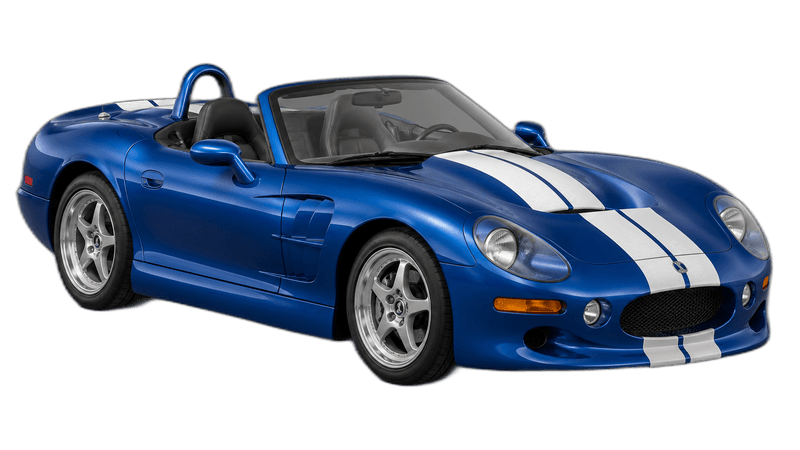
Shelby Series 1
320bhp
Power
274km/h
Top Speed
The Shelby Series 1 is a 2-door roadster by Shelby, with 320 bhp, 393 Nm of torque and a top speed of 274 km/h.
Dream Car Garage Editorial · Last updated 3 November 2026
Overview
We have not driven this car. This review is based on published specifications and the sources listed below.
Scope of this guide
This guide is scoped to the Shelby Series 1 (1999), the two-seat roadster that Carroll Shelby designed and had built by Shelby American in the Las Vegas area. It is a front-engine, rear-wheel drive car: the Oldsmobile-derived V8 sits ahead of the cockpit but behind the front axle, and a six-speed ZF transaxle drives the rear wheels through a torque tube. It is a guide to the standard naturally aspirated car. The factory options that raised power (a performance package and a supercharger) are described where the sources describe them, but their figures are not the ones we headline. It is not a guide to the Series II, the later project that Wikipedia says stopped at prototypes.
We have not driven this model for this article. We are an editorial desk that reads sources, and everything below comes from pages we opened: Wikipedia, RM Sotheby's, Motorious, the Museum of American Speed, the Newport Car Museum, Ultimate Car Page, Racecar.com and Silodrome. We have not inspected, owned or tested a car. The Series 1 is a rare collector car, so this page is for research, not a buying recommendation, and no web page can replace a specialist inspection.
The figures at a glance
- Engine: 4.0L naturally aspirated V8, 3,995 cc according to Wikipedia and Ultimate Car Page, a four-valve-per-cylinder double overhead cam unit descended from Oldsmobile's Aurora V8 (the L47 in Wikipedia's wording). It is mounted front-engine, behind the front axle.
- Drivetrain: rear-wheel drive, six-speed ZF manual transaxle.
- Power: 320 bhp at 6,500 rpm. Every page that gives a rating for the standard car gives 320 hp or 320 bhp. Wikipedia also prints 324 PS, and converting that at 0.98632 gives about 319.6 bhp, which agrees. We use 320 bhp throughout.
- Torque: 393 Nm at 5,000 rpm. Ultimate Car Page prints 393 Nm directly. RM Sotheby's, Motorious, the Museum of American Speed and Silodrome print 290 lb ft, and 290 multiplied by 1.35582 is 393.2 Nm, so the figures agree.
- 0-100 km/h: no figure shown. The pages we read give 0-60 mph, not 0-100 km/h, and we have not relabelled one as the other.
- Top speed: 274 km/h. This is 170 mph (Wikipedia, the Museum of American Speed and the Newport Car Museum), and 170 mph multiplied by 1.60934 is 273.6 km/h. RM Sotheby's prints 185 mph, about 298 km/h. See below for why we chose 274 km/h.
- Weight: 2,650 lb, which Wikipedia and Ultimate Car Page convert to 1,202 kg.
- Production: 249 cars, all 1999 models, against a run of 500 that was announced.
- Original price: RM Sotheby's gives a base price of 181,000 dollars in 1999 and the Newport Car Museum gives a list price of 181,824 dollars.
History of the Series 1
Several of the pages describe the Series 1 as the only car Shelby designed from a clean sheet. His better-known cars were re-engineered versions of another maker's model,. RM Sotheby's says development began in 1994 after eight years of false starts and calls it the most vexing project in Shelby's career. Silodrome says the car was unveiled at the 1997 Los Angeles Auto Show and that Oldsmobile's chief champion of the project, John Rock, was pushed out in 1996.
The engine is the core of the story. The Aurora V8 was developed by Oldsmobile, and Silodrome says it was originally created for the Indy Racing League. Racecar.com says the production engine was detuned to meet government regulations. Silodrome gives the explanation that Shelby had specified 350 bhp but Oldsmobile would not share the engine's computer tuning codes, so the production engine delivered 320 bhp. That is one source's account, and the other pages we read do not repeat it.
The structure was unusual for the period. Wikipedia, the Museum of American Speed and RM Sotheby's describe a welded, heat-treated 6061 aluminium chassis made of extruded and formed sections, with aluminium honeycomb panels bonded into the floor and rocker panels. The body panels are carbon fibre and fibreglass laminate. The suspension is double wishbone, with inboard coil-over dampers worked by rocker arms. The tyres were Goodyear Eagle F1 on 18 inch wheels, 10 inches wide at the front and 12 inches wide at the rear. Weight distribution is quoted at 49/51 front to rear.
Performance and the figures we chose
Acceleration
The sources agree on a 0-60 mph time of 4.4 seconds for the naturally aspirated car (Wikipedia citing Motor Trend, Motorious, the Museum of American Speed, the Newport Car Museum and Ultimate Car Page), while RM Sotheby's says under 4.5 seconds. They also give a quarter mile of 12.8 seconds, at either 109.9 mph (Wikipedia, citing Motor Trend) or 112 mph (RM Sotheby's, the Museum of American Speed and the Newport Car Museum). Wikipedia gives 4.1 seconds for 0-60 mph in a supercharged car tested by Car and Driver, and the Museum of American Speed lists 3.2 seconds for the supercharged version without saying how it was measured. None of these is a 0-100 km/h time. Ultimate Car Page lists its 0-100 km/h field as not given. So for 0-100 km/h there is no figure shown on this page.
Top speed
The top speed is where the sources disagree most. Wikipedia, the Museum of American Speed and the Newport Car Museum all say 170 mph, and the museum adds that this is 15 mph faster than a 427 Cobra. RM Sotheby's lists 185 mph. Wikipedia notes that its own 170 mph claim has no citation, and Ultimate Car Page lists no top speed at all. We chose 170 mph, 274 km/h, because three of the pages repeat it and because the 185 mph figure appears only in an auction description. It is a claimed number, not a figure we found in a road test.
Power with options
The standard car had 320 bhp, and the sources describe a ladder of options on top. Silodrome gives the X50 performance package at 20,150 dollars, intended to add roughly 50 bhp, and the Vortech supercharger package at 35,100 dollars, raising output to 450 bhp. Wikipedia says the X50 gain fell short of the advertised 50 hp. Silodrome and Wikipedia both say only 11 cars had both options, with just over 540 bhp. Early supercharged prototypes are reported at about six hundred bhp and 530 lb ft by Wikipedia, Silodrome and the Museum of American Speed, and the Newport Car Museum says a few cars were supercharged to over four hundred horsepower. None of those supercharged numbers are the ones in our headline figures.
Production: 249 built, 500 planned
Seven of the pages we read give 249 as the number built, all as 1999 models. Wikipedia and Silodrome say a run of 500 had been planned or announced. The Museum of American Speed, the Newport Car Museum, Motorious and Racecar.com give the 249 figure without stating a planned number. Ultimate Car Page is the odd one out: its production field says 500 built, and it says its text comes from a company press release last updated before 1 December 2004. We take that as a repeat of the plan and not a count of finished cars, because it conflicts with every page that names a specific serial number: RM Sotheby's confirms number 20 of 249 through its 17-digit VIN, and Racecar.com calls a car number 249 of 249.
The production story has a second chapter. Wikipedia and the Newport Car Museum say Venture Corporation bought Shelby American during production because of severe cost overruns, and that Venture later went bankrupt, in 2004. Shelby's new company, Shelby Automobiles, then bought the Series 1 assets, including parts for several more cars. The 1999 safety certification had expired and renewing it was prohibitively expensive, so Wikipedia and Silodrome say later cars were finished as component cars without an engine or transmission (Wikipedia gives a numbering series beginning CSX5000 and dates those cars to 2005). The Museum of American Speed says an early-2000s plan for a Series II with more power was killed by stricter federal rules.
Known problems from the sources
Only Silodrome gives specifics about teething trouble, so treat this as one source's account. It says the manufacturing jigs were not strong enough to stop the chassis warping, which meant costly retooling. It says the convertible soft tops did not attach properly and were redesigned after more than 60 cars were built, and that thirty cars were delivered to customers without tops, with technicians sent to buyers' homes to install them. It also says a Car and Driver test in 2000 of a supercharged car destroyed two clutches, threw an engine pulley and blew a piston, with Brock Yates calling the car a work in progress. Wikipedia also mentions clutch problems in the Car and Driver test. We do not know how many of these faults affected the standard naturally aspirated cars, and we have found no recall notice.
What to check before buying
The sources give few buying specifics, so this is a short list drawn from what they say, not an inspection scheme.
- Which car it is: confirm that it is a numbered 1999 production car and not a later component car. The RM Sotheby's page shows the production number carried in the last digits of the 17-digit VIN (number 20 has a VIN ending 000020).
- Which options it has: the standard 320 bhp car, the X50 package and the supercharged car are different machines, and the supercharged cars are the ones with the reported clutch and engine trouble.
- Soft top: because early tops had to be redesigned, ask what top is fitted and whether it was supplied late.
- Mileage and documentation: the cars described by RM Sotheby's, Motorious and Racecar.com all show low mileage and signed or documented history, and the Silodrome car comes with a spare crate Aurora V8, which suggests that engine support is a real question.
- Specialist help: with a car this rare and this hand-built, a qualified specialist inspection is the sensible step, and we cannot offer one.
Market and value notes
We give only prices that a source states. RM Sotheby's page shows a sale of 104,500 dollars for number 20 at its Auburn Fall 2016 sale. Ultimate Car Page lists past results of 112,000 dollars at RM Sotheby's Arizona in 2024, 91,840 dollars at RM Sotheby's Arizona in 2020 and 101,320 euros at Artcurial in 2019, and says two Broad Arrow sales in 2024 ended with no sale. Racecar.com reports car number 249 of 249 going to the Mecum Glendale sale on 28 March to 1 April 2023, but its page lists no result. The Motorious page says car number 238 was offered at RM Sotheby's on 23 and 24 October 2020 and gives no price. These are single auction results and not valuations, so check live listings before relying on any of them.
What we could not find
- 0-100 km/h: no figure shown on any page we read. Only 0-60 mph times are given.
- A road-test-measured top speed. The 170 mph and 185 mph claims are not backed by a test that we read.
- A planned production number on the museum, Racecar.com and Motorious pages. Only Wikipedia and Silodrome state the 500 plan.
- A recall or fault list specific to the standard car. The faults above come from one source.
- The Autotrader Canada find-of-the-week page appeared in a search but its address did not resolve for us, so we did not use it.
About the photograph
The page uses the catalogue photograph for this model, and its credit is listed on the credits page.
Verdict
The Series 1 is an unusual and honestly documented kind of rarity: a clean-sheet Shelby roadster with a lightweight aluminium and carbon fibre structure, a detuned racing-derived V8 and a short, troubled production run that ended at 249 cars against a plan for 500. Our figures are 4.0L naturally aspirated V8, 320 bhp, 393 Nm and a claimed 274 km/h, with no figure shown for 0-100 km/h. Check the sources behind any specific car, be careful about options and later component cars, and treat this page as a research aid and not a buying recommendation.
Sources
- Wikipedia: Shelby Series 1
- RM Sotheby's: 1999 Shelby Series 1 (Auburn Fall 2016)
- Motorious: Oldsmobile Powered 1999 Shelby Series 1
- Museum of American Speed: Shelby Series 1
- Newport Car Museum: 1999 Shelby Series 1
- Ultimate Car Page: Shelby Series 1 specifications
- Racecar.com: The final Shelby Series 1 Convertible at Mecum Glendale
- Silodrome: Supercharged Shelby Series 1
Specifications
Engine
4.0L naturally aspirated V8
Displacement
4.0L
Power
320 bhp
Torque
393 Nm
Top Speed
274 km/h
Drivetrain
RWD
Country
United States
Body Style
2-door roadster
Years
1999
Production
249
Specifications are manufacturer-published figures.
More from Shelby
Frequently Asked Questions
What are the specifications of the Shelby Series 1?
The Shelby Series 1 is a 2-door roadster by Shelby, with 320 bhp, 393 Nm of torque and a top speed of 274 km/h.
How many Shelby Series 1 were made?
Shelby produced 249 units of the Shelby Series 1.
What drivetrain does the Shelby Series 1 use?
The Shelby Series 1 is configured with rear-wheel drive.
What type of car is the Shelby Series 1?
The Shelby Series 1 is a sports cars manufactured by Shelby in United States. Production ran from 1999 to 1999.