
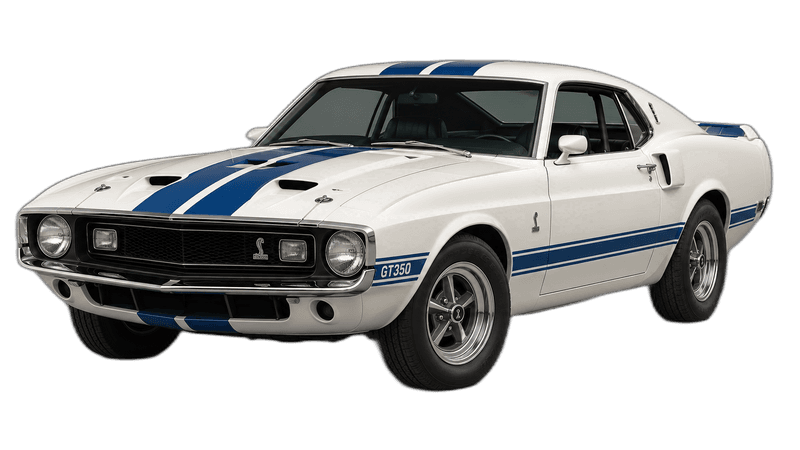
Shelby Mustang GT350 1969
290bhp
Power
The Shelby Mustang GT350 1969 is a 2-door coupé by Shelby, with 290 bhp and 522 Nm of torque.
Dream Car Garage Editorial · Last updated 3 November 2026
Overview
We have not driven this car. This review is based on published specifications and the sources listed below.
Scope of this guide
This guide is scoped to the Shelby Mustang GT350 (1969), the last of the original Shelby GT350 line and the first to use Ford's 351 cubic inch Windsor V8 in place of the small-block 289 and 302 engines of the earlier cars. It is a front-engine, rear-wheel drive car with a live rear axle, sold as a SportsRoof fastback or as a convertible, with a four-speed manual gearbox or a three-speed automatic. Many of the unsold 1969 cars were given new serial numbers and sold as 1970 models, so the catalogue lists the years as 1969 to 1970. This page treats those re-serialled cars as the same car with a different identity, and it is not a guide to the GT500, to the 1968 car with its 302 engine, or to the 1965 to 1967 cars.
We have not driven this model for this article. We are an editorial desk that reads sources, and everything below comes from pages we opened: Wikipedia, three RM Sotheby's auction pages, Silodrome, two Mustang Specs pages, Barn Finds and the Conceptcarz price listing. We have not owned, inspected or tested a car. This page is for research, not a buying recommendation, and it cannot replace an inspection by a Shelby specialist, because cars of this kind are sold on paperwork and originality as much as on condition.
The figures at a glance
- Engine: 5.8L naturally aspirated V8, the Ford 351 Windsor, with a bore of 4 inches and a stroke of 3.5 inches according to Mustang Specs, mounted front-engine.
- Drivetrain: rear-wheel drive, four-speed Toploader manual or three-speed FMX automatic.
- Power: 290 bhp. RM Sotheby's prints bhp, and Silodrome says 290 bhp at four thousand eight hundred rpm. Silodrome's listing and the Mustang Specs pages print the same number as hp. None of the pages says whether this is a gross or a net rating, so we do not state a basis.
- Torque: 522 Nm. The sources print 385 lb ft (Silodrome gives it at three thousand four hundred rpm), and 385 multiplied by 1.35582 is 522.0 Nm.
- 0-100 km/h: no figure shown. The only acceleration time we found is a 0-60 mph time, and we have not relabelled it as a metric time.
- Top speed: no figure shown. One page mentions a 140 mph speedometer, which is a dial and not a measured top speed.
- Years: 1969, with re-serialled cars sold as 1970 models.
- Production: no single figure shown. The sources disagree, as explained below.
History and what changed
The original GT350 arrived in 1965 as a track-capable Mustang, and RM Sotheby's records 562 white fastbacks that year, sold through selected Ford dealers. By 1969 the story had changed. RM Sotheby's says Ford redesigned the 1969 car itself, leaving Carroll Shelby little input, and that Shelby ended his contract with Ford in the summer of 1969. Barn Finds makes the same point in plainer words, saying Carroll Shelby was not involved in the 1969 production.
The 1969 car was longer and more elaborately styled than the 1965 original. RM Sotheby's says the body grew by four inches. The details listed by Silodrome include:
- Molded fiberglass front fenders in place of steel ones, said to reduce front-end weight.
- A hood with three flush recessed NACA ducts instead of the protruding twin scoops of the 1968 car. The centre duct feeds a functional ram-air system.
- Driving lights moved beneath a wrap-around bumper, and semi-functional brake-cooling scoops molded into the front fenders.
- A shortened trunk and tail with a Kamm-style rear and an integrated spoiler, with 1965 Thunderbird taillight bezels carrying sequential turn signals.
- A cast-aluminum exhaust collector feeding a single centre outlet.
- Standard 15 by 7 inch five-spoke wheels with Goodyear F60-15 tyres.
Mustang Specs adds that the interior was a deluxe affair, with a padded roll bar, shoulder harnesses, a wood-rim wheel, Mach 1 style high-back bucket seats, a tachometer and a 140 mph speedometer. These are described on its 1970 page, which says the 1970 car was fundamentally the same as the 1969 model, so we read them as 1969 equipment as well, but that page does not itself list the 1969 interior.
Which figures we chose, and why
Power
Every source that gives a power rating for the 1969 GT350 gives 290. RM Sotheby's (on all three pages), Silodrome, Barn Finds and both Mustang Specs pages agree, while Wikipedia gives no power figure for these years in the parts we read. RM Sotheby's also notes that the 351 engine was offered in the ordinary Mustang as well, so the Shelby car was not unique in its engine. Barn Finds describes its car as rated at 290 horsepower to the wheels, which we think is a loose use of words, because a wheel figure would not be a factory rating and would be lower than the engine figure. We use 290 bhp as the engine rating throughout this page.
Torque
Silodrome and both Mustang Specs pages print 385 lb ft. RM Sotheby's does not state torque on the pages we read. The conversion at 1.35582 gives 522 Nm, and that is the figure we use.
Acceleration and top speed
Mustang Specs prints 0-60 mph in 6.5 seconds, a quarter mile in 14.9 seconds and a weight of 3,689 pounds, but it prints them on its 1970 GT350 page, and a 0-60 mph time is not a 0-100 km/h time. RM Sotheby's, Silodrome and Barn Finds give no acceleration or top speed. So there is no figure shown for 0-100 km/h or for top speed.
Production and the 1969 to 1970 count
This is where the sources disagree most, and we have not forced them into one number.
- RM Sotheby's, on two pages, says 1,085 coupes and 194 convertibles were built in 1969, 1,279 in total. A Mustang Specs page prints the same 1,085 and 194, but places them in a way that leaves unclear whether they refer to the GT350 or to the whole 1969 Mustang range.
- Silodrome says 821 SportsRoof fastbacks and 139 convertibles were built as 1969 models, and that GT350 and GT500 together came to 2,362 units that year.
- Barn Finds says 1,086 fastbacks were produced in 1969, which is one more than RM Sotheby's.
- Wikipedia gives no 1969 production total for the GT350 in the section we read.
On the re-serialled cars, Wikipedia says no 1970 models were built as such and that unsold 1969 cars received 1970 identification numbers under FBI supervision, with a total of 789 re-numbered. Silodrome also says 789 and adds that this brings the combined 1969 to 1970 total of GT350 and GT500 cars to around 3,150. RM Sotheby's says Ford sent 788 unsold 1969 Shelbys to Kar Kraft in Dearborn for hood stripes and a front chin spoiler, and that new numbers and data plates were issued because the FBI destroyed the 1969 data plates. RM Sotheby's also says the work was done to avoid a federal requirement for an anti-theft steering column that applied to 1970 cars. These counts cover both the GT350 and the GT500 in the pages we read, and none of them splits the total between the two models.
Our reading is that the 1,279 figure and the 960 figure (821 plus 139) count different things, and none of the pages explains how. Because we cannot tell whether either figure includes cars that were later re-serialled as 1970 models, we give no production total for this page. Anyone quoting a single number should say which count they mean.
Years
We show 1969 to 1970. Wikipedia says no 1970 cars were built as such, so the 1970 cars are 1969 cars with new numbers, a chin spoiler and two black hood stripes. RM Sotheby's lists one 1970 car as the last GT350 built, with production starting on 19 June 1969, and states that this makes it the final 1969 to 1970 Shelby Mustang. That is an auction house description of one car, not a production record.
The 1970 cars
Mustang Specs says the 1970 GT350 carried over the triple-scoop hood, the integrated rear spoiler and the side stripes, and that the visible changes were the Boss-style front chin spoiler and the dual hood stripes. It lists base prices of 4,434 dollars for the fastback and 4,753 dollars for the convertible, nine standard colours and four Grabber colours (orange, yellow, green and blue), and it says the GT350 was missing from Ford's 1971 sales brochure. It also says the 1970 engine was the same 351 Windsor with an aluminum intake and a 470 CFM Autolite four-barrel carburetor, rated at 290 hp. Wikipedia adds that the 1970 cars had a modified carburetor on the GT500 and an updated distributor for emissions reasons. For the GT350 in this guide, we treat a 1970-serialled car as a 1969 GT350 with those small changes.
Market and value notes
We only report prices that pages we read actually gave, and these are not valuations.
- RM Sotheby's sold a 1969 GT350 with 75,189 miles stated as original, restored in red from its original Black Jade, for 104,500 dollars. The page we read does not give the sale date in its text.
- RM Sotheby's California 2013 sold an Acapulco Blue 1969 GT350 for sixty-three thousand eight hundred dollars, with the title noted as in transit.
- RM Sotheby's Monterey 2013 sold a 1970 car, described as the last GT350 built, for 189,750 dollars.
- Conceptcarz lists 1969 GT350 sale prices from 67,100 dollars at a 2025 Mecum Harrisburg sale to 187,000 dollars at a 2026 Mecum Indy sale, and it records a 2026 Kissimmee car that failed to sell on a high bid of 120,000 dollars.
- Barn Finds reported a 72,000 mile car on eBay, and a commenter said the listing ended at 87,900 dollars. The page itself says that does not confirm a sale.
The spread is wide. It reflects originality, documentation, mileage, colour, gearbox and the market on the day, and the older prices will not reflect today's market. Check current sales before relying on any of them.
What to check before buying
Only some of our sources give specifics, so this is a short list and not an inspection scheme.
- Documentation. The Silodrome auction listing mentions a build sheet, a Deluxe Marti Report and a Shelby owner's manual, and Barn Finds recommends inspections before sending money. A Marti report can confirm whether a colour or option is factory original, as one Barn Finds commenter points out about a claimed Grabber Orange car.
- Originality. The Silodrome car is labelled original but has a respray, a stainless fuel tank, rebuilt suspension, dual-chamber mufflers in place of the original exhaust and a Holley carburetor in place of the original type, and the page says buyers should check which parts are original and which are period or aftermarket.
- Mileage. The same page says the seller does not warrant the 86,577 mile reading. Mileage is a claim to verify, not a fact to assume.
- Identity. Because so many cars were re-serialled in 1970, a seller's description of a car as a 1969 or a 1970 model needs matching to its paperwork.
- Fiberglass. The fenders and nose were fiberglass, so panel fit and repairs are worth a specialist look, though none of our sources describes failure rates or repair costs, so we offer no numbers.
What we could not find
- No agreed production total, and no split of the 788 or 789 re-serialled cars between the GT350 and the GT500.
- No 0-100 km/h time and no measured top speed for the 1969 car, so there is no figure shown for either. The only acceleration figures belong to the 1970 page of Mustang Specs and are in miles per hour.
- No statement of whether 290 bhp is a gross or a net rating.
- No running-cost, fuel economy or reliability data in any page we opened.
- Our Wikipedia source covers the whole Shelby Mustang family, and it gave no power, torque or performance figures for the 1969 GT350 in the parts we read.
About the photograph
The page uses the catalogue photograph for this model, and its credit is listed on the credits page.
Verdict
The 1969 GT350 is the Shelby that moved furthest from the stripped 1965 original, with a longer fiberglass-nosed body, a 351 Windsor V8 and a more luxurious cabin, made when Carroll Shelby's own involvement was ending. Our figures are 290 bhp and 522 Nm from a 5.8L naturally aspirated V8, with no figure shown for 0-100 km/h, top speed or total production because the pages we read either do not give them or disagree. The 1970 cars are best treated as re-numbered 1969 cars, and identity, documentation and originality matter at least as much as headline numbers. Treat this page as a research aid and have any car inspected by a specialist.
Sources
- Wikipedia: Shelby Mustang
- RM Sotheby's: 1969 Shelby GT350 SportsRoof (John Staluppi Collection)
- RM Sotheby's California 2013: 1969 Shelby GT 350
- RM Sotheby's Monterey 2013: 1970 Shelby GT350 SportsRoof
- Silodrome: 1969 Shelby Mustang GT350
- Mustang Specs: 1970 Shelby GT350 in-depth guide
- Mustang Specs: Mustang of the Day, 1969 Shelby Mustang GT350 Fastback
- Barn Finds: 72k mile 1969 Shelby GT350
- Conceptcarz: 1969 Shelby Mustang GT 350 price listing
Specifications
Engine
5.8L naturally aspirated V8
Displacement
5.8L
Power
290 bhp
Torque
522 Nm
Drivetrain
RWD
Country
United States
Body Style
2-door coupé
Years
1969–1970
Specifications are manufacturer-published figures.
More from Shelby
Frequently Asked Questions
What are the specifications of the Shelby Mustang GT350 1969?
The Shelby Mustang GT350 1969 is a 2-door coupé by Shelby, with 290 bhp and 522 Nm of torque.
What drivetrain does the Shelby Mustang GT350 1969 use?
The Shelby Mustang GT350 1969 is configured with rear-wheel drive.
What type of car is the Shelby Mustang GT350 1969?
The Shelby Mustang GT350 1969 is a sports cars manufactured by Shelby in United States. Production ran from 1969 to 1970.