
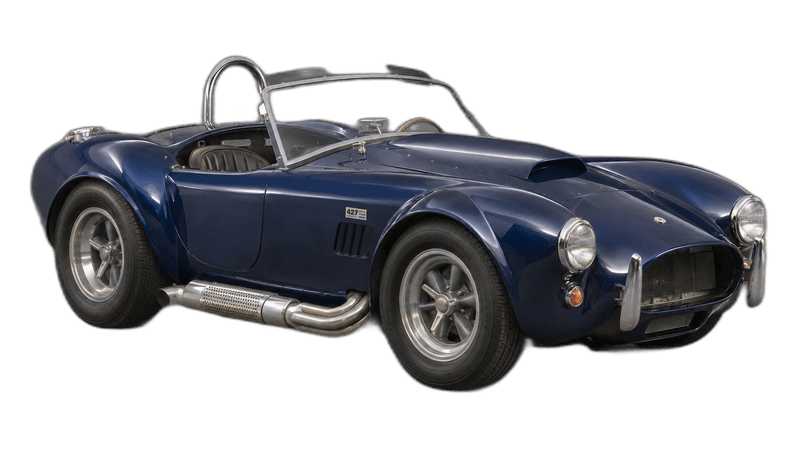
Shelby 427 Super Snake
The Shelby 427 Super Snake is a 2-door roadster by Shelby, powered by a 7.0L supercharged V8.
Dream Car Garage Editorial · Last updated 3 November 2026
Overview
We have not driven this car. This review is based on published specifications and the sources listed below.
Scope of this guide
This guide is scoped to the Shelby 427 Super Snake (1966), the twin-supercharged 427 cubic inch big-block Cobra that Carroll Shelby had built for his own use. It is a front-engine, rear-wheel drive open roadster with a big V8 ahead of the cockpit, an aluminium body over a tubular steel frame, and Girling disc brakes at all four corners. The pages we read treat it as one of only two such cars, and the one this guide concentrates on is the survivor, chassis CSX 3015. It is not a guide to the 2008 Shelby GT500 Super Snake, to later cars wearing the same name, or to replicas and tribute cars, and it is not a guide to the ordinary 427 Cobra from which the Super Snake was made.
We have not driven this model for this article. We are an editorial desk that reads sources, and everything below comes from pages we opened: Wikipedia, Supercars.net, Sports Car Market, New Atlas, FordMuscle, Old Cars Weekly, InsideHook, Classic Cars Journal, The Drive and Jalopnik. We have not inspected, owned or tested a car, and a car like this almost never comes to market, so this page is for research and not a buying recommendation. It cannot replace a specialist inspection of the specific car in front of you.
The figures at a glance
- Engine: 7.0L supercharged V8. Supercars.net gives the capacity as 427 cubic inches, 6,997 cc, with a bore of 107.4 mm and a stroke of 96.0 mm. The supercharging is two Paxton units, so the car is usually described as twin-supercharged.
- Layout: front-engine, rear-wheel drive. Supercars.net lists the engine as front-longitudinal.
- Power: no figure shown as a rating. The widely repeated number is about eight hundred horsepower, and every page that gives it treats it as Shelby's claim or as a belief, not a measured result. Details are below.
- Torque: no figure shown. One database-style page gives a number, which we explain below, but no other page we read gives any torque for this car.
- 0-100 km/h: no figure shown. The only measured acceleration we found is a 0-60 mph time of 3.8 seconds from a 1968 Road & Track test as reported by Sports Car Market. A 0-60 mph time is not a 0-100 km/h time, and we have not relabelled it.
- Top speed: no figure shown as a measured value. Road & Track estimated 182 mph was possible but did not run it, and a few other pages give very different numbers.
- Weight: 1,035 kg (2,282 lb) kerb weight according to Supercars.net, the only page we read that gives a weight.
- Production: 2. Sports Car Market, Supercars.net, New Atlas, Jalopnik, The Drive and Classic Cars Journal all describe two Super Snake Cobras.
- Years: we keep 1966, with the caveat that the pages disagree about when the conversion was done, explained below.
History of CSX 3015
The car began as a Cobra 427 Competition roadster. Sports Car Market says CSX 3015 was one of 22 such cars, invoiced to Shelby American in early 1965 and completed that December. Other pages give a different count for the same group: New Atlas and FordMuscle say Shelby picked it from 19 production Competition Cobras, while Old Cars Weekly, Jalopnik, The Drive and Classic Cars Journal say 23. We do not know which count is right and it does not change the story, so we only note that it varies.
Supercars.net says the chassis was shipped and invoiced to Ford Advanced Vehicles on September 7, 1965, and Sports Car Market says it went to Ford Advanced Vehicles in England before returning to Los Angeles in late 1966, when it was rebuilt as a Super Snake. Shelby kept it for his personal use. Several pages say he drove it in the Turismos Visitadores event in Nevada, and Old Cars Weekly, Classic Cars Journal and The Drive repeat a story from Barrett-Jackson chief Craig Jackson that Shelby was stopped by the Nevada Highway Patrol while doing 190 mph. That is an anecdote, not a timed run. At 1.60934 km/h per mph, 190 mph is about 306 km/h, and it should not be read as a top speed.
The magazine that gave the car its nickname was Road & Track. Supercars.net, New Atlas and FordMuscle all say the February 1968 issue called it "The Cobra to End All Cobras". InsideHook quotes a different Road & Track phrase, calling it the most extreme factory-built Shelby Cobra in existence.
When was it built
This is the first place the sources disagree. Wikipedia describes a 1966 conversion. New Atlas and FordMuscle call it a 1966 car. Classic Cars Journal says it was built as a competition roadster in 1966 and converted about a year later. Supercars.net says Shelby converted it somewhere between early and mid 1967, and InsideHook says it was upgraded to Super Snake status in 1967 after a trip to Europe. Sports Car Market has the car returning to Los Angeles in late 1966 for the rebuild. We use 1966 because that is how the auction house and most of the pages name the car, but a reader should treat 1966 and 1967 as both defensible for the conversion.
What made it a Super Snake
The key change was the pair of Paxton superchargers. Sports Car Market describes a 427 big block with twin Paxton superchargers and two Holley four-barrel carburettors, sitting on an experimental Edelbrock cross-ram manifold. The Drive describes the same arrangement as two Paxton units feeding two Holley four-barrels. Wikipedia says the car was based on the 427 S/C racing model, made street legal and fitted with the twin superchargers, while keeping the racing rear end, brakes and headers. Old Cars Weekly says it was reclassified as a 427 Semi-Competition car after the conversion. Sports Car Market adds that it kept its original date-coded engine.
The pages also agree that the car was fitted with an automatic gearbox. New Atlas, FordMuscle, Jalopnik, Classic Cars Journal and Old Cars Weekly call it a three-speed automatic. The Drive says the standard four-speed Borg-Warner manual was replaced with a three-speed Lincoln Cruise-O-Matic. Sports Car Market says it is a Ford C-6 and passes on an explanation attributed to Don McCain that no production clutch could handle the torque. Those descriptions are compatible, since the C-6 is a three-speed automatic. Supercars.net contradicts itself, with its text mentioning a three-speed automatic and its spec table listing a four-speed manual, and we think the table is wrong.
Which figures we chose, and why
Power
There is no rated power figure for this car. The number everyone repeats is about eight hundred horsepower. New Atlas, FordMuscle and Jalopnik print eight hundred horsepower, and Supercars.net lists 596.6 kW or eight hundred bhp as a claim. The Drive is more careful and says the car made "somewhere in the neighborhood" of that figure, calling it a belief. Sports Car Market is the most useful, noting that the figure came from Shelby and that Road & Track called the power more than adequate instead of publishing a number. For comparison, Wikipedia lists the ordinary 427 S/C at 362 kW, which is 485 hp. We have no dyno sheet and no factory rating, so there is no figure shown for rated power and we treat eight hundred horsepower as a claim that was never verified in anything we read.
Torque
The only torque we found is on Supercars.net, which lists 626.39 Nm, or 462.0 lb-ft, at two thousand eight hundred rpm. Converting 462.0 lb-ft at 1.35582 gives about 626.4 Nm, so the two numbers agree with each other, but the page gives no test, dyno or maker source, and no other page we read gives torque for this car. We therefore leave it out, with no figure shown, and do not present it as measured.
Acceleration
The sources span a wide range and only one is a magazine test. Sports Car Market reports that Road & Track in 1968 recorded 0-60 mph in the 3.8 second range, a quarter mile in 11.86 seconds at 115 mph (about 185 km/h) and 0-100 mph in the low seven-second range. Supercars.net lists 4.5 seconds for 0-60 mph, 10.3 seconds for 0-100 mph and 12.4 seconds for the quarter mile, with no stated basis. The Drive says about three seconds if the tyres could hook up, which is a guess and not a result. All of these are in miles per hour, and none is a 0-100 km/h time, so there is no figure shown for 0-100 km/h. We would trust the Road & Track numbers over the others because they come from a named test, but we only have them second hand through Sports Car Market.
Top speed
Nobody ran it flat out. Sports Car Market says no top speed test was performed and that Road & Track estimated 182 mph was possible, which at 1.60934 is about 293 km/h. Supercars.net lists about 265.5 km/h (165.0 mph), again with no source. The Highway Patrol story of 190 mph is an anecdote. For context, Wikipedia gives 264 km/h for the standard 427 Cobra and 298 km/h for the S/C. With an estimate, a database number and a story that do not agree, there is no figure shown for top speed.
Production
Two. That is the number given by Sports Car Market, Supercars.net, New Atlas, Jalopnik, The Drive and Classic Cars Journal, and it matches the idea that CSX 3015 is the sole survivor. Sports Car Market's specification box also prints a production figure of 348, which we think refers to 427 Cobras in general and not to the Super Snake, so we did not use it.
The second car
The second Super Snake, CSX 3303, was built for Bill Cosby. The pages agree on the outline and differ on the detail. Sports Car Market says Cosby bought it in 1968 and returned it within a month, reportedly because it scared him, after which it passed through a San Francisco dealer to Tony Maxey, who crashed it at Half Moon Bay and died a few days later. The Drive says Cosby sold it to a California dealer, that it was resold in 1969 to Maxey, and that he drove it off a cliff into the Pacific, adding that the wreck's whereabouts are unknown. Jalopnik says Cosby drove it once and returned it. Wikipedia says the buyer lost control and drove it off a cliff. Whatever the exact sequence, the car was destroyed, and we have not tried to reconcile the small differences.
Ownership and sale history
The ownership chain for CSX 3015 is better documented than its performance, but the pages vary on dates.
- Sports Car Market says Shelby sold it to the songwriter Jimmy Webb for $10,500, and that Webb later said he turned down $1.2 million in the collector car boom of 1989 and 1990. The Drive dates the sale to Webb as 1970.
- The Drive and Sports Car Market both say the US tax authority seized the car and auctioned it in 1995 for $375,000.
- The Drive says a billionaire collector bought it in 1998 and sold it back to the 1995 buyer eight years later.
- On January 20, 2007, it sold at Barrett-Jackson in Scottsdale for $5.5 million. Wikipedia says that was $5 million plus commission, The Drive calls $5.5 million the hammer price, and Classic Cars Journal says it was $5.5 million including fees. Sports Car Market describes it as the highest price ever paid for an American car at a public auction at that time.
- Jalopnik reports it sold again in Scottsdale for $5.115 million, in an article dated January 21, 2015. The Drive says $5.1 million in 2015, while Classic Cars Journal says 2017. We use 2015 because it is the date on the contemporary report.
- In March 2021 it was offered again at Barrett-Jackson with a reserve. InsideHook and Classic Cars Journal wrote before the sale, and The Drive quoted an expected range of $5 million to $8 million. We did not open a page reporting the outcome, so we give no result.
These are the prices the pages report, not valuations, and they do not tell you what a comparable car is worth, because there is no comparable car.
What the rarity means
For a collector or competition car this unusual, the usual buying checklist does not apply, and none of the pages we read gives a pre-purchase inspection scheme. Sports Car Market notes the survivor kept its original date-coded engine, differential oil cooler and brake calipers, which is the kind of detail a specialist would verify against the chassis number on the passenger foot box and the engine casting numbers. Beyond that, the sensible reading is that provenance, matching numbers and period documentation matter far more than the usual condition checks. If you are researching the name, be careful to keep the two Super Snake Cobras separate from the modern cars and replicas that borrow it.
What we could not find
- No rated or measured power figure, no verified torque and no measured top speed. The details are above, and for each of them there is no figure shown.
- No 0-100 km/h time. All of the performance figures we found are in miles per hour.
- We could not open the Hagerty article (access refused), the Top Gear article (access refused), the Barrett-Jackson archive page (payment required) or a MotorAuthority page (access refused), and we did not work around any of these.
- No page we read reports the outcome of the March 2021 sale.
- Pages disagree on the build date, the number of Competition roadsters, the gearbox description and the date of the second sale. None of them cite a primary document that we could open.
About the photograph
The page uses the catalogue photograph for this model, and its credit is listed on the credits page.
Verdict
The Super Snake is better understood as a story than as a spec sheet. What the sources support is a 7.0L supercharged V8 in a light Cobra roadster, two cars built, one survivor that Shelby used himself, and a Road & Track test that reported 0-60 mph in the 3.8 second range and a quarter mile in 11.86 seconds. What they do not support is a rating: the eight hundred horsepower is a claim, the torque and top speed are not measured, and the 0-100 km/h time does not exist in anything we read. Treat the price history as a record of what bidders paid for one unique car, and treat this page as a research aid and not a buying recommendation.
Sources
- Wikipedia: Shelby Cobra
- Supercars.net: 1966 Shelby Cobra 427 Super Snake
- Sports Car Market: 1966 Shelby Cobra 427 Super Snake profile
- New Atlas: Carroll Shelby's personal twin-supercharged Cobra
- FordMuscle: Shelby's Super Snake CSX3015
- Old Cars Weekly: A special Snake goes up for sale in the desert
- InsideHook: Carroll Shelby's Cobra 427 Super Snake is being sold at auction
- Classic Cars Journal: Carroll Shelby's personal Super Snake set for Barrett-Jackson auction
- The Drive: Carroll Shelby's own 1966 Super Snake could fetch $8M at auction
- Jalopnik: The ultimate Shelby Cobra just sold for $5.115 million
Specifications
Engine
7.0L supercharged V8
Displacement
7.0L
Drivetrain
RWD
Country
United States
Body Style
2-door roadster
Years
1966
Production
2
Specifications are manufacturer-published figures.
More from Shelby
Frequently Asked Questions
What are the specifications of the Shelby 427 Super Snake?
The Shelby 427 Super Snake is a 2-door roadster by Shelby, powered by a 7.0L supercharged V8.
How many Shelby 427 Super Snake were made?
Shelby produced 2 units of the Shelby 427 Super Snake.
What drivetrain does the Shelby 427 Super Snake use?
The Shelby 427 Super Snake is configured with rear-wheel drive.
What type of car is the Shelby 427 Super Snake?
The Shelby 427 Super Snake is a track focused manufactured by Shelby in United States. Production ran from 1966 to 1966.