
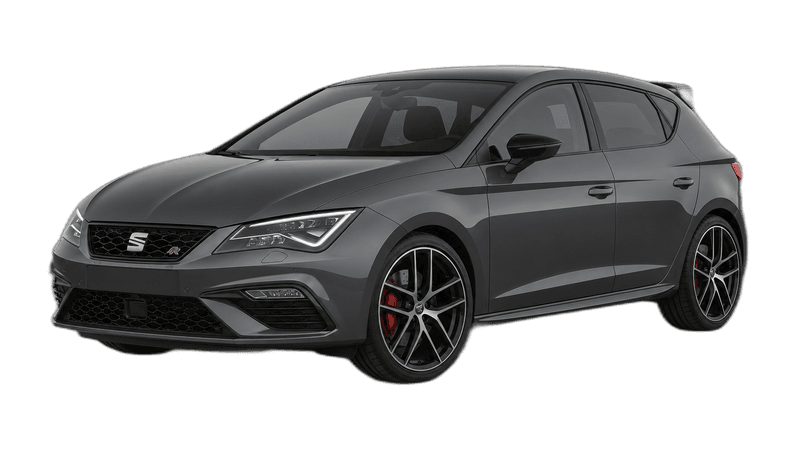
Seat Leon Cupra R (Mk3)
£22,000
usedIndicative market price, updated periodically.
306bhp
Power
5.8s
0-100 km/h
250km/h
Top Speed
£22,000
Price Used
How hard it pulls.
Peak g-force the instant you bury the throttle, estimated from the car's 0–100 time and drivetrain.
Seat Leon Cupra R (Mk3)Estimated peak launch g from the 0–100 time and drivetrain: an honest approximation, not a measured figure.
The Seat Leon Cupra R (Mk3) is a 4/5 seater hatchback by Seat, with 306 bhp, 380 Nm of torque, a 0-100 km/h time of 5.8 seconds and a top speed of 250 km/h. Indicative used value: approximately £22,000. Actual values vary with specification, condition and history.
Dream Car Garage Editorial · Last updated 2 November 2026
Overview
We have not driven this car. This review is based on published specifications and the sources listed below.
Scope of this guide
This guide is scoped to the Mk3 (5F) SEAT Leon Cupra R limited edition, the five-door hatchback with the 2.0L turbocharged inline-4 petrol (1984 cc) engine and front-wheel drive. It is not a guide to the ordinary Leon Cupra 280, 290 or 300, to the earlier Mk1 and Mk2 Cupra R cars, or to the Leon ST estate, and we say below where they differ so you can tell which car an advert is really describing.
We have not driven this model for this article. Everything here comes from a SEAT-hosted technical data sheet for the car, a PistonHeads used buying guide written for the wider Mk3 Leon Cupra range, and the government recall checker. We also read launch coverage from Carscoops and the Spanish site km77.com for the production split and a few equipment details, and we flag those points in the text. Where sources disagree, or where a figure in our catalogue could not be confirmed word for word, we say so.
The figures at a glance
- Engine: 2.0L turbocharged inline-4 petrol (1984 cc), four cylinders and 16 valves, Euro 6.
- Power: 310 PS (228 kW) with the manual gearbox, which is 306 bhp after conversion.
- Torque: 380 Nm between 1,800 and 5,700 rpm, about 280 lb ft.
- Gearbox: six-speed manual or six-speed DSG dual-clutch automatic.
- Drive: front-wheel drive only.
- 0-100 km/h: 5.8 seconds for the manual car on SEAT's data sheet.
- Top speed: 250 km/h, which is about 155 mph by our conversion.
- Body: five-door hatchback, 4,324 mm long, 1,816 mm wide and 1,435 mm high.
- Weight: 1,453 kg in running order for the manual, 1,479 kg for the DSG.
- Production: 799 cars in total.
Why the quoted power and torque vary
SEAT quotes 310 PS, a metric horsepower figure, and 228 kW for the manual car. Converting either gives 305.8 bhp, which we round to the 306 bhp we publish. That is a conversion made by us, not a number printed by SEAT. PistonHeads labels the same output 310hp, so it is the same rating under a different label, not a more powerful car.
The DSG car is rated lower. The SEAT sheet gives 300 PS and 221 kW for the 300 PS DSG version, with the power peak at 5,500 to 6,200 rpm rather than 5,800 to 6,500 rpm. Torque is the same 380 Nm for both gearboxes. PistonHeads puts the Cupra R at 280 lb ft, and 280 lb ft converts to about 380 Nm, so the two sources agree.
We use 380 Nm throughout. No source we read gave a different torque figure for the Cupra R.
Performance claims and what they mean
SEAT's data sheet gives 5.8 seconds from 0 to 100 km/h for the manual car and 5.7 seconds for the DSG car. Carscoops, writing at launch in December 2017, quoted 5.8 seconds for both versions, so the sources differ by a tenth on the DSG. An earlier catalogue value of 6.0 seconds was not supported by any source we read, and we have corrected it. These are manufacturer claims from a single document, not measured times, and we have no independent test figure.
Top speed is 250 km/h on the SEAT sheet, which is about 155 mph by our conversion. Treat it as a claimed figure, not a measured maximum, and we did not find a source that says how the limit is applied.
Model years and production numbers
SEAT showed the car at the Frankfurt motor show in September 2017. The SEAT data sheet is dated 21 November 2017, and km77.com lists sales from November 2017 with a stated period running to October 2018. PistonHeads calls it the 2018-19 Cupra R. We therefore use 2017 to 2019 as the span for this guide, but the exact first-registration and last-build dates are not confirmed in what we read.
Production was limited to 799 cars. Carscoops reports a split of 499 manual and 300 DSG cars, and that split comes from launch coverage rather than the SEAT sheet. km77.com says 40 of the 799 were for Spain. PistonHeads says only 24 were right-hand drive for the UK, and a separate PistonHeads article says the UK allocation sold out. A photograph of the show car at Frankfurt carries a sign reading 001/799, which suggests the cars were numbered, though we did not find a source that describes the numbering.
How the Cupra R differs from the Cupra 280, 290 and 300
PistonHeads lists the Mk3 range as the 265 and 280 in 2014 and 2015, the 290 from 2015 to 2017, and the 300 from 2017, with the 290 specification returning in 2018 after petrol particulate filter rules. It describes the Cupra R as a separate 2018-19 car rated at 310hp and says it is not considered in the guide.
From the sources we read, the Cupra R differs in these ways:
- Power: 310 PS with the manual gearbox, against 280, 290 or 300 PS on the ordinary cars. With DSG it falls to 300 PS, the same as the Cupra 300.
- Brakes: Brembo calipers with 370 x 32 mm front discs, where km77.com says the Cupra uses 340 x 30 mm discs.
- Aerodynamics and trim: Carscoops describes carbon aerodynamic parts, copper-coloured trim and Alcantara, and claims an aerodynamic gain of 12.5 per cent. We have not verified that claim.
- Wheels and tyres: 19-inch wheels with 235/35 R19 tyres on the SEAT sheet, and km77.com names Michelin Pilot Sport Cup 2 tyres.
- Production: a limited run of 799 cars, against a regular production model.
Engine and gearbox
SEAT's sheet gives a bore and stroke of 82.5 x 92.8 mm and a compression ratio of 9.3:1. The fuel is listed as 98 octane petrol, so budget for premium fuel. The torque plateau is wide, from 1,800 to 5,700 rpm, which is why the engine feels flexible below its power peak.
PistonHeads has several general warnings for Mk3 Cupra cars that may apply, but it did not write them for the Cupra R and we cannot confirm they do. It says the clutch on manual cars is a weak point, with slip in higher gears as the usual symptom. It says a silica gel bag in the coolant header tank could split and block the heater matrix, that water pump housings have failed, and that silicone sealant from a pump replacement has reached the valvegear. It also mentions early cars with IHI turbochargers as a possible concern. Ask any seller for evidence of cooling system work.
On DSG cars, PistonHeads says launch control is poor and causes wheelspin, and that the software can make unrequested shifts. It also says the paddles felt flimsy on some cars. Dual-clutch servicing intervals are not stated in the sources we read, so ask a SEAT or Cupra specialist for the schedule for a specific car.
Chassis, steering and brakes
The sheet lists McPherson struts at the front and a multi-link rear axle, plus electrohydraulic power steering with progressive steering and the DCC adaptive damping system. Carscoops says the car has an electronic limited-slip differential and adaptive suspension, but we could not confirm from our sources what was retuned compared with the ordinary Cupra.
Brakes are ventilated at both ends, 370 x 32 mm at the front and 310 x 22 mm at the rear. Inspect disc wear and the condition of the front calipers, and note that these are larger and likely dearer to replace than the parts on an ordinary Cupra, though our sources give no parts prices.
Our sources disagree on track widths. The SEAT sheet lists 1,568 mm at the front and 1,543 mm at the rear, while Carscoops gives 1,593 mm and 1,530 mm. We cannot tell which is correct for the production car, so treat both as unconfirmed.
Running costs and practicality
SEAT's sheet gives a weighted fuel consumption of 7.3 litres per 100 km and 170 g/km of CO2 for the manual car, and 6.9 litres per 100 km and 158 g/km for the DSG. That is roughly 38.7 and 40.9 mpg after our conversion, but the sheet does not name the test cycle, so real-world figures will be lower, particularly on a track or a spirited road. The fuel tank holds 50 litres and the boot holds 380 litres.
Our sources do not cover servicing costs, insurance, annual road tax or tyre costs for the Cupra R, so we give no figures. Check the CO2 value against the current tax rules on GOV.UK before you buy.
What to check before buying
- Confirm it is a genuine Cupra R and not an ordinary Cupra with badges, using the paperwork, the VIN and the specification, and ask SEAT or a specialist how to verify build numbers.
- Ask whether it is a manual or a DSG car, since the power rating differs by 10 PS.
- Check the clutch for slip in higher gears on a manual car, and the DSG for unrequested shifts or hesitation.
- Look for evidence of coolant and water pump work, and check the heater output.
- Examine the front tyres, since PistonHeads mentions heavy front tyre wear on cars used on track days.
- Test the infotainment, the climate controls, the rear wiper and every warning light.
- Ask about modifications, since a tuned car may carry added wear and could affect warranty and insurance.
- Confirm every recall is closed, using the check below.
Recalls and the DVSA check
We did not find a recall list for the Leon Cupra R in the sources we read, and PistonHeads does not list recalls for the Mk3 Cupra range. That does not mean there are none. Always run the vehicle through the DVSA vehicle recall check on GOV.UK using the registration number or VIN, and ask the seller for the recall paperwork from a SEAT dealer.
Verdict
The Leon Cupra R is a rare, numbered, front-wheel drive hot hatch with a well-documented engine and chassis, and its rarity matters as much as its speed. If you are shopping for one, confirm the exact car, check the clutch or gearbox, the cooling system and the recalls, and treat the 306 bhp, 380 Nm, 5.8 seconds and 250 km/h figures as published ratings, with the caveats explained above. We have not driven it, so use the sources and a proper inspection to decide.
Specifications
Engine
2.0L turbocharged inline-4 petrol (1984 cc)
Displacement
2.0L
Power
306 bhp
Torque
380 Nm
0-100 km/h
5.8s
Top Speed
250 km/h
Drivetrain
FWD
Country
Spain
Body Style
4/5 seater hatchback
Years
2017–2019
Production
799
Price Used
£22,000
Specifications are manufacturer-published figures.
More from Seat
Frequently Asked Questions
What are the specifications of the Seat Leon Cupra R (Mk3)?
The Seat Leon Cupra R (Mk3) is a 4/5 seater hatchback by Seat, with 306 bhp, 380 Nm of torque, a 0-100 km/h time of 5.8 seconds and a top speed of 250 km/h. Indicative used value: approximately £22,000. Actual values vary with specification, condition and history.
How much does a Seat Leon Cupra R (Mk3) cost?
Indicative used value: approximately £22,000. Actual values vary with specification, condition and history.
How many Seat Leon Cupra R (Mk3) were made?
Seat produced 799 units of the Seat Leon Cupra R (Mk3).
What drivetrain does the Seat Leon Cupra R (Mk3) use?
The Seat Leon Cupra R (Mk3) is configured with front-wheel drive.
What type of car is the Seat Leon Cupra R (Mk3)?
The Seat Leon Cupra R (Mk3) is a hot hatches manufactured by Seat in Spain. Production ran from 2017 to 2019.