
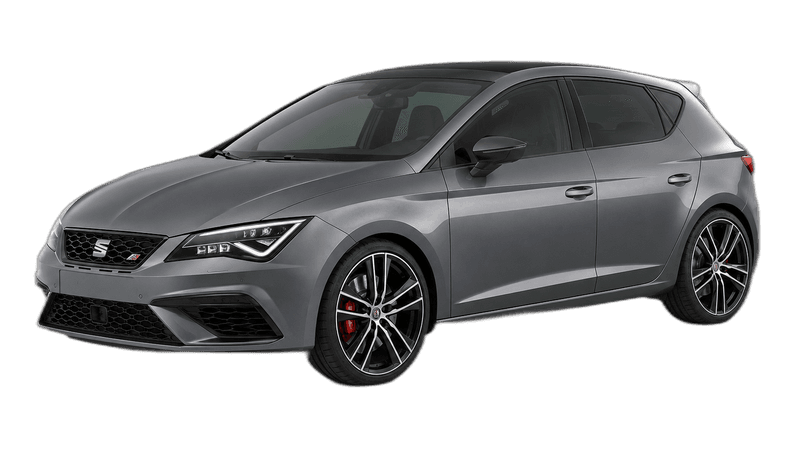
Seat Leon Cupra 300
£20,000
usedIndicative market price, updated periodically.
296bhp
Power
5.8s
0-100 km/h
250km/h
Top Speed
£20,000
Price Used
How hard it pulls.
Peak g-force the instant you bury the throttle, estimated from the car's 0–100 time and drivetrain.
Seat Leon Cupra 300Estimated peak launch g from the 0–100 time and drivetrain: an honest approximation, not a measured figure.
The Seat Leon Cupra 300 is a 4/5 seater hatchback by Seat, with 296 bhp, 380 Nm of torque, a 0-100 km/h time of 5.8 seconds and a top speed of 250 km/h. Indicative used value: approximately £20,000. Actual values vary with specification, condition and history.
Dream Car Garage Editorial · Last updated 2 November 2026
Overview
We have not driven this car. This review is based on published specifications and the sources listed below.
Scope of this guide
This guide is scoped to the SEAT-badged Leon Cupra 300 five-door hatchback (Typ 5F facelift), the front-wheel drive car with the 2.0L turbocharged inline-4 petrol (1984 cc) engine and a choice of six-speed manual or six-speed DSG gearbox, sold from 2017 to 2018. It is not a guide to the three-door SC, to the ST estate with the 4Drive all-wheel drive system, to the 310 PS Cupra R, or to the later 290 PS hatchback that replaced this car for the new emissions test. We say below where each of those differs, so that you can tell which one an advert really describes.
We have not driven this model for this article. Everything here comes from three cited sources: SEAT's own press text from the January 2017 launch (the French-language version, hosted on SEAT's media site), PistonHeads' used buying guide covering the whole third-generation Leon Cupra, and the government recall checker. We also read a PistonHeads Spotted article, a Wikipedia article and the Auto Express and evo launch coverage, and we flag each point that rests on them. Where sources disagree we say so rather than pick a winner quietly. Prices are history or ranges, not valuations.
The figures at a glance
- Engine: 2.0L turbocharged inline-4 petrol (1984 cc), 300 PS (221 kW) according to SEAT, with maximum torque from 1,800 to 5,500 rpm.
- Power: 296 bhp, which is SEAT's 300 PS converted by us (300 x 0.98632 is about 295.9). Auto Express, evo and Wikipedia also print 296 bhp. SEAT's press text prints PS and kW, not bhp.
- Torque: 380 Nm, which Wikipedia and PistonHeads' spotted article print as 280 lb ft.
- 0-100 km/h: 5.8 seconds for the manual five-door. This exists in our sources only as 0-62 mph, and 62 mph is 99.8 km/h, so we treat the two as the same. SEAT's press text gives no acceleration figure at all.
- Top speed: 250 km/h, electronically limited with either gearbox (155 mph in the English-language sources).
- Drive: front-wheel drive, with an electronically controlled locking differential on the front axle (SEAT's VAQ).
- Economy: SEAT's French text gives 153 to 164 g/km of CO2 across all three bodies, depending on model and gearbox. The five-door is quoted at 6.8 l/100 km in the press text, which the wording makes slightly ambiguous.
What the Leon Cupra 300 was
SEAT's press text is dated Martorell, 23 January 2017, and says the car could be ordered from 18 January 2017. Its headline claim was that the 2.0 TSI at 300 PS was the most powerful series-production engine in SEAT's history, with 10 PS more than the Cupra 290 and torque raised from 350 Nm to 380 Nm. The press text says the previous Cupra sold 9,000 cars worldwide in 2016, 8,300 of them in Europe, and describes three bodies: the five-door, the three-door SC and the ST estate. The ST with DSG and 4Drive was the only all-wheel drive version.
The facelift added full LED headlights with indicators in the daytime running lights, an 8-inch touchscreen, an electric handbrake, keyless entry and a wireless charging pad, plus two new metallic colours, electric blue and desire red. Outside, the Cupra has bigger front air intakes, twin chrome exhaust tips, red brake calipers with a Cupra logo, aluminium sills and a rear spoiler. Inside are Alcantara and leather sports seats with a Cupra logo, with Alcantara bucket seats as an option.
Why the quoted power and acceleration vary
Power is straightforward. SEAT prints 300 PS and 221 kW. PS is the metric horsepower, so 300 PS is about 296 bhp, which is what the English-language reviews and Wikipedia print. Some listings simply say 300 hp, and that is the same engine rounded up. The catalogue figure we started from, 296 bhp, is the one we keep.
Acceleration is less tidy. PistonHeads says the front-drive 300 had no real change from the 290's headline figures, which it gives as 5.8 seconds for the manual and 5.7 seconds for the DSG. Auto Express quotes 5.8 seconds for the manual five-door and 5.7 seconds for the manual SC, and says the automatic cuts about a tenth from the manual times. Wikipedia's table gives 5.8 seconds, and evo's pre-launch piece guessed at 5.9 for a five-door 290. A database listing we saw gives 5.9 for a DSG hatchback. All of these are 0-62 mph figures, none came from SEAT, and real cars vary with tyres, temperature and launch technique. We use 5.8 seconds for the manual and treat it as a claim.
How the Leon Cupra 300 differs from other versions
The SC is the three-door body, quoted by Auto Express at 5.7 seconds for the manual, and PistonHeads says it was dropped in 2018. The ST estate is quoted at 4.9 seconds from 0 to 62 mph with 4Drive and DSG, weighing 1,545 kg, and PistonHeads says it stayed at 300 PS when the five-door was cut. The Cupra R is 310 PS (about 306 bhp according to Wikipedia), and PistonHeads excludes it because only 24 were right-hand drive.
The important change is in 2018. PistonHeads and Wikipedia both say that new emissions test rules brought particulate filters, and that the front-drive hatch was cut back to a 290 PS car while the ST kept its 300 PS. Wikipedia's text dates the Cupra 300 as 2017 to 2018, while its table runs to 2020, which we take to include the ST. So a five-door described as a 300 and registered after the change deserves a check of its actual power and its documents.
Engine and gearbox
The 2.0L turbocharged inline-4 petrol (1984 cc) is the unit common to the Leon Cupra range, and PistonHeads says a Stage 1 remap on a 280 or 300 typically lifts power to over 360 hp. It says the early turbocharger issue applied only to very early 5F cars, not this period. PistonHeads reports that the manual clutch can be a weak point, usually as slip in the higher gears, on standard and remapped cars.
The six-speed DSG fitted to more than seven in ten buyers is described by PistonHeads as having fairly low cruising gears, software that can upshift or double-downshift unasked even in manual mode, and plastic paddles that some owners found small and gritty. It also calls the launch control poor, dumping the clutch at 3,000 rpm with wheelspin in the first two gears, and says dealers allegedly warned that more than three uses could affect the warranty. That is a guide to driving behaviour and a reason to ask about use, not a verified fault list.
Chassis, differential and brakes
SEAT's press text says the Cupra has electronically controlled DCC adaptive dampers, progressive steering as standard, and a Haldex VAQ electronic locking differential that works by opening and closing clutch plates, with the aim of removing understeer. The press text also lists five drive profiles (Comfort, Sport, Eco, Individual and Cupra) and an ESC that has three settings. evo describes a locking differential as standard.
The optional Performance Pack is not described in the SEAT text. Web-search summaries of reviews say it adds Brembo brakes with red or black callipers, 19-inch wheels and side trim, and a Wikimedia Commons caption for our hero image mentions pack-specific wheels. Treat that as second-hand: ask the seller for the original order or build sheet, and check the brake discs and tyre sizes. A PistonHeads Spotted article on an ST also calls the Cupra wagon lairy and unruly at times and mentions axle tramp, which is a driving trait and not a defect we can confirm.
Running costs and ownership
PistonHeads' November 2021 guide quotes main dealer servicing at around 250 pounds a visit, says the cars are cheaper to insure than an Audi S3 or Golf R, and says real-world economy is in the low to mid 30s mpg in harder or mixed use, with around 300 miles per tank and premium fuel recommended. A PistonHeads Spotted piece on an 18,000-mile 2018 ST manual quotes 40.4 mpg and 161 g/km on the old test, a new price of 31,135 pounds and an August 2020 asking price of 20,000 pounds, all from a different body style.
Other ownership points from the PistonHeads guide are a silica gel bag in the coolant header tank that could split and block the heater matrix, water pump housings that have failed, sealant particles from pump work reaching the valvegear, warm air missing from one dash vent on some cars, and a juddery rear wiper. The spec table in that guide is headed for the 280, so its weight, mpg and CO2 figures are not confirmed for the 300 and we do not use them.
Buying notes
The PistonHeads guide dates from November 2021 and put a Cupra 280 from about 12,500 pounds, noting that sub-12,000 pounds examples are often Cat N or S write-offs. It listed a 7,000-mile ST 4Drive 300 at 32,465 pounds, which is not a five-door. Those are old asking prices, not valuations, and we have not tracked the market since. We could not find a five-door-only price history in the cited sources, so we give none.
What to check before buying
- Confirm the engine power on the V5C and the documents, because a post-change hatch may be a 290.
- Ask about launch control use, and look for any clutch slip in fourth to sixth gear on manual cars.
- On DSG cars, test the gearbox in manual mode and on the move for unwanted shifts.
- Check the coolant level, any leaks around the water pump and the heater output from every dash vent.
- Look for stage remaps, and ask for the invoice and the tuner's name.
- Check brake discs, calipers and tyre sizes against the Performance Pack claim, if the advert makes one.
- Read the service history, including any recall work and coolant system repairs.
- Run the registration through the recall check described below.
Recalls and the DVSA check
We did not find a recall list for a UK-registered Leon Cupra 300 in the cited sources, and PistonHeads mentions none. Web-search summaries of third-party recall sites pointed to non-Cupra-specific Leon campaigns, including an airbag matter for cars built in early December 2017, which we could not confirm from an official page. None of that proves a UK car is affected. Run the registration or VIN through the DVSA vehicle recall check on GOV.UK, and ask a SEAT dealer to confirm anything open.
Verdict
The SEAT Leon Cupra 300 five-door is 296 bhp, 380 Nm, 5.8 seconds, 250 km/h and front-wheel drive, in a practical hatchback with a locking differential. It rewards a buyer who checks the clutch or DSG, the coolant system and the paperwork. If you are shopping for one, confirm which body and which power it is, insist on a full history, and treat the published figures as claims with the caveats above. We have not driven it, so use the sources and a proper inspection to decide.
Specifications
Engine
2.0L turbocharged inline-4 petrol (1984 cc)
Displacement
2.0L
Power
296 bhp
Torque
380 Nm
0-100 km/h
5.8s
Top Speed
250 km/h
Drivetrain
FWD
Country
Spain
Body Style
4/5 seater hatchback
Years
2017–2018
Price Used
£20,000
Specifications are manufacturer-published figures.
More from Seat
Frequently Asked Questions
What are the specifications of the Seat Leon Cupra 300?
The Seat Leon Cupra 300 is a 4/5 seater hatchback by Seat, with 296 bhp, 380 Nm of torque, a 0-100 km/h time of 5.8 seconds and a top speed of 250 km/h. Indicative used value: approximately £20,000. Actual values vary with specification, condition and history.
How much does a Seat Leon Cupra 300 cost?
Indicative used value: approximately £20,000. Actual values vary with specification, condition and history.
What drivetrain does the Seat Leon Cupra 300 use?
The Seat Leon Cupra 300 is configured with front-wheel drive.
What type of car is the Seat Leon Cupra 300?
The Seat Leon Cupra 300 is a hot hatches manufactured by Seat in Spain. Production ran from 2017 to 2018.