
Rolls-Royce Silver Shadow II
£35,000
usedIndicative market price, updated periodically.
189bhp
Power
10.7s
0-100 km/h
182km/h
Top Speed
£35,000
Price Used
How hard it pulls.
Peak g-force the instant you bury the throttle, estimated from the car's 0–100 time and drivetrain.
Rolls-Royce Silver Shadow IIEstimated peak launch g from the 0–100 time and drivetrain: an honest approximation, not a measured figure.
The Rolls-Royce Silver Shadow II is a 4/5 seater sedan/saloon by Rolls-Royce, with 189 bhp, 393 Nm of torque, a 0-100 km/h time of 10.7 seconds and a top speed of 182 km/h. Indicative used value: approximately £35,000. Actual values vary with specification, condition and history.
Dream Car Garage Editorial · Last updated 2 November 2026
Overview
We have not driven this car. This review is based on published specifications and the sources listed below.
Scope of this guide
This guide is scoped to the Rolls-Royce Silver Shadow II saloon, the standard-wheelbase four-door car built at Crewe from 1977 to 1980 with the 6.75L V8 naturally aspirated engine, an automatic gearbox and rear-wheel drive. It is not a guide to the Bentley T2, which is the same car with a different radiator and badge and its own entry in any serious register. It is not a guide to the long-wheelbase Silver Wraith II, to the Corniche two-door cars, or to the earlier Silver Shadow of 1965 to 1976, which had recirculating-ball steering and a different front end. Where those cars differ we say so below, because an advert that says only "Silver Shadow" can describe any of them.
We have not driven this model for this article. Everything here comes from three cited sources: Bill Boddy's report on the Shadow II in the October 1977 issue of Motor Sport, a 1979 Shadow II classified listing on PistonHeads, and the government recall checker. We also read Wikipedia, the Hagerty UK buying guide written by Alisdair Suttie (13 April 2022), Motor Sport's February 1997 buyer's guide to the Shadow family, a Dutch enthusiast site that reproduces a May 1977 Motor road test table, and a spec page on supercars.net, and we flag each point that rests on them. Where sources disagree we say so instead of picking a winner quietly.
The figures at a glance
- Engine: 6.75L V8 naturally aspirated, a 6750 cc overhead-valve petrol engine in a front-engine car. Rolls-Royce did not publish a power or torque figure for it, so every output number below is an estimate from a named source.
- Power: 189 bhp. Wikipedia prints 189 hp (141 kW) for the 6.75 litre engine and states that no official output was given. Supercars.net lists 190 bhp at 4000 rpm. Hagerty quotes 220 bhp for the 6.75 litre engine, which is out of line with the rest, and we have not used it. As a conversion, 189 bhp is about 192 PS (189 x 1.01387).
- Torque: 393 Nm, from the 393 Nm at 2500 rpm printed on supercars.net, which is about 290 lb ft. This is the weakest number in the guide, because other listings give 312, 339 and 398 lb ft, and one enthusiast review prints 393 lb ft, which would be about 533 Nm. We think that is a unit mix-up, but we cannot prove it. Treat 393 Nm as a published estimate, not a measurement.
- 0-100 km/h: 10.7 seconds. This is the 0-60 mph time from the May 1977 Motor test table on the Dutch enthusiast site, and we treat it as the 0-100 km/h figure, so a true 0-62 mph time would be a touch longer. Other sources give 10.6, 10.9 and 11.3 seconds for 0-60 mph, for different cars and tests.
- Top speed: 182 km/h, which is the 112.9 mph in that same Motor table (112.9 mph is about 181.7 km/h). Boddy says the car "hurries, up to around 120 m.p.h., if you extend it", which is about 193 km/h and is a driver's impression, not a timed run.
- Drive: rear-wheel drive through a General Motors three-speed Turbo-Hydramatic 400 automatic, according to Wikipedia. Hagerty says every Shadow used the three-speed unit from 1969.
- Size: 119.5 inch (3,035 mm) wheelbase, 203.5 inch (5,169 mm) length and a kerb weight of 2,108 kg (4,648 lb) in Wikipedia's infobox. Supercars.net prints 2,254 kg for the same model, so check the figure against the car's own paperwork.
What changed for 1977
The Shadow II was a revision of a car already twelve years old, and the changes were mostly to how it felt. Wikipedia describes rack-and-pinion steering as the most significant change, together with front suspension changes that it says improved handling markedly. Hagerty agrees and adds rubber-tipped bumpers, a small front spoiler and a reorganised dashboard. Boddy, writing in October 1977, found the power steering had moved from a feel he called far too finger-light to one with a much nicer feel, with a smaller 15.5 inch wheel. He also noted new air-conditioning with outside sensors, a speed-hold control and a new four-needle dial, and thought the ride had deteriorated very slightly, with some mild float over certain surfaces. The PistonHeads listing makes the same steering point in its sales copy.
One useful detail: Wikipedia says the bumpers outside North America stayed solidly mounted and projected about 2 inches less than the large rubber-and-alloy units used on American cars. If a car carries the big bumpers, it is probably a North American model, and its emissions equipment and some figures may differ.
What the road tests say
The figures a buyer should treat as the real benchmark are the period tests, because the manufacturer never supplied any. The May 1977 Motor table reproduced on the Dutch enthusiast site gives 112.9 mph and 10.7 seconds from 0-60 mph for the 6750 cc Shadow II, with fuel consumption of 11.1 mpg. That site also lists later Motor tests of the related cars: the Silver Wraith II at 119 mph and 10.1 seconds in October 1978, and the Bentley T2 at 119 mph and 9.4 seconds in October 1979. We could not tell from the page whether those later cars were quicker or the tests were run differently, so we do not carry those numbers across to the Shadow II. Boddy, driving gently in traffic, measured exactly 15 mpg and noted little more sound at 100 mph than at 60 mph.
How many were built
Wikipedia gives 8,425 for the Shadow II saloon from 1977 to 1980, against 2,135 Silver Wraith II cars from 1975 to 1980. A search result for Classic and Sports Car showed 8,422, which we only saw as a snippet, so we keep 8,425 and say it is Wikipedia's figure. The Bentley T2 has no separate count in the article we read, which lists the whole Bentley T series from 1965 to 1980 at 2,336. The same article is inconsistent on dates: it says the model was renamed in 1977 in one place and that the Shadow II arrived in 1976 in another, and we have used 1977. The 1997 Motor Sport guide says some 32,000 Shadows and Bentley equivalents were built, and Hagerty says more than 40,000, so counts for the whole family also disagree and none of them is specific to this car.
Hydraulics, rust and mechanicals
The Shadow uses a hydropneumatic system licensed from Citroen for suspension and braking. Hagerty says it is costly to maintain: check that the car sits square rather than slumped at the back or to one side, listen for loud pumps, inspect the pipes and confirm the correct RR363 fluid is used. The 1997 Motor Sport guide says the high-pressure pipes can corrode and leak, and that the whole system wants overhauling every 48,000 miles, though that guide covers the Shadow family, not this model alone. The V8 is called virtually indestructible if maintained, with more than 150,000 miles between rebuilds common, cold valve-gear chatter that should fade, and blue smoke as a warning of worn rings or bores. Hagerty says the rear main oil seal on the earlier 6.2 litre engine was a weak point and later engines had an improved seal.
Rust is the other main risk. Both guides list the wheelarches, sills, inner wings, valances, shock absorber mounts and the boot floor, and Hagerty adds the screens, the vinyl roof and the bumper brackets. Motor Sport adds that aluminium doors, boot and bonnet can corrode where trim is fitted. Chrome is expensive to refinish.
What to check before buying
- Ask for the full service history, including the last hydraulic overhaul and any work on the steering rack, which the PistonHeads car had reconditioned.
- Check the car sits level, then listen to the pumps, and look at the pipes for corrosion or weeping.
- Look at the steering feel: Motor Sport's 1997 guide says it should be light, and a leaking pump is a known fault.
- Inspect the sills, wheelarches, inner wings and the boot floor, and lift the vinyl roof if fitted.
- Confirm every servo and motor works. Petrolicious says the Series II cars have many, though we saw that only in a search summary.
- Confirm the bumpers and lamps match the market the car was built for.
- Ask a Rolls-Royce specialist to inspect it, and consider joining the Rolls-Royce Enthusiasts Club, as the 1997 guide suggests.
On costs, we found no maker's price list or servicing schedule. The PistonHeads listing, a 1979 car with 87,145 miles and eleven owners, offered by Historics Auctioneers on 27 May 2023, shows recommissioning invoices of 9,917.78 pounds and parts invoices of 3,846.20 pounds. Those are one vendor's bills, not a typical cost, but they show the scale. Hagerty says to avoid cars around 6,000 pounds, which may need major work, and that scruffy usable cars were around 12,000 pounds in 2022. Those are history, not a valuation. Motor Sport reported the new car in October 1977 at 24,148 pounds.
Recalls and the DVSA check
The government recall checker is a weak fit for a car this old. The page says that with a registration number you use the MOT service to see safety recalls that have not been checked or fixed, and that without a registration you need the manufacturer, model and year of manufacture. It does not mention a cut-off date, but we found no recall data for the Shadow II in any source and we did not run the checker, because we are not looking at a specific car. Absence of a recall in our sources is not a clean bill of health. Ask a specialist and the Rolls-Royce Enthusiasts Club whether any service bulletin applies, and look through the history for any past recall work.
About the photograph
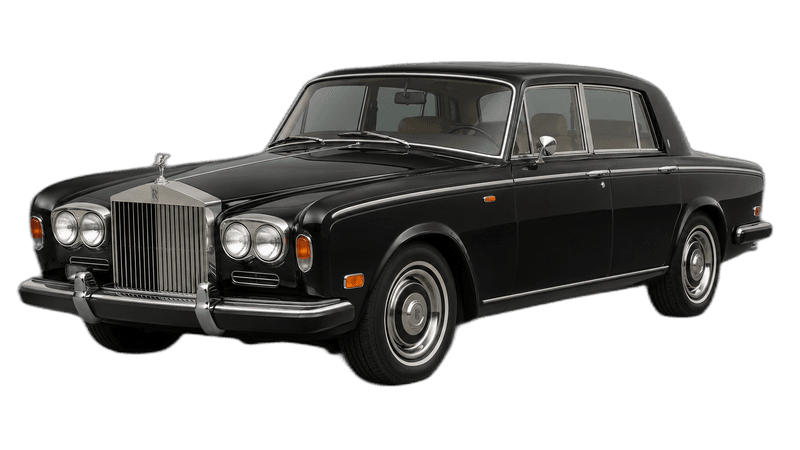
The picture at the top of this page shows a 1979 Silver Shadow II in Brewster Green, photographed on 30 May 2026 by the Commons contributor Mr.choppers and used under a CC BY-SA 4.0 licence. It looks like a North American car, with the larger rubber bumpers. We blurred its number plate and a passer-by in the background, cropped it and resized it. It shows the shape, not the specification of a European car.
Verdict
The Silver Shadow II in this guide is a 6.75L V8 naturally aspirated saloon with an estimated 189 bhp, a published estimate of 393 Nm, a road-test 10.7 seconds from 0-60 mph and a road-test 182 km/h, rear-wheel drive and built from 1977 to 1980. It is a big, quiet, slow-by-modern-standards car whose values rest on the condition of its hydraulics and bodywork rather than its numbers. If you are looking at one, take the figures as estimates, insist on history, have the hydraulic system and the underside checked by a specialist, and make sure you know whether it is a Rolls-Royce or a Bentley T2, a short or long wheelbase and a European or American car. We have not driven it, so use the sources and a proper inspection to decide.
Specifications
Engine
6.75L V8 naturally aspirated
Displacement
6.8L
Power
189 bhp
Torque
393 Nm
0-100 km/h
10.7s
Top Speed
182 km/h
Drivetrain
RWD
Country
UK
Body Style
4/5 seater sedan/saloon
Years
1977–1980
Production
8,425
Price Used
£35,000
Specifications are manufacturer-published figures.
More from Rolls-Royce



Frequently Asked Questions
What are the specifications of the Rolls-Royce Silver Shadow II?
The Rolls-Royce Silver Shadow II is a 4/5 seater sedan/saloon by Rolls-Royce, with 189 bhp, 393 Nm of torque, a 0-100 km/h time of 10.7 seconds and a top speed of 182 km/h. Indicative used value: approximately £35,000. Actual values vary with specification, condition and history.
How much does a Rolls-Royce Silver Shadow II cost?
Indicative used value: approximately £35,000. Actual values vary with specification, condition and history.
How many Rolls-Royce Silver Shadow II were made?
Rolls-Royce produced 8,425 units of the Rolls-Royce Silver Shadow II.
What drivetrain does the Rolls-Royce Silver Shadow II use?
The Rolls-Royce Silver Shadow II is configured with rear-wheel drive.
What type of car is the Rolls-Royce Silver Shadow II?
The Rolls-Royce Silver Shadow II is a luxury manufactured by Rolls-Royce in UK. Production ran from 1977 to 1980.