
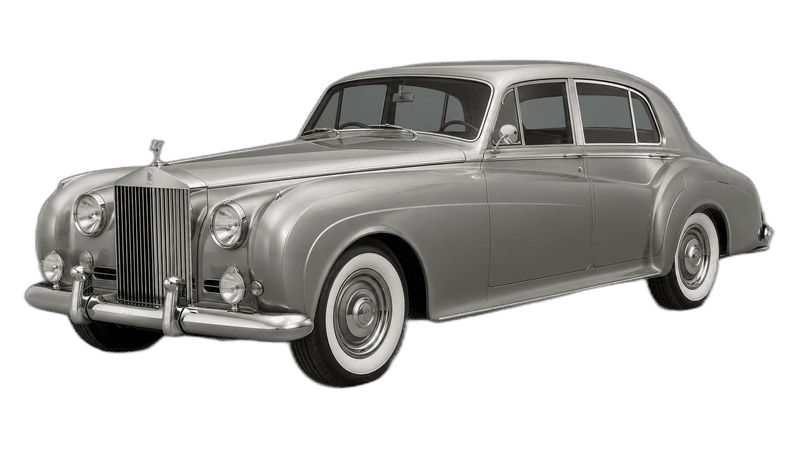
Rolls-Royce Silver Cloud III
£85,000
usedIndicative market price, updated periodically.
210bhp
Power
10.8s
0-100 km/h
185km/h
Top Speed
£85,000
Price Used
How hard it pulls.
Peak g-force the instant you bury the throttle, estimated from the car's 0–100 time and drivetrain.
Rolls-Royce Silver Cloud IIIEstimated peak launch g from the 0–100 time and drivetrain: an honest approximation, not a measured figure.
The Rolls-Royce Silver Cloud III is a 4-door saloon by Rolls-Royce, with 210 bhp, 460 Nm of torque, a 0-100 km/h time of 10.8 seconds and a top speed of 185 km/h. Indicative used value: approximately £85,000. Actual values vary with specification, condition and history.
Dream Car Garage Editorial · Last updated 2 November 2026
Overview
We have not driven this car. This review is based on published specifications and the sources listed below.
Scope of this guide
This guide is scoped to the standard-steel Rolls-Royce Silver Cloud III saloon, the short-wheelbase four-door car with the 6.2L V8 naturally aspirated petrol engine, four-speed automatic gearbox and rear-wheel drive that was announced in October 1962 and replaced by the Silver Shadow in October 1965. It is not a guide to the long-wheelbase saloon, to the coachbuilt cars (the fixed-head and drophead coupes by Mulliner Park Ward and the one-off bodies by other coachbuilders), to the Bentley S3, which shares the chassis and engine and is a sister car, or to the earlier Silver Cloud II. Where those cars differ we say so below, because an advert that says only "Silver Cloud III" can describe any of them.
We have not driven this model for this article. Everything here comes from three cited sources: Rolls-Royce Motor Cars' own press release for a 1965 coachbuilt Silver Cloud III, a PistonHeads classified listing for a 1963 saloon, and the government recall checker. We also read Motor Sport's September 1965 road test, Motor Sport's November 1965 report on the Silver Shadow, RM Sotheby's lot description for a 1966 car, a Bonhams lot description for a 1962 saloon, Wikipedia (the Silver Cloud article and the L-series V8 engine article), Autocade and the Rolls-Royce press history of the Silver Cloud. Where sources disagree we say so rather than pick a winner quietly. Nothing here is a valuation.
The figures at a glance
- Engine: 6.2L V8 naturally aspirated petrol, a 90-degree overhead-valve aluminium engine with two SU carburettors, called the L410 inside the company and first used in 1959. Motor Sport's road test gives a bore and stroke of 104.14 by 91.4 mm, which is 6,230 cc.
- Power: 210 bhp, which is our working estimate and not a manufacturer rating. Rolls-Royce never published a power figure for these cars. Its own modern press office says the engine delivers "around 210bhp". That is about 213 PS by our conversion (210 x 1.01387), assuming the press office means mechanical horsepower.
- Torque: 460 Nm, about 340 lb ft, again an estimate. We found no figure from the factory and only one third-party estimate, so treat the number as indicative.
- 0-100 km/h: 10.8 seconds. That is the 0-60 mph time quoted for the car, not a measured 0-100 km/h time, so a true 0-62 mph run would be a little slower.
- Top speed: 185 km/h, which is 115 mph. Motor Sport's 1965 test said 114 mph "or perhaps a little more".
- Drive: rear-wheel drive through a four-speed automatic gearbox derived from General Motors' Hydramatic, with a front-mounted engine.
- Weight: 4,640 lb (about 2,105 kg) on the Motor Sport test car. Wikipedia says the Series III was just over 100 kg lighter than the Series II.
Why the quoted power varies
Rolls-Royce published no output figure for the Silver Cloud III. The company said only that the new engine gave "perhaps 7%" more than the Silver Cloud II, according to Wikipedia. RM Sotheby's repeats the seven percent and lists 200 hp. Another site quotes eight percent, while Wikipedia's infobox lists 220 HP and labels it an estimate. A search summary of other listings turned up figures between 190 and 250 hp. Rolls-Royce's 2024 press release for a coachbuilt car says around 210 bhp, and that is the figure we use because it comes from the manufacturer, but it is a modern statement about a coupe that shares the saloon's engine, not a period specification. If you see a precise figure in an advert, ask where it came from.
The changes that produced the gain are better documented. For the Series III, Wikipedia says the carburettors grew from 1.75 inch to 2 inch SUs and the compression ratio rose to 9:1, with an 8:1 option for markets with poor fuel. Bonhams mentions a new distributor as well. Wikipedia adds a nitride-hardened crankshaft, fitted after reports of broken crankshafts in earlier V8s. That is worth remembering if you are looking at a car with a replacement or reconditioned engine, so ask which crankshaft is in it.
What the performance figures really are
The performance numbers are period claims, and none comes from a modern measured test. RM Sotheby's lot description gives a top speed of 115 mph and 0-60 mph in 10.8 seconds, and a search of auction results found the same pair repeated by other auction houses. A PistonHeads listing for a 1963 saloon says 10.1 seconds and a mean top speed of 114.3 mph, without naming its source. Motor Sport's September 1965 road test of a four-year-old car with nearly 50,000 miles recorded no 0-60 mph time at all. It said the car would reach 114 mph under favourable conditions, indicated 85 mph on an average straight road, and needed a motorway to reach 100 mph. We do not know of a trustworthy 0-100 km/h time, so our 10.8 seconds should be read as a 0-60 mph figure.
Motor Sport's other numbers show the character better than a stopwatch does. It recorded 11.7 mpg and a range of roughly 200 miles from a tank. It used half a gallon of oil in 1,245 miles. The kick-down upshifts came at about 26, 40 and 74 mph. It said the car "does not handle like a GT car, nor would one expect it to", and it praised the quietness, the brakes and the power steering. This is a heavy, soft, very quiet saloon, and the performance should be judged as such.
How the cars differ
The Silver Cloud III is a facelift and a mechanical update of the Silver Cloud II rather than a new car. The most visible change is the pair of horizontal headlamps on each side in place of single units, with the sidelights moved from the top of the wing and carrying the indicators. The bonnet line is lower and the radiator is about 1.5 inches shorter. Wikipedia says the interior was remodelled with wider front seats from January 1964 and a better rear window demister from November 1963.
Production counts disagree, and we want to be plain about that. Wikipedia gives 2,044 standard cars, 206 long-wheelbase cars and 328 coachbuilt cars. RM Sotheby's gives 2,044 plus 253 long-wheelbase cars. Autocade lists 2,809 cars including 253 long-wheelbase. The supercars.net page quotes 7,372 for the whole Silver Cloud series, so it is not a Series III figure. We keep 2,044 for the standard saloon and do not try to reconcile the others. Rolls-Royce's press office says only around 100 fixed-head coupes were built on the Silver Cloud III chassis, which gives a sense of how rare the coachbuilt cars are compared with the saloon.
Dates also differ. Wikipedia says the saloon was shown at the Paris Salon in October 1962 and gives 1963 to 1966 for standard production. Autocade says 1962 to 1965, Bonhams says production lasted until the autumn of 1965, and Motor Sport says the Silver Shadow superseded the Silver Cloud III on 6 October 1965. The PistonHeads listing describes a car delivered on 29 October 1962, so we use 1962 to 1965 for the saloon. One other site gives March 1966 as the end of the whole Silver Cloud line, which would include late coachbuilt chassis; we have not checked that.
Dimensions, steering and brakes
Wikipedia gives a wheelbase of 127 in (3,226 mm) and a length of 211.7 in. Motor Sport's test gives 17 ft 6.25 in, which is a little under 211 in, so the figures are close but not identical. The steering is a cam-and-roller power system with 4.25 turns from lock to lock and a turning circle of 41 ft 8 in. The brakes are drums, with two master cylinders, combined hydraulic and mechanical rear actuation and a gearbox-driven servo. They are powerful and light to use according to Motor Sport, but they are old technology.
What to check before buying
- Check the chassis number against the Rolls-Royce Enthusiasts' Club chassis records. The PistonHeads listing we read, for a car with chassis SAZ.37, mentions a history file with club records, invoices, MOT certificates and a touring spares package, which is the kind of paperwork to ask for.
- Confirm the body is a standard-steel short-wheelbase saloon and not a long-wheelbase or coachbuilt car.
- Read the engine description closely. That same listing states the engine as 5.2L, which is a data entry error, since the V8 is 6.2 litres, and it shows why a printed spec line is not proof.
- Ask what work the car has had on the power steering and brakes. The listing mentions power steering fettling, wheel refurbishment and a brake refresh, which is the sort of detail to look for.
- Inspect the steel body, wings, sills and floors for corrosion and poor repairs. This is general advice, not something our sources cover for this car, and we have no published figure for restoration cost.
- Test the automatic gearbox and the hydraulic systems on a long drive, not a short one.
- Get a specialist inspection from someone who knows the marque.
Recalls and the DVSA check
We ran no check on a specific car, because we are not looking at one. The government page says that for a car you can use the registration number, and that for a vehicle without one you need the manufacturer, model and year of manufacture. It says the service covers safety recalls and that the manufacturer tells you about recalls for any other reason. It states no start date, but this is a 1960s car and a weak fit for the checker: the manufacturer and model route may return nothing for a model built long before modern recall records, and a clean result would not mean the car is free of known faults. The page does say you must not drive a vehicle with a serious safety defect. We found no recall notice for the Silver Cloud III in any source, and absence from our sources is not a clean bill of health. Ask the Rolls-Royce Enthusiasts' Club or a marque specialist about service bulletins instead. The listing we read said the car was MOT exempt, which is normal for a car of this age, so do not assume a recent MOT has checked the brakes and steering.
About the photograph
The picture at the top of this page shows a 1964 Silver Cloud III saloon in burgundy and cream, photographed by Lothar Spurzem in October 2009 and shared on Wikimedia Commons under the CC BY-SA 2.0 de licence. The original carries a German show plate described as a fantasy registration. We blurred the plate, cropped the image to 16:9 and resized it. It shows a standard saloon, which is what this guide covers.
Verdict
The Silver Cloud III saloon in this guide is a 6.2L V8 naturally aspirated petrol, rear-wheel drive car with an estimated 210 bhp, an estimated 460 Nm, a claimed 10.8 seconds to 60 mph, treated here as the 0-100 km/h figure, and a top speed of about 185 km/h. It is a heavy, quiet, old-fashioned saloon, and its figures are all estimates or period claims. Buy on paperwork and a specialist inspection, check which body and which engine you are really looking at, and treat every published number with the caveats above. We have not driven it, so use the sources and a proper inspection to decide.
Specifications
Engine
6.2L V8 naturally aspirated petrol
Displacement
6.2L
Power
210 bhp
Torque
460 Nm
0-100 km/h
10.8s
Top Speed
185 km/h
Drivetrain
RWD
Country
UK
Body Style
4-door saloon
Years
1962–1965
Production
2,044
Price Used
£85,000
Specifications are manufacturer-published figures.
More from Rolls-Royce



Frequently Asked Questions
What are the specifications of the Rolls-Royce Silver Cloud III?
The Rolls-Royce Silver Cloud III is a 4-door saloon by Rolls-Royce, with 210 bhp, 460 Nm of torque, a 0-100 km/h time of 10.8 seconds and a top speed of 185 km/h. Indicative used value: approximately £85,000. Actual values vary with specification, condition and history.
How much does a Rolls-Royce Silver Cloud III cost?
Indicative used value: approximately £85,000. Actual values vary with specification, condition and history.
How many Rolls-Royce Silver Cloud III were made?
Rolls-Royce produced 2,044 units of the Rolls-Royce Silver Cloud III.
What drivetrain does the Rolls-Royce Silver Cloud III use?
The Rolls-Royce Silver Cloud III is configured with rear-wheel drive.
What type of car is the Rolls-Royce Silver Cloud III?
The Rolls-Royce Silver Cloud III is a luxury manufactured by Rolls-Royce in UK. Production ran from 1962 to 1965.