
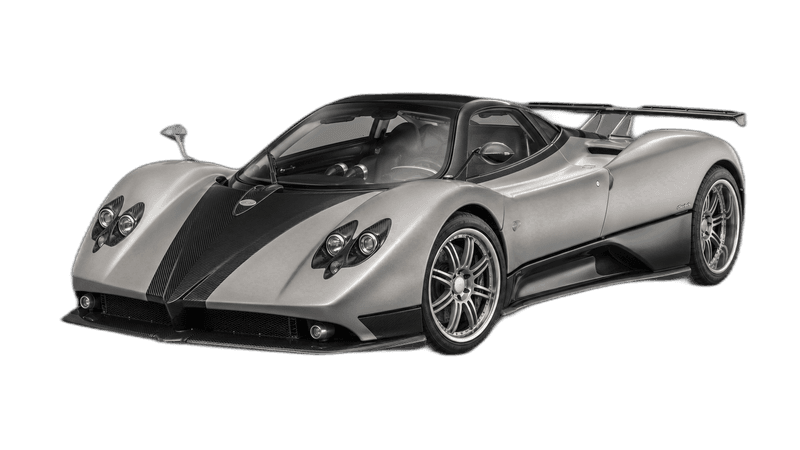
Pagani Zonda F
£1,750,000
usedIndicative market price, updated periodically.
594bhp
Power
3.6s
0-100 km/h
345km/h
Top Speed
£1,750,000
Price Used
How hard it pulls.
Peak g-force the instant you bury the throttle, estimated from the car's 0–100 time and drivetrain.
Pagani Zonda FEstimated peak launch g from the 0–100 time and drivetrain: an honest approximation, not a measured figure.
The Pagani Zonda F is a 2-door coupé by Pagani, with 594 bhp, 760 Nm of torque, a 0-100 km/h time of 3.6 seconds and a top speed of 345 km/h. Indicative used value: approximately £1,750,000. Actual values vary with specification, condition and history.
Dream Car Garage Editorial · Last updated 2 November 2026
Overview
We have not driven this car. This review is based on published specifications and the sources listed below.
Scope of this guide
This guide is scoped to the Pagani Zonda F coupe, the fixed-roof, two-seat, mid-engine, rear-wheel drive car with the 7.3L naturally aspirated AMG V12 petrol (7291 cc) engine in its standard 602 PS tune, first shown at the Geneva Motor Show in March 2005. The F stands for Fangio, after the Formula One champion Juan Manuel Fangio. It is not a guide to the Zonda F Roadster, which has its own guide in this catalogue, nor to the Zonda F Clubsport pack, the earlier Zonda S, or later one-off cars built on the same V12. We say below where those cars differ, so that you can tell which one an advert really describes.
We have not driven this model for this article. Everything here comes from three cited sources: the official Pagani page for the Zonda F, PistonHeads' road test by Nick Hall (20 February 2006), and the government recall checker. We also read a Wikipedia article and three Supercar Nostalgia pages (a technical appraisal by Ben Tyer dated 29 July 2023 and two sale write-ups), and we flag every point that rests on them. Where sources disagree we say so rather than pick a winner quietly. Prices and costs are history or single examples, not valuations.
The figures at a glance
- Engine: 7.3L naturally aspirated AMG V12 petrol (7291 cc), 60 degree vee, 48 valves, mounted behind the cabin.
- Power: 594 bhp, which is Pagani's 602 PS converted by us. Pagani prints "602 hp at 6150 rpm" next to 443 kW, and 443 kW is 602 PS, so its "hp" is the metric unit. 602 x 0.98632 is about 593.8, which we round to 594. PistonHeads prints 602bhp, which looks like the metric number under a different label.
- Torque: 760 Nm at 4,000 rpm, per Pagani. PistonHeads prints 560 lb ft, which is about 759 Nm.
- 0-100 km/h: 3.6 seconds, Pagani's own figure. It also lists 0-200 km/h in 9.8 seconds and 200-0 km/h braking in 4.4 seconds. PistonHeads timed 0-60 mph at 3.6s.
- Top speed: 345 km/h. Pagani prints "more than 345 km/h". PistonHeads says 216 mph but was not allowed to test it.
- Drive: rear-wheel drive and mid-engine, with a mechanical six-speed manual gearbox, a twin-plate clutch and a self-locking differential.
- Weight: 1,230 kg dry, which Pagani says is without the Comfort Pack and with carbon-ceramic brakes. PistonHeads says under 1,230 kg.
- Weight distribution: 46 per cent front and 54 per cent rear, per Pagani.
What the Zonda F was
Pagani's page describes the car as the high point of a friendship between Horacio Pagani and Juan Manuel Fangio, which began with a wish to use a Mercedes-Benz engine. The logo, design concept and name are all dedicated to Fangio. The page also says the F was the first car to offer, on client request, bodywork in natural exposed carbon fibre. Under the skin it has a central carbon-fibre safety cell, steel and carbon-fibre roll protection, chromium-molybdenum steel frames at each end, and carbon body panels. Pagani lists titanium, aluminium and Inconel parts, and says the exhaust manifolds follow Formula One practice.
PistonHeads' 2006 road test is a short first drive, not an ownership report. It praises zero body roll, strong grip and an easy-to-drive character, and it gives the new price as 478,000 euros. That is a launch price from 2006 and has no bearing on what a car costs now.
How many were built
For the coupe the count is clear but rests on secondary sources. Wikipedia says production of the Zonda F was limited to 25 cars. A Supercar Nostalgia sale write-up calls a 2006 car number 16 of the 25 coupes built, and says Pagani built 25 of each body style, 50 cars in all. PistonHeads said in 2006 that Pagani would build just 25 Fs, before the roadster existed. Pagani's own page gives no production number. We therefore use 25 coupes, as a figure from those secondary sources and not a manufacturer statement.
We also could not pin down when the coupe run ended. The same write-up has a coupe delivered in December 2006, and another Supercar Nostalgia article describes an F that was the Pagani show car at Geneva in March 2007. The technical appraisal says production ended in 2011 after 25 coupes and 25 roadsters, which is a combined statement. We give 2005 as the first year and no end year.
Why the quoted power and torque vary
The standard car is 602 PS, which is 594 bhp, and 760 Nm. Pagani's own page also lists 650 hp at 6,200 rpm and 780 Nm for a more powerful setting, marked as optional on special request, and its body text even quotes 650 HP and 780 Nm. Wikipedia gives that output to the Roadster F and describes a Clubsport with an upgraded engine. Supercar Nostalgia gives the Club Sport as 641 bhp and 575 lb ft, and says that pack adds more radical camshafts, an optimised intake and an Inconel exhaust, plus carbon brakes. In short, the figures on this page are for the 602 PS car. If an advert quotes 650 PS or 780 Nm it describes a different specification, or a car that has been changed.
Acceleration has the same problem. Pagani says 3.6 seconds to 100 km/h. Supercar Nostalgia says 0-62 mph in 3.5 seconds, and the PistonHeads 0-60 mph time is 3.6s. Those are manufacturer or road-test numbers from 2005 and 2006 and not a promise about any car today.
Drivetrain and layout
Pagani lists a longitudinal mid-engine layout with rear-wheel drive. Wikipedia says the transmission is largely that of the earlier C12 S with stronger internals and stronger differential gears, and Supercar Nostalgia says the six-speed manual has new ratios and an AP twin-plate clutch. PistonHeads does not state the drivetrain but describes a six-speed box. Nothing we read suggests any all-wheel drive F, and we make no claim about it.
How the Zonda F differs from other versions
The Zonda F Roadster debuted at Geneva in 2006 and is a separate car with its own guide. Wikipedia gives it 650 PS and 780 Nm with a quoted 3.4 seconds to 100 km/h and 350 km/h, and says production was limited to 25 units. The Clubsport pack is an option on the F and not a separate model, per the Supercar Nostalgia appraisal. The earlier Zonda S has the same 7.3 litre V12 at 555 bhp and 553 lb ft, according to the same appraisal, which says the F is 20 kg lighter. Wikipedia describes a later one-off 760 series with 760 PS and 780 Nm, and a PistonHeads piece (5 August 2025) describes a Zonda F-based car with Cinque-derived carbon aero and 760-style panels. If an advert mentions carbon aero, a Cinque specification, a roadster body or a Clubsport pack, it is not the standard car in this guide.
Chassis, brakes and wheels
Pagani lists four independent wheels with double wishbones, pull-rod springs and adjustable Öhlins dampers, plus a TRW power-assisted rack. The brakes are Brembo: steel discs of 380 x 34 mm at the front with six-piston calipers and 355 x 32 mm at the rear with four-piston calipers, with 380 mm carbon-ceramic discs optional. Wheels are forged aluminium and magnesium alloy, 19 inch at the front and 20 inch at the rear, fitted with Michelin Pilot Sport 2 tyres. Supercar Nostalgia gives the tyre sizes as 255/35 ZR20 at the front and 335/30 ZR20 at the rear, which does not match the 19 inch front wheel on Pagani's page. We have not resolved that, so check the wheel and tyre sizes on any car you view.
PistonHeads says the Kevlar front splitter grinds away over serious bumps and ruts and that replacing it would cost somewhere in the region of 10,000 euros. It also says the wider rear track has caused a few problems for some owners and gives no detail. Supercar Nostalgia says the 85 litre fuel tank carried over from earlier cars.
Running costs and parts
Costs in the sources are anecdotes. A coupe sold by RM Sotheby's in Paris had a new clutch and flywheel in December 2018 for 23,000 euros, and comprehensive maintenance in April 2024 at Pagani of Copenhagen for 10,300 euros. That is one owner's invoice trail, so it is a data point and not a price list. Pagani lists optional remote diagnosis with Texa Mobile Diagnostic. We found no service interval, insurance or parts price figures in our sources, so we give none.
What to check before buying
- Confirm the car is a coupe and not a roadster, and ask for the chassis number and the Pagani documentation.
- Confirm the power specification, since a 650 PS or Clubsport-pack car is a different specification from the standard 594 bhp car.
- Ask for the clutch and flywheel history, given the 2018 invoice above.
- Check the front splitter, underside and carbon panels for scrapes and repairs.
- Check the wheel and tyre sizes and the age of the tyres.
- Ask whether the car has carbon-ceramic or steel brakes and what has been replaced.
- Ask who has serviced it and whether the work was done by Pagani or a dealer.
- Ask what has been changed from the original specification, including any Cinque-style parts.
- Run the registration through the recall check described below.
Recalls and the DVSA check
PistonHeads does not mention any recall, and the Pagani page does not either. We did not find a recall list for the Zonda F and we did not run the government checker, which asks for a registration number or the manufacturer, model and year. The page says it shows safety recalls that have not been checked or fixed and the MOT history, and that the manufacturer will contact you directly about non-safety recalls. Run the registration through the check on GOV.UK, and ask a Pagani dealer to confirm anything open.
Verdict
The standard Zonda F coupe is 594 bhp and 760 Nm from a 7.3L naturally aspirated AMG V12 petrol (7291 cc), a quoted 3.6 seconds to 100 km/h and more than 345 km/h, rear-wheel drive and mid-engine, in a carbon-tub two-seater built in a run of about 25 coupes. It rewards an owner with specialist support and a long history file. If you are shopping for one, confirm which version it is, check it against the options above, and treat the published figures as claims with the caveats above. We have not driven it, so use the sources and a proper inspection to decide.
Specifications
Engine
7.3L naturally aspirated AMG V12 petrol (7291 cc)
Displacement
7.3L
Power
594 bhp
Torque
760 Nm
0-100 km/h
3.6s
Top Speed
345 km/h
Drivetrain
RWD
Country
Italy
Body Style
2-door coupé
Years
2005–present
Production
25
Price Used
£1,750,000
Specifications are manufacturer-published figures.
More from Pagani
Frequently Asked Questions
What are the specifications of the Pagani Zonda F?
The Pagani Zonda F is a 2-door coupé by Pagani, with 594 bhp, 760 Nm of torque, a 0-100 km/h time of 3.6 seconds and a top speed of 345 km/h. Indicative used value: approximately £1,750,000. Actual values vary with specification, condition and history.
How much does a Pagani Zonda F cost?
Indicative used value: approximately £1,750,000. Actual values vary with specification, condition and history.
How many Pagani Zonda F were made?
Pagani produced 25 units of the Pagani Zonda F.
What drivetrain does the Pagani Zonda F use?
The Pagani Zonda F is configured with rear-wheel drive.
What type of car is the Pagani Zonda F?
The Pagani Zonda F is a hypercars manufactured by Pagani in Italy. Production started in 2005.