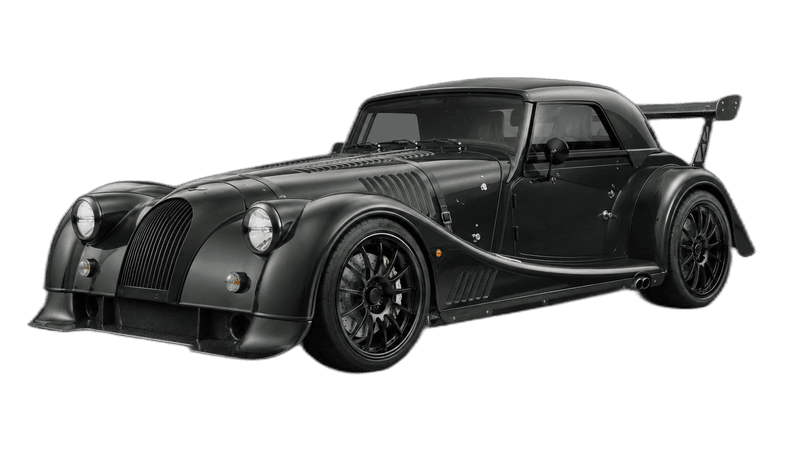
Morgan Aero 8
£55,000
usedIndicative market price, updated periodically.
362bhp
Power
4.5s
0-100 km/h
274km/h
Top Speed
£55,000
Price Used
The Morgan Aero 8 produces 362 bhp, reaches 100 km/h in 4.5 seconds and has a top speed of 274 km/h. A representative example is worth about £55,000.
How hard it pulls.
Peak g-force the instant you bury the throttle, estimated from the car's 0–100 time and drivetrain.
Morgan Aero 8Estimated peak launch g from the 0–100 time and drivetrain: an honest approximation, not a measured figure.
Dream Car Garage Editorial · Edited by José Teo Lorente Vallecillos · Last updated 2 November 2026
Overview
We have not driven this car. This review is based on published specifications and the sources listed below.
Scope of this guide
This guide is scoped to the Morgan Aero 8 Series 5, the fifth-generation soft-top car with the 4.8L N62B48 naturally aspirated V8 petrol engine, 362 bhp, rear-wheel drive, a manual or automatic gearbox and an aluminium chassis, revealed at the Geneva show in March 2015 and built until 2018. It is not a guide to the 4.4 litre Series 1, 2 and 3 cars of 2000 to 2007, to the Series 4 of 2007 to 2010, or to the Aero SuperSports, Aero Coupe, AeroMax and Aero GT. Where those cars differ we say so below, because an advert that says only "Aero 8" can describe any of them.
We have not driven this model for this article. Everything here comes from three cited sources: Morgan's own launch release for the fifth-generation Aero 8, hosted on motorshow.me, PistonHeads' used buying guide of 2 July 2023, and the government recall checker. We also read the Truth About Cars Geneva report, an Auto-Data specification page, the Malvern Observer report on the first Aero GT and Wikipedia, and we flag every point that rests on them. Where sources disagree we say so instead of choosing a winner quietly. Prices are history, not valuations.
The figures at a glance
- Engine: 4.8L N62B48 naturally aspirated V8 petrol, 4799 cc, supplied by BMW and mounted at the front (Wikipedia calls the layout front mid-engine). Morgan's release says only "4.8 litre V8 BMW engine". The N62B48 code comes from PistonHeads, Wikipedia and Auto-Data.
- Power: 362 bhp. Morgan's release prints 367bhp, and Auto-Data and the Truth About Cars also give 367 for the same engine. In BMW terms 367 is the metric figure (PS), and 367 divided by 1.01387 is about 362 bhp, so we store 362 bhp and treat Morgan's number as the PS figure printed with the wrong unit. We could not confirm that from Morgan. PistonHeads gives 370hp for the Series 5, which is a third value.
- Torque: 490 Nm, which Auto-Data prints as 490 Nm (361 lb ft). The Truth About Cars and PistonHeads give 370 lb ft for the same engine, which is about 502 Nm by our conversion, so the sources differ by about 12 Nm.
- 0-100 km/h: 4.5 seconds. The sources print 4.5 seconds for 0-62 mph, which is 99.8 km/h, so we treat it as the 0-100 km/h figure. We have not verified it on a road.
- Top speed: 274 km/h, our conversion of the roughly 170 mph that the Truth About Cars quotes for the Series 5 launch and PistonHeads quotes for the Aero GT. Auto-Data prints 273 km/h, and a snippet from a launch report said 270 km/h. These are claimed figures.
- Drive: rear-wheel drive through a six-speed manual or a six-speed automatic with paddle shift, and a new BMW limited-slip differential.
- Weight: 1180 kg (2601 lb), from Auto-Data and Wikipedia. Older Aero 8 figures in PistonHeads are lower, at about 1,132 kg for a Series 2.
What changed for the Series 5
Morgan's release said the new car signified a return to soft-top motoring in the Aero range. It has hand-sculpted aluminium bodywork, a rear-opening clamshell boot that tensions and hides a double-lined mohair hood, and an optional hardtop that turns it into a coupe. The aluminium chassis was given improved torsional stiffness and a revised front end, along with all-new suspension, anti-roll bars and the BMW limited-slip differential. PistonHeads says the chassis is about 10 percent stiffer and describes outboard wishbones with coil-over units. The interior gained a new dashboard layout, a new air-conditioning system and a long options list that includes touch-screen media and carbon seats. ABS with EBD, power steering, cruise control and airbags were fitted.
The release also said the Aero SuperSports and Coupe ended production in April 2015 and that Series 5 production would begin in the fourth quarter of 2015 in limited numbers. Morgan said it had delivered over 1250 Aero platform cars since 2000. That is why you will see both 2015 and 2016 as the first year in adverts: it is a late 2015 start, often sold as a 2016 car.
How the other Aero 8 cars differ
The Series 1 of 2000 to 2004 used BMW's M62 V8 with 282 bhp (286 PS), according to Wikipedia and PistonHeads, and just over 200 were built. The Series 2 of 2004 and 2005 brought the 4.4 litre N62B44 Valvetronic V8 with 333 bhp, and the Series 3 followed in 2005 to 2007. The Series 4 of 2007 to 2010 is the first with the 4.8 litre N62B48, rated at 362 bhp and 370 lb ft by PistonHeads, with a ZF six-speed automatic on offer for the first time. Wikipedia lists estimated 0-100 km/h times of 4.3 seconds for a manual and 4.1 seconds for an automatic, which are not the Series 5 numbers.
The Aero Coupe, a fixed-roof car from 2012, and the AeroMax and SuperSports are separate bodies with their own prices, so they are outside this guide. The Aero GT was the final run of eight cars with a manual gearbox, adjustable suspension and 367bhp, a claimed 4.5 seconds and 170 mph. The Malvern Observer reported the first car in May 2018, and PistonHeads says prices started at 144,000 pounds.
What the sources disagree on
Three things are loose. The first is power: 362, 367 and 370 hp all appear for the same engine, and only some of that is a unit difference. The second is torque, 490 Nm against 370 lb ft. The third is performance, where Auto-Data prints 4.5 seconds and one specification database we saw only in a search snippet printed 4.2. We did not use that figure. None of these tells you what a used car will do.
We could not confirm how many Series 5 cars were built. Dealer listings and enthusiast sites say 160, but we did not find that on a manufacturer page and the count may or may not include the eight Aero GT cars. Our catalogue therefore gives no production figure.
Running costs and what tends to fail
PistonHeads says Morgan's fixed prices at the time of its guide were 70 pounds for a health check, 542 pounds for an interval service and 898 pounds for a full service, excluding VAT, with a 10,000 mile interval. Treat those as dated. The guide covers the Series 5 only briefly, so most of its fault list is about the N62 V8 in general.
- Valve seal wear, which shows as smoking and heavy oil consumption.
- Oil leaks from the valve cover, the alternator bracket gasket and the coolant transfer pipe. The coolant pipe repair can need the cylinder heads off, though an aftermarket fix avoids that.
- A dry, hardening oil filter O-ring that weeps.
- Rear axle pinion seal weeps.
- Hood and windscreen seals that let water in, a point PistonHeads makes mainly about the earlier cars.
PistonHeads also advises a trickle charger for the gel battery and evidence of the first 1,000 mile service. We have not checked whether these are all present on a Series 5, so treat them as a prompt for questions.
What to check before buying
- Confirm the series from the chassis number and the build date, and ask Morgan to confirm the specification, since an advert may mix Series 4 and Series 5 figures.
- Ask which gearbox it has. The sources say manual or automatic, and one specification database, seen only in a search snippet, listed a lower top speed for the automatic.
- Look for service history at Morgan or a specialist, and for the work listed above.
- Check the hood, the hardtop if fitted, the boot hinge and the seals for water ingress.
- Inspect the aluminium bodywork and chassis for accident repair. PistonHeads describes the chassis construction but raises no corrosion concern, and we have not checked this independently.
- Examine the tyres and wheels for damage and ask which options were fitted.
- Take an independent specialist inspection, because there is no large dealer network.
Recalls and the DVSA check
We did not run the government checker, because we are not looking at a specific car. The page says that for a car you can use the registration number to see unfixed safety recalls, and that if you have no registration you need the manufacturer, model and year. It also says the manufacturer will tell you if a car has been recalled for a reason other than safety, and that you should not drive a car if a serious defect letter says so. We found no recall for the Series 5 Aero 8 in any other source, and absence from our sources is not a clean bill of health, so run the check on the actual car and ask Morgan about any service bulletin.
About the photograph
The picture at the top of this page was taken in Warwick and is described on Wikimedia Commons as a 2017 Morgan Aero 8 4.8. It is by Vauxford under a CC BY-SA 4.0 licence, cropped to a wide frame and resized. We believe, from the 2017 date and the shape of the front end, that it is a Series 5 car, but Commons does not say so. The front number plate was already blank in the original.
Verdict
The Aero 8 Series 5 in this guide is a hand-built, rear-wheel drive soft-top with a BMW V8 of 4799 cc, 362 bhp, 490 Nm, a claimed 4.5 seconds to 100 km/h and a claimed top speed near 274 km/h, built in limited numbers from late 2015 to 2018. It is rare, and the paperwork and condition matter more than the headline figures. Confirm which series you are looking at, check the hood and engine leaks, run the recall check and get a specialist inspection. We have not driven it, so use the sources and a proper inspection to decide.
Specifications
| Engine | 4.8L N62B48 naturally aspirated V8 petrol |
|---|---|
| Displacement | 4.8L |
| Power | 362 bhp |
| Torque | 490 Nm |
| 0-100 km/h | 4.5s |
| Top Speed | 274 km/h |
| Drivetrain | RWD |
| Country | UK |
| Body Style | 2 seater convertible/cabriolet |
| Years | 2015–2018 |
| Price Used | £55,000 |
Specifications are manufacturer-published figures.
Frequently Asked Questions
What is a Morgan Aero 8 worth?
A representative example is worth about £55,000. Actual values vary with specification, condition and history.
How much power does the Morgan Aero 8 have?
The Morgan Aero 8 produces 362 bhp and 490 Nm of torque.
How fast is the Morgan Aero 8 from 0 to 100 km/h?
The Morgan Aero 8 accelerates from 0 to 100 km/h in 4.5 seconds.
What is the top speed of the Morgan Aero 8?
The Morgan Aero 8 has a top speed of 274 km/h.
What engine does the Morgan Aero 8 have?
The Morgan Aero 8 uses a 4.8L N62B48 naturally aspirated V8 petrol.
When was the Morgan Aero 8 built?
The Morgan Aero 8 was built from 2015 to 2018.
Is the Morgan Aero 8 all-wheel drive?
No. The Morgan Aero 8 is configured with rear-wheel drive.