
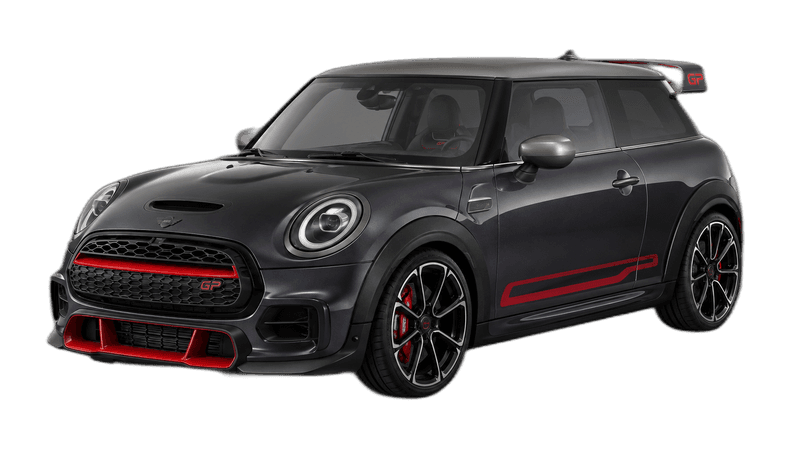
MINI JCW GP (F56)
£35,000
usedIndicative market price, updated periodically.
302bhp
Power
5.2s
0-100 km/h
265km/h
Top Speed
£35,000
Price Used
How hard it pulls.
Peak g-force the instant you bury the throttle, estimated from the car's 0–100 time and drivetrain.
MINI JCW GP (F56)Estimated peak launch g from the 0–100 time and drivetrain: an honest approximation, not a measured figure.
The MINI JCW GP (F56) is a 3-door hatchback (2-seat) by MINI, with 302 bhp, 450 Nm of torque, a 0-100 km/h time of 5.2 seconds and a top speed of 265 km/h. Indicative used value: approximately £35,000. Actual values vary with specification, condition and history.
Dream Car Garage Editorial · Last updated 2 November 2026
Overview
We have not driven this car. This review is based on published specifications and the sources listed below.
The two-seat, front-wheel-drive GP
The John Cooper Works GP is the most extreme MINI of its generation: a three-door F56 hatchback with the rear seats removed, a wide-arch body kit, a big rear wing and an automatic gearbox. This guide is scoped to the 2020 F56 John Cooper Works GP, the third car to carry the GP name, and not to the standard F56 John Cooper Works or to the earlier GP models. Our catalogue lists a 2.0L turbocharged inline-4 petrol engine (1,998 cc) producing 302 bhp and 450 Nm, with 0 to 100 km/h in 5.2 seconds, a top speed of 265 km/h, an eight-speed automatic gearbox and front-wheel drive. We have not driven this model for this article. This is a desk-researched ownership guide built from the BMW Group newsroom's MINI timeline, a PistonHeads used buying guide published in March 2024 and the government recall check, plus a few clearly named secondary reads where those three are silent. The PistonHeads author calls the data on weight and power hard to pin down with absolute certainty, and we have tried to say where our figures are approximate.
The car was announced on 20 November 2019 and shown at the Los Angeles show that month. It went on sale in 2020 and was built at MINI's Oxford plant. Our catalogue lists it as a 2020 to 2021 model, because PistonHeads says most used examples were registered in 2020 and some in 2021. We found no official statement of the last build date, so treat the end year as approximate.
Checking the figures
MINI's launch release, which we read as reproduced on the motoring site Motoringfile, gives 225 kW and 306 hp, and 450 Nm of torque from 1,750 to 4,500 rpm. The hp in that figure is the metric horsepower, 306 PS. Converted, that is about 302 bhp, which is the number in our catalogue and the one evo printed at launch. PistonHeads prints 306 hp at 5,000 to 6,250 rpm and 332 lb ft from 1,750 to 4,500 rpm, which is the same 450 Nm. So an advert that says 306 PS, 306 hp, 225 kW or 302 bhp describes one engine. Note that the same Motoringfile page carries a headline reading 301 hp, which we read as a rounding of the same figure and not a different tune.
The same release gives 5.2 seconds for 0 to 100 km/h and a top speed of 265 km/h that it says is not electronically limited. PistonHeads and evo both print 5.2 seconds for 0 to 62 mph and 164 mph, which is the same 265 km/h. A search summary of a Spanish data sheet gave 4.9 seconds and 250 km/h, but we could not read that page and it conflicts with every source we did read, so we do not use it. PistonHeads gives a weight of 1,255 kg and up to 70 kg less than a standard John Cooper Works, which it quotes alongside 241 hp per tonne. Treat the weight as approximate. The same guide quotes 38.7 mpg and 167 g/km of CO2.
Do not confuse this car with its predecessors. PistonHeads lists the 2006 R53 supercharged 1.6 S Works GP at 215 hp and 1,090 kg, and the R56 John Cooper Works GP of the early 2010s at 215 hp and 1,160 kg. The R56 is dated 2013 by PistonHeads, and other sources give 2012, so check the car you are viewing against its V5C date. Those cars share a name and not an engine, a gearbox or a layout with the F56 GP.
Production and numbering
BMW Group's newsroom timeline says the car would be built at Plant Oxford in a limited run of 3,000 vehicles globally, 575 of which were for UK customers. That is the official source for the production count in our catalogue. MINI's launch release, as reproduced by Motoringfile, says the cars are individually numbered from 0001 to 3000, and PistonHeads says each car carries its build number, which also appears in a Union Jack on the roof. Check that the number on the car matches the paperwork. A car that has been repainted, had its roof wrapped or had its body panels replaced should come with a clear explanation, because the numbering is part of what you are paying for. The UK allocation is small: PistonHeads said in March 2024 that fewer than a dozen were for sale in the country.
Engine and gearbox
PistonHeads describes the engine as a 1,998 cc, 16-valve turbocharged four-cylinder based on BMW's B48, which has been used in many BMWs since 2014. It says the engine has a reputation as a very reliable workhorse, with forged rods and crankshaft from the start, and that the GP received a stronger crank, bigger main bearings and lower-compression pistons. It says the GP avoided the crank bearing and oil solenoid problems of earlier F56 Cooper S cars. At higher mileage it lists occasional valve cover oil leaks, odd air leaks and cracks in the plastic oil filter housing. Look for oil around the top of the engine and ask whether anything has been replaced.
The gearbox is an eight-speed Steptronic sports automatic. PistonHeads identifies it as an Aisin torque-converter unit and not a dual-clutch, rated for more than 350 lb ft. It says the gearbox never felt all that energised, sometimes gave a harsh downshift into second, and that torque steer is quite noticeable. No manual was offered. Servicing intervals quoted by PistonHeads are two years or 18,000 miles, whichever comes first, but a car driven hard may suit a shorter oil interval, so ask what the previous owner actually did. Check for stored fault codes and any remap, which would change the figures above.
Chassis, brakes and wheels
MINI describes a mechanical front differential lock networked with the stability control, locking by up to 31 percent under load. PistonHeads says the GP sits 10 mm lower than the standard car, with 40 mm wider tracks, more camber, firmer engine mounts and bushes, and passive dampers only with no adaptive option. Its author criticises the tendency to tramline, the way the car squirms under power, the lack of steering feel and the way it copes with potholes. It also says front suspension control arms are prone to wear and can cause knocking, so listen on a bumpy road and ask for evidence of any replacement.
Brakes are four-piston fixed aluminium calipers with 360 mm front discs, and single-piston floating calipers at the rear. PistonHeads gives the rear discs as 330 mm. The wheels are lightweight 18-inch forged alloys, 8 J wide per MINI and under 9 kg each, with 225/35 tyres. PistonHeads lists the tyres as Hankook, naming an Evo Z or a semi-slick TD. Tyres this low and wide wear fast and are expensive, and the two fronts do the driving and the steering, so check both for uneven wear, which can point to alignment problems or hard use. Inspect the forged wheels for kerb damage and the discs for lipping.
Body, interior and electronics
The GP has a deeper front bumper with a redesigned splitter, carbon fibre wheelarch spats, a roof spoiler and twin stainless steel exhaust outlets. PistonHeads says the colours were restricted to Racing Grey, with roof and mirror caps in Melting Silver and a spoiler in Racing Grey or Chili Red. Inside there are GP Sport bucket seats in Dinamica fabric and leather, and the rear seats are replaced by a steel crossmember and a rally net, so this is a two-seater. That makes it impractical for families.
PistonHeads lists used-car issues including rubbed paint in the door shut areas, fading plastics, clouding in the door mirrors and misted headlights, and says these are unlikely to show on relatively recent cars. It also reports a few electronics problems, such as the sat nav and the steering wheel horn push, and the occasional dash creak, while saying the F56 has held up very well overall. Test every screen function, the horn, the sat nav and the lights, and look closely at the arch spats, splitter and wing for cracks, scrapes or poorly matched repairs, because a car this low picks up front-end damage.
Recalls and history
PistonHeads mentions a spring 2022 recall covering a coolant ventilation line, but its author believes it only affected US cars. We did not find a UK recall list for this model from MINI or DVSA that we could read, so we cannot say whether any campaign applies to a particular car. Enter the registration in the DVSA vehicle recall service, and ask a MINI dealer to check the VIN for open campaigns. Ask for the full service history, any accident repair evidence and a list of modifications. Cars of this type attract track use, so ask directly about it.
Buying decision
PistonHeads' verdict is critical of how the car was developed. Its author questions the removal of the rear seats, the choice of an automatic and the reliance on marketing language in place of chassis work, but says strong power, styling and rarity keep used values firm. The author also suggests some of the car's reputation for being hard to drive may be exaggerated. The car was pitched against hot hatches such as the Civic Type R and the Megane RS 300 Trophy. In our view it is a limited, numbered, front-wheel-drive collector's car first and a hot hatch second, so buy the best-documented example you can find. Prefer a car with a clear history, matching tyres in good condition, no unexplained bodywork and a clean recall record, and compare current adverts instead of relying on a price quoted here.
Specifications
Engine
2.0L turbocharged B48 inline-4 petrol
Displacement
2.0L
Power
302 bhp
Torque
450 Nm
0-100 km/h
5.2s
Top Speed
265 km/h
Drivetrain
FWD
Country
UK
Body Style
3-door hatchback (2-seat)
Years
2020–2021
Production
3,000
Price Used
£35,000
Specifications are manufacturer-published figures.
More from MINI
Frequently Asked Questions
What are the specifications of the MINI JCW GP (F56)?
The MINI JCW GP (F56) is a 3-door hatchback (2-seat) by MINI, with 302 bhp, 450 Nm of torque, a 0-100 km/h time of 5.2 seconds and a top speed of 265 km/h. Indicative used value: approximately £35,000. Actual values vary with specification, condition and history.
How much does a MINI JCW GP (F56) cost?
Indicative used value: approximately £35,000. Actual values vary with specification, condition and history.
How many MINI JCW GP (F56) were made?
MINI produced 3,000 units of the MINI JCW GP (F56).
What drivetrain does the MINI JCW GP (F56) use?
The MINI JCW GP (F56) is configured with front-wheel drive.
What type of car is the MINI JCW GP (F56)?
The MINI JCW GP (F56) is a hot hatches manufactured by MINI in UK. Production ran from 2020 to 2021.