
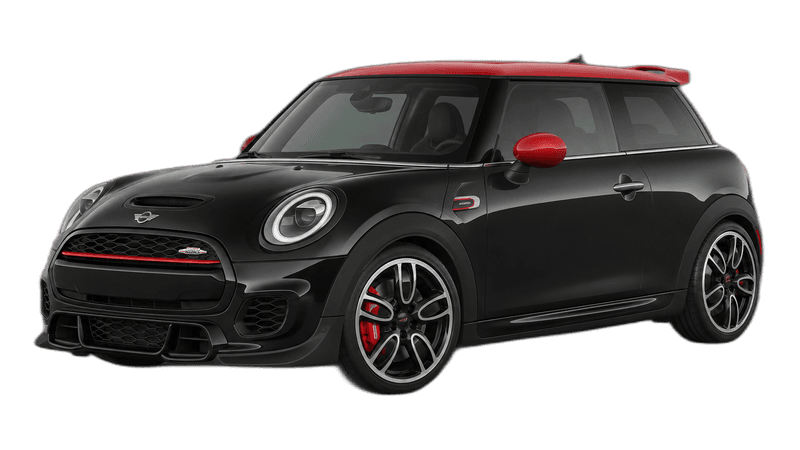
MINI JCW (F56)
£22,000
usedIndicative market price, updated periodically.
228bhp
Power
6.3s
0-100 km/h
246km/h
Top Speed
£22,000
Price Used
How hard it pulls.
Peak g-force the instant you bury the throttle, estimated from the car's 0–100 time and drivetrain.
MINI JCW (F56)Estimated peak launch g from the 0–100 time and drivetrain: an honest approximation, not a measured figure.
The MINI JCW (F56) is a 3-door hatchback by MINI, with 228 bhp, 320 Nm of torque, a 0-100 km/h time of 6.3 seconds and a top speed of 246 km/h. Indicative used value: approximately £22,000. Actual values vary with specification, condition and history.
Dream Car Garage Editorial · Last updated 2 November 2026
Overview
We have not driven this car. This review is based on published specifications and the sources listed below.
The MINI John Cooper Works in its F56 generation is the three-door hatchback described in BMW Group's launch press kit, with a 2.0-litre turbocharged petrol engine driving the front wheels. This guide covers the 2015 launch-specification three-door JCW with the 231 PS engine. It does not cover the JCW Challenge, the GP or post-2018 facelift cars, whose specification differs, and it does not cover the convertible or the five-door cars. Our catalogue lists the car with the 2.0L turbocharged inline-4 petrol (TwinPower Turbo) engine, 228 bhp, 320 Nm, 0 to 100 km/h in 6.3 seconds and a 246 km/h top speed. We have not driven this model for this article. This is a desk-researched ownership guide built from two sources: the BMW Group PressClub press kit for the new MINI John Cooper Works of 7 May 2015, read as an archived copy, and the PistonHeads used buying guide to the Cooper S and JCW of February 2022. We did not consult the government recall check for this article, and you should use it yourself. The PistonHeads guide is written mainly around the Cooper S, so we use its comments only where they plainly apply to the JCW and say where they cover the whole F56 family.
Checking the figures
The press kit gives the output as 170 kW and 231 hp, at 5,200 to 6,000 rpm. That hp figure is the metric horsepower (PS) unit, not the mechanical horsepower used in most British adverts. We multiplied 231 by 0.9863 to get 227.8, which we round to 228 bhp for the catalogue, and the conversion is ours, not BMW's. PistonHeads writes 231hp for the JCW as well, so both sources agree on the underlying number.
Torque is 320 Nm according to the press kit, which says it is 23 per cent more than the predecessor. PistonHeads gives 236 lb ft for the JCW, which converts to the same figure. The torque band is given slightly differently. The press kit gives the peak as available from 1,250 to 4,800 rpm, while PistonHeads prints a single range of 1,250 to 4,750 rpm for both the Cooper S and the JCW.
BMW states 0 to 100 km/h in 6.3 seconds with the manual gearbox and 6.1 seconds with the automatic, and a top speed of 246 km/h for both. PistonHeads lists 6.3 seconds for 0 to 62 mph on the manual and 153 mph, which converts to about 246 km/h. PistonHeads marks its 0 to 62 mph row as manual for both cars. Note that 0 to 62 mph is not exactly 0 to 100 km/h, so treat the two 6.3 second figures as close but not identical measures.
Fuel economy is where the two sources are hardest to reconcile. The press kit gives 6.7 litres per 100 km and 155 g/km of CO2 for the manual car, and 5.7 litres per 100 km and 133 g/km for the automatic. PistonHeads prints 42.2 mpg together with 133 g/km for the JCW. Our own conversion of 6.7 litres per 100 km is about 42 mpg, so the mpg figure appears to belong to the manual car, while 133 g/km belongs to the automatic in BMW's figures. Both are laboratory figures from the European cycle, and PistonHeads itself says that 30 to 40 mpg is typical in real driving.
Other differences are worth knowing. PistonHeads gives a kerb weight of 1,280 kg, but the press kit gives no weight figure and says only that vehicle weight is the same as the predecessor when adjusted for equipment, and PistonHeads warns that weight and power data are hard to pin down. PistonHeads also says the JCW began life with the six-speed Steptronic automatic only, which does not match the press kit, where the six-speed manual is standard and the automatic is an option, and PistonHeads' own later remark that four out of five JCWs were manuals. Finally, PistonHeads says the JCW did not pass Euro 6 regulations at the time of the 2018 facelift, yet the press kit lists the launch car as meeting EU6. We take the BMW wording as the launch position. Neither source gives the output of the later particulate-filter car, so do not assume it matches these figures.
Engine and gearbox
The press kit calls it the most powerful engine fitted to a production MINI to that date: a 1,998 cc four-cylinder with MINI TwinPower Turbo Technology, meaning turbocharging, direct injection, fully variable valve control and variable camshaft control. PistonHeads identifies the engine as the aluminium B48 two-litre with a twin-scroll turbo, Valvetronic and double VANOS, shared with several BMW models, and says the JCW joined the range in 2015.
On reliability, PistonHeads is positive. It says the B48 does not carry the negative legacies of earlier MINI engines, such as problems with crank bearings and oil solenoids, and calls it sturdy and reliable in general. It still advises checking the oil level as a matter of principle, and mentions a few reports of injector trouble and air leaks. Ask the seller how often the oil has been checked and changed, and whether any of those faults were dealt with. PistonHeads also lists broken engine mounts (a thud on start up), a faulty fuel tank vent valve (high idle and ticking) and turbo wastegate fault codes that can sometimes be traced back to unstable voltage from old batteries, all as family-wide comments for the Cooper S and JCW.
PistonHeads also reports that the factory JCW Pro exhaust gained a reputation for droning on the motorway, and that the standard JCW exhaust was loud enough for most. It says a simple remap with that exhaust can reach around 270 hp, which it describes as about the limit for the pistons in the Cooper S. That is a Cooper S comment, so we would not assume the same ceiling for a JCW.
The standard gearbox is the six-speed manual, and PistonHeads says, of the F56 family and not the JCW specifically, that it works well but can feel springy and slightly notchy. For the Cooper S and JCW together, it says jerky gear changes can often be traced to a clutch delay valve in the slave cylinder, which can be removed. It also reports, for the F56 family in general, that manual clutches are known to squeak, quietly when cold and more loudly when warm, and that MINI had not found a lasting fix, with some owners seeing the noise return in under 10,000 miles after a full clutch replacement. Check the clutch bite point, listen for squeaks and ask for invoices.
The optional automatic in the press kit is the six-speed Steptronic sports transmission. PistonHeads says that the pre-facelift automatic was an option and was not the quickest to respond, and adds that it had no paddles, in a passage about the automatic in general. The press kit says the JCW steering wheel carries shift paddles in conjunction with the automatic, so confirm on the car you are viewing whether paddles are fitted. PistonHeads says the eight-speed automatic arrived on the JCW with the facelift, which falls outside this guide.
Chassis, brakes and wheels
The press kit says the suspension was tuned to suit the power, with a newly developed Brembo sports brake system, 17-inch John Cooper Works Race Spoke alloy wheels, electromechanical steering with Servotronic and a stability system that includes Dynamic Traction Control, Electronic Differential Lock Control and Performance Control. Dynamic Damper Control was optional. PistonHeads calls them Variable Damper Control, a different name from the press kit's Dynamic Damper Control, and says the passive dampers are stiff, so Variable Damper Control is well worth having on both Cooper S and JCW cars.
PistonHeads describes the F56 as less frenetic than the car before it, with steering that is positive and accurate but a little artificial, and minimal torque steer. It says the steering can feel artificially heavy in Sport mode, and that the JCW has the same Performance Control electronic differential function as the Cooper S, with uprated springs, dampers and anti-roll bars compared to the old JCW.
On wheels and tyres, PistonHeads says the JCW has 17-inch alloys as standard with 18-inch wheels optional, and that few people rated the Pirelli run-flat tyres fitted from the factory. It says most drivers found Michelin Pilot Sport 4 tyres better for grip and ride comfort.
Brakes are the other item to inspect. In its general F56 comments, PistonHeads reports that pads wore out quite quickly and that a two-yearly main service including front pads typically ran to a few hundred pounds, which is a dated figure we do not repeat. The press kit mentions the Brembo system but gives no pad or disc life. Look at disc condition, ask when pads and discs were last done, and check for warning lights.
Body, interior and electronics
The press kit lists a model-specific front apron with large cooling air inlets in place of the fog lamps, distinctive side sills and rear apron, a John Cooper Works rear spoiler, LED headlamps with white direction indicators, a wheel arch surround and a sports exhaust with special tailpipes. It says Rebel Green paint was available only on the new JCW. The car is 3,874 mm long, 1,727 mm wide and 1,414 mm high on a 2,495 mm wheelbase, according to BMW. PistonHeads notes that the JCW has gaping front air intakes and extra ducts in place of the fog lights, and that only one of those ducts is functional with the other blanked off. Check that the front end looks complete and consistent, and look for mismatched panels.
PistonHeads says, for F56 cars generally, to check the door shut paint, which the seals can rub off. For the F56 family it reports one owner who was quoted for new gloss black pillar sections and a scuttle panel alongside a replacement windscreen after a crack, so a windscreen claim may not be as simple as it looks. It also says there are quite a few crash-repaired F56 cars on the market, in listings that are mostly Cooper S cars, so ask for evidence of any accident repair and look closely at panel gaps and paint texture.
Inside, the press kit lists JCW sports seats in Dinamica and fabric with integrated headrests, a JCW steering wheel, stainless steel pedals, an anthracite roof liner and MINI Driving Modes as standard. Options include a head-up display, Harman Kardon audio, navigation, a camera-based driving assistant and a glass roof. PistonHeads says the JCW seats are Dinamica with JCW badging, and that many people found the high-backed seats more supportive than the flatter ones on lesser models. It also warns, of MINIs in general, that the leather on steering wheels is not that durable (the JCW seats are Dinamica, so that part may not apply), that the horn push can fail to sound, and that some S models had badly routed air conditioning drainage which wet the front carpets.
For electronics, the press kit describes the connected infotainment programme and an optional Excitement package with an interactive LED light ring. PistonHeads mentions an 8.8-inch central display with an LED light ring and says digital radio, keyless entry and Bluetooth are standard.
Recalls and history
Neither source supplies a recall list for the F56 JCW, and we do not state recall numbers or dates. The BMW press kit is a launch document from 7 May 2015 and says nothing about later campaigns, and the PistonHeads guide, written in 2022, does not mention recalls. Enter the registration into the government recall check, ask a MINI dealer about open campaigns and software updates for the specific chassis, and ask the seller for dealer invoices showing what was done. Ask for the full service history, any accident repair records and the paperwork for modifications such as remaps, exhausts or suspension changes. PistonHeads reports that these cars were often heavily personalised through the options list, and says that expensively optioned cars rarely fetch a premium secondhand, so do not pay extra for options without checking they work.
Buying decision
The PistonHeads verdict is that the third-generation Cooper S and JCW were thoughtfully improved cars that challenged the Fiesta ST for best-in-class driving honours, with extra practicality and space and without losing the charm. It says the B48 is all about mid-range torque, that the useful performance sits between 2,000 and 4,000 rpm, and that these MINIs deliver strong pace without feeling hot in the old-fashioned sense. PistonHeads gives asking prices from early 2022, which we have left out as dated: compare current adverts and confirm the specification of each car, because the launch JCW, the Challenge and the later facelift cars are different propositions.
Our practical advice follows from the two sources. Prefer a car with a clean government recall check, a documented service history, evidence on the clutch and engine mounts, working adaptive dampers if fitted, and a clear record of any tuning. Be wary of crash-repaired cars without proper documentation. Because this guide is desk-researched from a launch press kit and one combined used buying guide, a pre-purchase inspection by someone who knows these cars is worth more than anything we have written here.
Specifications
Engine
2.0L turbocharged inline-4 petrol (TwinPower Turbo)
Displacement
2.0L
Power
228 bhp
Torque
320 Nm
0-100 km/h
6.3s
Top Speed
246 km/h
Drivetrain
FWD
Country
UK
Body Style
3-door hatchback
Years
2015–present
Price Used
£22,000
Specifications are manufacturer-published figures.
More from MINI
Frequently Asked Questions
What are the specifications of the MINI JCW (F56)?
The MINI JCW (F56) is a 3-door hatchback by MINI, with 228 bhp, 320 Nm of torque, a 0-100 km/h time of 6.3 seconds and a top speed of 246 km/h. Indicative used value: approximately £22,000. Actual values vary with specification, condition and history.
How much does a MINI JCW (F56) cost?
Indicative used value: approximately £22,000. Actual values vary with specification, condition and history.
What drivetrain does the MINI JCW (F56) use?
The MINI JCW (F56) is configured with front-wheel drive.
What type of car is the MINI JCW (F56)?
The MINI JCW (F56) is a hot hatches manufactured by MINI in UK. Production started in 2015.