
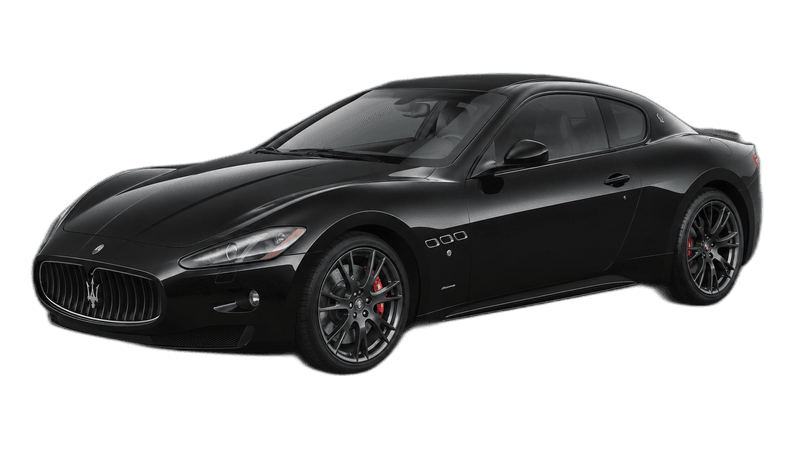
Maserati GranTurismo MC
£52,000
usedIndicative market price, updated periodically.
454bhp
Power
4.5s
0-100 km/h
303km/h
Top Speed
£52,000
Price Used
How hard it pulls.
Peak g-force the instant you bury the throttle, estimated from the car's 0–100 time and drivetrain.
Maserati GranTurismo MCEstimated peak launch g from the 0–100 time and drivetrain: an honest approximation, not a measured figure.
The Maserati GranTurismo MC is a coupe by Maserati, with 454 bhp, 520 Nm of torque, a 0-100 km/h time of 4.5 seconds and a top speed of 303 km/h. Indicative used value: approximately £52,000. Actual values vary with specification, condition and history.
Dream Car Garage Editorial · Last updated 2 November 2026
Overview
We have not driven this car. This review is based on published specifications and the sources listed below.
A 4.7 V8 coupe that went back to four seats
The Maserati GranTurismo MC Stradale is the hardest-edged road car in the GranTurismo family: a front-engined, rear-wheel-drive coupe with a naturally aspirated Maserati V8, a robotised six-speed transaxle, carbon-ceramic brakes and a track-derived aero kit. Our catalogue describes it as a 4.7L naturally aspirated V8 petrol car with 454 bhp and 520 Nm, reaching 100 km/h in 4.5 seconds and a top speed of 303 km/h. This guide is scoped to the four-seat GranTurismo MC Stradale introduced in 2013. It is not about the two-seat MC Stradale of 2010 to 2012, the GranCabrio MC, or the ordinary GranTurismo and GranTurismo Sport, and we explain below why that matters for the numbers.
We have not driven this model for this article. This is a desk-researched ownership guide built from two sources we read in full and one pointer. The first is Maserati's own launch release for the four-seat car, dated 5 March 2013 and read on the Stellantis Media press site, which also hosts Maserati's older releases. The second is the PistonHeads GranTurismo buying guide, which is spread across several linked pages published in July 2016 and credited to a contributor named Alisdairsuttie. We also read a PistonHeads article by Matt Bird from February 2021 about a 2013 four-seat car. The third source is the government recall check, which we did not use for this article and which you should use yourself. Maserati's release has no torque figure, and PistonHeads' guide mostly describes the whole GranTurismo range, so where we say something applies to the MC Stradale specifically we say which source it comes from.
Checking the figures
Several different sets of numbers circulate for this car, because Maserati made two quite different MC Stradales. The original two-seater was launched in 2010. Maserati's release for it gave 331 kW or 450 horsepower, 510 Nm, 4.6 seconds to 100 km/h, 301 km/h and a dry weight of 1,670 kg. The four-seater release gives 460 CV or 338 kW, a 100 km/h time of 4.5 seconds, 303 km/h and a dry weight of about 1,700 kg. A listing quoting 450 hp, 510 Nm, 4.6 seconds or 301 km/h is describing the earlier two-seater, or copying its figures.
Power needs a unit check. Maserati quotes 460 CV, which is metric horsepower. Converted to mechanical horsepower that is about 454 bhp, which is the figure we use. PistonHeads' guide uses 450 hp throughout, which matches the two-seater's launch output, and the 2021 PistonHeads article also says 450 hp for a 2013 four-seater. We treat those as the older rating and give 454 bhp for the 460 CV car, but the sources do not agree, so check the car's paperwork for its stated output.
Torque is the weakest figure. Maserati's four-seater release does not give one. The 2021 PistonHeads article quotes 383 lb ft at 4,750 rpm, which converts to about 519 Nm, and the catalogue figure of 520 Nm is consistent with that. We treat 520 Nm as a rounded figure from secondary sources and not a Maserati-published number for this car.
Speed and acceleration come from the release: 4.5 seconds to 100 km/h and 303 km/h. The PistonHeads guide quotes 4.6 seconds to 62 mph and 188 mph for the MC Stradale, which uses the earlier two-seater time, and 188 mph is about 303 km/h. These are manufacturer claims, not tests we have done. Our previous catalogue row showed 490 bhp, 4.7 seconds and 301 km/h, which do not match the four-seater under any source we read, so we have corrected it.
Weight is where care is needed. Maserati's 1,700 kg is a dry weight, which leaves out fluids and so is lower than the weight of the car on the road. PistonHeads describes the GranTurismo as about 1.8 tonnes in general. Maserati's older material for the two-seater gave 1,670 kg in one release and 1,770 kg in another, so even the manufacturer's own sheets are inconsistent. We do not give a production count for the four-seater and found no source that does.
Engine and gearbox
The engine is the 4.7-litre V8 that Maserati says first appeared in the GranTurismo Sport, now at its most powerful. PistonHeads gives the capacity as 4,691 cc. Maserati's 2013 release says this version has diamond-like coating on the tappets and camshaft lobes as part of its Low Friction Program, to give power and efficiency together. PistonHeads says owners and specialists consider both GranTurismo V8s very reliable, easier to live with than the earlier 4.2, and a big part of the appeal is the sound. Its 2021 article calls the MC Stradale the best GranTurismo, largely for that sound, and also notes a test car measured at 112 dB when stationary, so noise is a real consideration for track days.
Check the front engine covers for oil seepage, which PistonHeads flags for the range. It says the leaks that troubled the older 4.2 are less likely on the V8s, and that the cost is mostly labour. It also says early cars had faulty cam variators that Maserati addressed and repaired, so ask whether a 2013 car has any history of this. Service intervals in the guide are 12,000 miles or two years, with a major service every four years that some owners skip, so look closely at the history and ask for evidence of the major service. PistonHeads also advises keeping the battery on a trickle charger because small drains cause electrical faults, and says not to jump-start the car because a voltage spike can damage the engine computer.
The gearbox is the main point of difference. The MC Stradale uses the six-speed MC Race Shift electro-actuated transaxle, which Maserati says changes up in 60 ms and offers Automatic, Sport and Race modes plus sequential downshifting when you hold the paddle in under braking. An asymmetrical limited-slip differential shares the transaxle housing, and the layout helps give a 48:52 front-to-rear weight distribution, according to Maserati. PistonHeads says the MC Shift's clutch can wear quickly in slow traffic, that a careful driver can get about 30,000 miles from one, and that it suits owners who want paddle control. Ask when the clutch was last replaced and how the car was used. PistonHeads also says the Sport-mode exhaust valve solenoid can stick closed, leaving the car in its quieter setting, which is easy to check on a drive.
Chassis, brakes and wheels
Maserati says the four-seater sits 10 mm lower at the front and 12 mm lower at the rear than a standard GranTurismo Sport, with a wheelbase of 2,938 mm. PistonHeads describes double-wishbone front suspension and multi-link rear suspension across the range, with the Stradale having its own suspension that is about 8 percent firmer than the S. A reviewer quoted in the guide calls the ride firm but not irritating. Because the car is heavy, PistonHeads recommends paying for a geometry check and alignment, and looking at the inner edges of the front tyres, which wear when the geometry is off.
The brakes are a headline feature. Maserati lists carbon-ceramic discs at all four corners, 380 by 34 mm at the front with six-piston calipers and 360 by 32 mm at the rear with four-piston calipers. PistonHeads says replacement ceramic discs from Maserati are expensive and that many owners instead have them refurbished by a specialist, which can save money but takes time. Ask for brake invoices and any evidence that the discs were assessed, because we found no source with wear limits.
The wheels are forged 20-inch alloys, which Maserati says are lighter than the standard ones, wearing Pirelli PZero Corsa tyres in 255/35 ZR20 at the front and 295/35 ZR20 at the rear. Pirelli developed the tyre for this car. PistonHeads says most owners prefer Michelin Pilot Super Sport or Cup 2 tyres, rating them higher for both dry and wet grip, so find out what is fitted and whether the car carries a mismatched set.
Body, interior and electronics
Maserati describes the 2013 car's new carbon-fibre bonnet, with a central intake and two hot-air extractors, as retaining almost the weight of the two-seater while adding about 25 percent more front downforce at 140 km/h. PistonHeads says the Stradale has a unique front splitter, extra bonnet vents and a small boot spoiler, that cars from 2013 onward have the carbon bonnet, and that the exhaust tips sit close to the centre of the rear. Use these as identification points when an advert is vague about which MC it is. A carbon bonnet is also worth inspecting for stone chips and previous repairs.
PistonHeads calls the body steel and aluminium with good corrosion protection and tough paint, so any rust is treated as a sign of poorly repaired accident damage. The nose chips easily, and the car is large, so look for parking scrapes. Every GranTurismo has parking sensors, but PistonHeads says they can be unreliable and that if one fails the whole system may stop working, so test all of them. It also says the rain-sensing wipers sometimes stop working automatically, a simple fix, and suggests pouring water over the top centre of the windscreen to test them.
The cabin is the main change from the two-seater. Maserati says four lightweight seats replace the two, with carbon-fibre backs on the front pair, leather and Alcantara trim, integrated head restraints, longer shift paddles, drilled alloy pedals and a choice of three steering wheels. PistonHeads says rear seats returned in 2013 to make the car more practical and that the standard coupe has a boot of about 260 litres. It says earlier satellite navigation is weak, accepting only the first part of a postcode, and that the optional Bose stereo is worth looking for. The 2021 article says the interior feels dated and that the firmer, louder MC is less relaxing as a grand tourer than a standard GranTurismo.
Recalls and history
Neither Maserati's release nor the PistonHeads pages we read mention any recall for the MC Stradale. That does not mean none exists, only that our sources do not say, and we do not state any recall number or date. Enter the registration into the government recall check, which we did not use for this article, and ask a Maserati specialist to check the car's VIN for open campaigns and software updates.
On history, Maserati's 2014 release says a Centennial special edition of the GranTurismo MC Stradale, with its own colour schemes, wheel finishes and interiors, was shown at the New York and Beijing shows, with sales due to begin in July 2014. It was powered by the same 460 HP engine with a top speed of 303 km/h. We found no source for how many were built or when four-seat MC Stradale production ended, so the catalogue leaves the end year blank and gives no production count. Ask for the full service history, evidence of the major services, clutch and brake invoices, and written confirmation of the exact model.
Buying decision
The PistonHeads view, written in 2021, is that the MC Stradale is the best GranTurismo, and that it had depreciated less steeply than other GranTurismos. It also says it is lighter and livelier than the standard car, can switch between relaxed grand touring and hooligan behaviour, and is still not stripped out enough to beat a dedicated track car. That fits Maserati's own positioning of the four-seater as just as fast as the two-seater but more practical. Prices are dated, so compare current adverts and leave our sources' numbers aside.
Keep the variants straight. A two-seat car with rear seats removed and 450 horsepower is the earlier MC Stradale. A GranCabrio MC is a convertible. The ordinary GranTurismo and Sport share the 4.7 engine and body shape but not the carbon bonnet, the lowered ride height or the carbon-ceramic brakes as standard. Prefer a four-seat car with confirmed paperwork, a documented clutch history, assessed carbon-ceramic discs, even tyre wear, working sensors and wipers, a charged battery and a clean government recall check.
Specifications
Engine
4.7L naturally aspirated V8 petrol
Displacement
4.7L
Power
454 bhp
Torque
520 Nm
0-100 km/h
4.5s
Top Speed
303 km/h
Drivetrain
RWD
Country
Italy
Body Style
coupe
Years
2013–present
Price Used
£52,000
Specifications are manufacturer-published figures.
More from Maserati
Frequently Asked Questions
What are the specifications of the Maserati GranTurismo MC?
The Maserati GranTurismo MC is a coupe by Maserati, with 454 bhp, 520 Nm of torque, a 0-100 km/h time of 4.5 seconds and a top speed of 303 km/h. Indicative used value: approximately £52,000. Actual values vary with specification, condition and history.
How much does a Maserati GranTurismo MC cost?
Indicative used value: approximately £52,000. Actual values vary with specification, condition and history.
What drivetrain does the Maserati GranTurismo MC use?
The Maserati GranTurismo MC is configured with rear-wheel drive.
What type of car is the Maserati GranTurismo MC?
The Maserati GranTurismo MC is a gts manufactured by Maserati in Italy. Production started in 2013.