
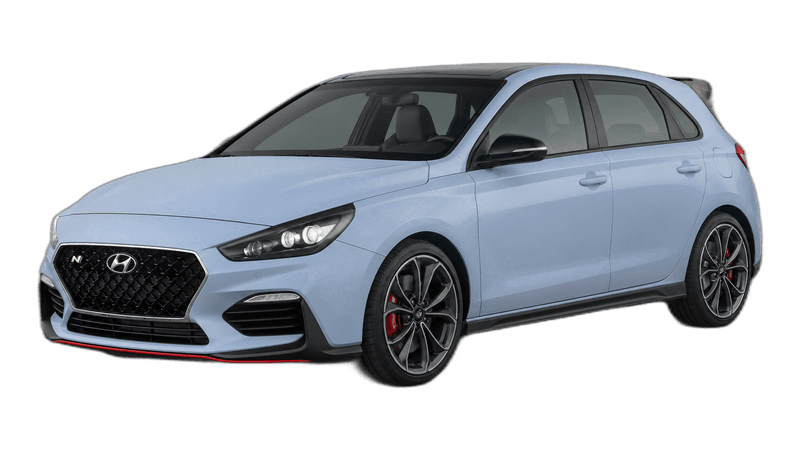
Hyundai i30 N Performance
£25,000
usedIndicative market price, updated periodically.
271bhp
Power
6.1s
0-100 km/h
250km/h
Top Speed
£25,000
Price Used
How hard it pulls.
Peak g-force the instant you bury the throttle, estimated from the car's 0–100 time and drivetrain.
Hyundai i30 N PerformanceEstimated peak launch g from the 0–100 time and drivetrain: an honest approximation, not a measured figure.
The Hyundai i30 N Performance is a 5-door hatchback by Hyundai, with 271 bhp, 353 Nm of torque, a 0-100 km/h time of 6.1 seconds and a top speed of 250 km/h. Indicative used value: approximately £25,000. Actual values vary with specification, condition and history.
Dream Car Garage Editorial · Last updated 2 November 2026
Overview
We have not driven this car. This review is based on published specifications and the sources listed below.
Hyundai's first N hot hatch
The Hyundai i30 N Performance is the more powerful of the two versions of the first car from Hyundai's N performance sub-brand. Hyundai UK describes the i30 N as its first performance model under the N name, engineered by the company's High Performance Vehicle Division. Our catalogue lists a 2.0L turbocharged inline-4 petrol engine producing 271 bhp and 353 Nm, with 0 to 100 km/h in 6.1 seconds and a 250 km/h limited top speed, driving the front wheels. We have not driven this model for this article. This is a desk-researched ownership guide built from the Hyundai Motor UK pricing and specification release of September 2017, a PistonHeads used buying guide published in February 2021 and the government recall check. Both written sources describe the early cars, so confirm every detail on the example you are viewing.
Checking the figures
Hyundai's release quotes up to 275 PS and 353 Nm of torque between 1,500 and 4,700 rpm, with an extra 25 Nm available from an overboost function that depends on exhaust temperature. The 275 PS rating is the metric figure, which converts to the 271 bhp in our catalogue, and 155 miles per hour is the 250 km/h electronic limit. PistonHeads lists 275 hp for the Performance in brackets after 250 hp for the standard car, and its torque of 279 lb ft in brackets is the overboost figure. Do not worry if adverts mix 250, 271 and 275: they refer to the standard car, the Performance in bhp and the Performance in PS. Hyundai gives 0 to 62 mph in 6.1 seconds for the Performance and 6.4 seconds for the standard car, the same times PistonHeads prints. The guide lists a weight of 1,400 kg for the standard car and 1,429 kg for the Performance and warns that its weight and power data is hard to pin down with certainty, so treat it as relative rather than definitive. It gives the on-sale date as 2017, while Hyundai UK said the car would go on sale on 4 January, which its release date places in 2018, so check the first registration rather than assuming a model year.
Engine and gearbox
The 2.0-litre inline-4 turbocharged petrol engine drives the front wheels through a six-speed manual gearbox, the only transmission in the early cars. PistonHeads admires the neat, purposeful engine bay and says the torque delivery felt a touch boosty to one magazine, which it counts as character rather than a flaw. It also describes pops and bangs on the overrun in Sport mode, but Hyundai says the Performance adds an active variable exhaust that produces crackle and pop sounds in N or Custom drive mode, so the mode names differ between the sources. Hyundai also says both versions have a rev match function and launch control.
The engine problems the guide reports are specific. Some cars suffered misfires, power losses and a lack of turbo boost that ended with the engine warning light. This was usually attributed to a faulty high pressure fuel pump, for which replacement was the fix, although loose battery terminals have also been identified as a cause. There was also an engine control unit recall on 2018 model year cars when the same symptoms appeared at start-up. Ask for dealer records of any fuel pump or software work, and check the car pulls cleanly and holds boost on a full-throttle test.
On the gearbox, PistonHeads says some cars had trouble with fifth and sixth gear, cured by fitting an improved fifth and sixth gear assembly and synchroniser ring. It suggests testing the clutch by trying to pull away from rest in fourth gear: if the car manages it, the clutch is probably slipping. The guide notes this is not something to make a habit of and the owner may object, so ask first; we would treat it as a rough check and still have the clutch inspected. PistonHeads says tuning opportunities are rife, and that a software stage one on either power level can lift output to around 300 hp, so ask whether any modification has been made and whether the seller has paperwork for it. The guide advises driving a car in standard trim first, as it may have more than enough performance as it stands.
Chassis, brakes and tyres
Hyundai lists electronically controlled suspension, a torque vectoring system and steering wheel mounted drive mode buttons on both versions. The Performance adds an electronically controlled limited-slip differential, 19-inch alloy wheels with Pirelli P Zero tyres in a compound specific to the car, and larger brakes with 18-inch ventilated front discs and 17-inch rears, against 17-inch and 16-inch on the standard car. Hyundai also lists reinforced front suspension strut rings, a strengthened front subframe, a central tunnel support bracket and a rear stiffness bar. PistonHeads says the Performance suspension sits 8 mm lower and that it reportedly has different steering and final drive ratios, plus a removable strut brace in the boot that gets in the way when the rear seats are folded.
PistonHeads calls the default ride fairly firm but in keeping with a taut chassis, with keen turn-in and a front end that seems to grip for ever. The five drive modes and the settings behind them can be combined in thousands of ways, and the guide's advice is to keep the suspension and steering in their normal settings, because the firmest settings are very hard to live with on British roads away from a circuit. Pirelli tyres marked HN on the sidewall are specific to the car, and the guide says they struggle to put the power down on wet roads. All i30 N wheels are diamond cut, so inspect each rim for kerb damage, which is costly to refurbish. Light judder when braking gently probably means warped discs. PistonHeads also reports autonomous emergency braking problems that usually came down to the front camera software needing an update, so ask whether it has been updated and make sure there are no warnings on the dash.
Interior and electronics
Hyundai's standard equipment includes an 8-inch touchscreen with satellite navigation, Android Auto and Apple CarPlay, keyless entry, LED lights and a bespoke 4.2-inch cluster with shift timing lights. The Performance adds leather and suede seats with electric adjustment, and Hyundai offered a no-cost cloth seat option that saves 12.7 kg. The guide also mentions heated seats and a heated steering wheel on the Performance. Seats are comfortable on long trips, but the cabin has some shiny plastic and the car isolates road and tyre noise less well than a Volkswagen Golf GTI.
The reliability reports concentrate on the 2018 and 2019 model year cars. The infotainment system can go blank at random moments, and PistonHeads says removing and reinserting the SD card sometimes fixes it. The sound fader settings sometimes do not return after a phone call, the alarm has been known to go off, and there are noises from wiring under the headlining at the front where the ceiling lights are mounted and from the trim where the lower edge of the screen meets the dash. Run through the screen functions, the phone connection, the lap timer and performance gauges, and listen for rattles on a bumpy road. Each of those faults is described for cars from the first two model years, so a later car should be checked but not assumed to have them.
Recalls and history
Hyundai sold the car with a five-year unlimited-mileage warranty, which PistonHeads highlights as part of the appeal, so ask whether any warranty cover remains and whether it transfers. Beyond the 2018 engine control unit recall, neither source supplies a full recall list, so enter the registration in the DVSA recall service and request dealer paperwork that confirms all open work was completed. PistonHeads found a few damaged cars for sale and says most of those had front-end impacts, so ask for evidence of structural repair, a full service history and mileage that matches the wear on the pedals, seats and steering wheel.
Buying decision
The PistonHeads verdict is that Hyundai's first hot hatch was an impressive effort and, for excitement per pound, a rival to the Golf GTI, with a stronger mechanical character, though the Volkswagen is the choice if refinement and image matter most. It points out that most UK buyers chose the Performance, so standard cars are rarer. The guide's market prices date from February 2021, so we have not repeated them: compare current adverts, and prefer a car with a documented service history, a clean fuel pump and software record, undamaged diamond-cut wheels, matching tyres and every recall closed.
Specifications
Engine
2.0L turbocharged inline-4 petrol
Displacement
2.0L
Power
271 bhp
Torque
353 Nm
0-100 km/h
6.1s
Top Speed
250 km/h
Drivetrain
FWD
Country
South Korea
Body Style
5-door hatchback
Years
2017–present
Price Used
£25,000
Specifications are manufacturer-published figures.
More from Hyundai
Frequently Asked Questions
What are the specifications of the Hyundai i30 N Performance?
The Hyundai i30 N Performance is a 5-door hatchback by Hyundai, with 271 bhp, 353 Nm of torque, a 0-100 km/h time of 6.1 seconds and a top speed of 250 km/h. Indicative used value: approximately £25,000. Actual values vary with specification, condition and history.
How much does a Hyundai i30 N Performance cost?
Indicative used value: approximately £25,000. Actual values vary with specification, condition and history.
What drivetrain does the Hyundai i30 N Performance use?
The Hyundai i30 N Performance is configured with front-wheel drive.
What type of car is the Hyundai i30 N Performance?
The Hyundai i30 N Performance is a hot hatches manufactured by Hyundai in South Korea. Production started in 2017.