
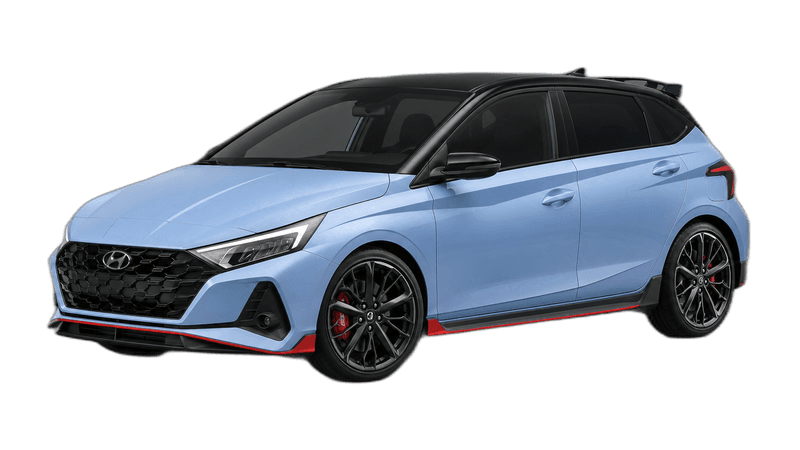
Hyundai i20 N
£22,000
usedIndicative market price, updated periodically.
201bhp
Power
6.2s
0-100 km/h
230km/h
Top Speed
£22,000
Price Used
How hard it pulls.
Peak g-force the instant you bury the throttle, estimated from the car's 0–100 time and drivetrain.
Hyundai i20 NEstimated peak launch g from the 0–100 time and drivetrain: an honest approximation, not a measured figure.
The Hyundai i20 N is a 5-door hatchback by Hyundai, with 201 bhp, 275 Nm of torque, a 0-100 km/h time of 6.2 seconds and a top speed of 230 km/h. Indicative used value: approximately £22,000. Actual values vary with specification, condition and history.
Dream Car Garage Editorial · Last updated 2 November 2026
Overview
We have not driven this car. This review is based on published specifications and the sources listed below.
A hot supermini with a short life on sale in Europe
The Hyundai i20 N is a five-door, front-wheel-drive hot hatch. Our catalogue lists the car as sold from 2021, and PistonHeads says it was revealed to the European market in October 2020. It has a 1.6L turbocharged inline-4 petrol engine producing 201 bhp and 275 Nm, with 0 to 100 km/h in 6.2 seconds and a 230 km/h top speed, driving the front wheels through a six-speed manual gearbox. We have not driven this model for this article. This is a desk-researched ownership guide built from two sources: Hyundai Motor Deutschland's "Technische Daten" sheet dated August 2021, a PistonHeads used buying guide published in December 2023. We did not consult the government recall check for this article, and you should use it yourself.
The Hyundai sheet is a German-language manufacturer document for the German market, so it is a statement of the launch specification rather than a record of every car sold in other countries. PistonHeads, which is written from a UK viewpoint, covers cars sold between 2021 and 2023 (its heading says 2020 to 2023, counting the October 2020 reveal) and says Hyundai ended sales of most of its N models in Europe because of Euro 7 emissions rules that were then due in July 2025. PistonHeads said in December 2023 that new cars were only available from existing stock, so for most buyers this is a used purchase where the quality of the individual car matters more than the badge.
Checking the figures
The Hyundai sheet gives 150 kW (204 PS) at 5,500 to 6,000 rpm. PS is a metric horsepower, and multiplying 204 PS by 0.9863 gives the 201 bhp in our catalogue, which is also what 150 kW works out to. PistonHeads agrees on the figure in its specification box (201 hp at 5,500 to 6,000 rpm) but its text calls the car a 204hp one, so the two numbers in that guide are the same rating written in two units rather than two different engines.
Torque needs more care. The sheet lists a maximum of 275 Nm from 1,750 to 4,500 rpm, which PistonHeads lists as 203 lb ft, and then adds a separate line: overboost of 304 Nm between 2,000 and 4,000 rpm. The same sheet says the engine has an overboost function lasting up to 7 seconds. A 304 Nm figure therefore exists in Hyundai's own data, but it is a temporary peak, not the continuous rating. We use 275 Nm and treat 304 Nm as the overboost peak. If an advert quotes 304 Nm, it is quoting that short-lived figure.
For performance, Hyundai gives 0 to 100 km/h in 6.2 seconds and 230 km/h, with a kerb weight of 1,190 to 1,220 kg depending on equipment. PistonHeads lists 6.7 seconds to 62 mph, a top speed of 142 mph (230 km/h is about 143 mph) and 1,190 kg. The 0.5 second gap is a real disagreement between the two sources, and PistonHeads warns that its own weight and power data should be treated as relative rather than definitive. Use the manufacturer's 6.2 seconds as the claim and the PistonHeads figure as a reminder that real cars vary.
One more variant point. The Hyundai sheet lists two German trims, i20 N and i20 N Performance, and says the mechanical limited-slip differential is fitted only to the Performance. PistonHeads treats the differential as part of the car it describes, and its discussion of UK pricing implies it came as standard there. We cannot reconcile those two statements, so confirm from the car's own specification that it has the differential before paying for one.
Engine and gearbox
Hyundai describes a Gamma II 1.6 T-GDI aluminium four-cylinder of 1,598 cc, mounted transversely, with a turbocharger (maximum boost 1.2 bar), intercooler, four valves per cylinder, two overhead camshafts driven by a timing chain, continuously variable valve timing, direct injection, a compression ratio of 10:1, a particulate filter and Euro 6d emissions. It is linked to a six-speed manual with a hydraulically operated single dry clutch, launch control and rev matching. The sheet gives engine oil capacity as 3.4 to 4.4 litres and gearbox oil as 1.5 to 1.6 litres, a useful pair of numbers to check against the service invoice.
PistonHeads calls the engine workmanlike rather than wondrous: it does not encourage high revs and is slow to shed them, which the guide links to a heavy flywheel effect. It also reports a slight roughness at idle when cold that disappears as the engine warms. The manual gearbox is described as slick and sturdy, though some owners noticed less than sweet engagement of first or reverse. Try both on a cold car.
The guide says the drivetrain seems to have been very reliable, though it found one owner whose fuel pump failed after six months, and another complained about topping up coolant twice when the engine was hot and received little help from the dealer. Check the coolant level cold, look for dried residue around hoses and ask what was done. PistonHeads also reports jerky throttle response in slow traffic, which one owner tackled by removing the exhaust valve fuse, a modification we would treat as a reason to ask questions about what else has been altered.
The exhaust is the most specific fault PistonHeads describes. The sheet lists a sports exhaust with variable flap control, and PistonHeads says the spring on the exhaust opening valve proved weak and caused a rattle. Hyundai would replace the full exhaust under warranty, which could repeat the problem, or owners could fit a stronger aftermarket spring. Listen for a rattle and ask which fix was used. The guide also notes the driving modes: eco, normal and sport, launch control and two custom modes selected by paddles on the steering wheel, with an auto-blip function that can be switched off.
Chassis, brakes and wheels
Hyundai's sheet describes a reinforced front axle with revised geometry, MacPherson struts at the front, stabilisers, 7.5J by 18-inch alloy wheels with Pirelli P Zero 215/40 R18 tyres carrying Hyundai's HN marking, ventilated floating-caliper discs of 320 mm at the front and 262 mm at the rear, and a mechanical handbrake acting on the rear wheels through a cable. PistonHeads agrees on the disc sizes and calls the handbrake an old-school metal lever.
The two sources disagree on the rear suspension. The Hyundai sheet says multi-link rear axle, while PistonHeads says the car has a stiffer rear torsion beam. We have not resolved this, and it does not change what to inspect, but do not rely on either description when ordering parts and check with a Hyundai dealer using the registration.
PistonHeads says the body is stiffened at twelve points and that the car has bigger anti-roll bars, aggressive camber, stiffer springs and passive dampers. The price is a firm ride that is not plush on poor roads, so drive a car on a route you know before committing. Look for uneven tyre wear, which can point to hard use or poor alignment.
The guide reports mixed views of the factory tyres. Some owners cited early degradation or poor grip in cold weather, and Michelin Pilot Sport 4 or 5 tyres usually fixed the complaint. Tyre prices in the guide are dated, so compare current quotes. It also reports that the brakes work well in the dry but that some owners were less keen on stopping distances in the rain, and that the car's large turning circle can produce a shocking judder and noise from the front end on full lock when cold, an issue it ties to the front differential and says is much less pronounced on Michelins. The sheet gives a turning circle of 10.54 m. Test full lock both ways on a cold car.
Body, interior and electronics
The sheet gives luggage space of 352 to 1,165 litres by the VDA measure (PistonHeads quotes the 352 litre figure for the boot), 130 mm of ground clearance and a drag coefficient of 0.32. PistonHeads notes the i20 N was only offered as a five-door and that the front vents are real.
Paint is the main body concern. PistonHeads reports that some cars left the factory with paint missing in places, leading to rust, mostly on Performance Blue cars though black and red cars were also affected, and that Hyundai fixed the defects under warranty, though not always promptly. Inspect door edges, the bumpers and the lower body carefully and ask for dealer records of any paint work. The guide also reports weak dipped-beam headlights, condensation in front and rear lenses, water ingress past the plastic trim piece between the rear lights, and a clunk on corners in cold weather that one owner thought sounded like suspension, while another owner said it was the tailgate rattling from looseness in the lock mechanism. Look for damp lenses and boot-area moisture.
Inside, PistonHeads says the cabin is not peerless but well equipped, with heated seats and wheel, parking sensors, a reversing camera and wireless phone charging, though it adds that the wireless charger can work intermittently and is fussy about phone position and cases. Other reports include some USB sticks not being read, horns that did not always work, infotainment screens that blanked out, usually cured by a software update from Hyundai, and a rear-occupancy warning that sounded with nobody in the back. Test the horn, USB, charger, screen and rear alert on the viewing.
The guide says seat bolster material has worn early on some cars, which Hyundai dealers have repaired, and that seat squeak is rare, with no reputation for trim rattles. Bose audio was a paid option on the UK car and PistonHeads says it delayed delivery of new cars, so used examples with it command a small premium.
Recalls and history
Neither the Hyundai sheet nor PistonHeads gives a recall list, so we do not state any recall numbers or dates here. Enter the registration into the DVSA recall service and ask the seller for dealer paperwork showing any open work was completed. Ask for a full service history, any evidence of warranty repairs for paint, exhaust or electrics, and receipts for modifications.
PistonHeads says Hyundai sells these cars with a five-year warranty, so even the oldest used cars were still covered when it wrote in December 2023. If cover runs five years from first registration, cars registered in 2021 would be reaching the end of it about now (our arithmetic, not a stated term), so check the registration date, the warranty terms and whether the cover can transfer to you, because we have not seen the terms themselves. PistonHeads also says some dealers offered free servicing for the first three years.
Buying decision
The PistonHeads verdict is that the Toyota GR Yaris is the one to have if money is no object, but that the i20 N is worth investigating because it is a lot cheaper used. The guide says there were around 70 used examples on sale at any time in the UK in December 2023. The prices it quotes are dated and not repeated here; compare current adverts instead. PistonHeads says the drivetrain seems very reliable and describes mechanical strength with a few quality issues, so the target is a car whose faults have been dealt with. The best car has a documented service history, the correct differential, an exhaust that does not rattle, even tyres on good rubber, paint free of rust spots, working electrics and every recall closed.
Specifications
Engine
1.6L turbocharged inline-4 petrol
Displacement
1.6L
Power
201 bhp
Torque
275 Nm
0-100 km/h
6.2s
Top Speed
230 km/h
Drivetrain
FWD
Country
South Korea
Body Style
5-door hatchback
Years
2021–2023
Price Used
£22,000
Specifications are manufacturer-published figures.
More from Hyundai
Frequently Asked Questions
What are the specifications of the Hyundai i20 N?
The Hyundai i20 N is a 5-door hatchback by Hyundai, with 201 bhp, 275 Nm of torque, a 0-100 km/h time of 6.2 seconds and a top speed of 230 km/h. Indicative used value: approximately £22,000. Actual values vary with specification, condition and history.
How much does a Hyundai i20 N cost?
Indicative used value: approximately £22,000. Actual values vary with specification, condition and history.
What drivetrain does the Hyundai i20 N use?
The Hyundai i20 N is configured with front-wheel drive.
What type of car is the Hyundai i20 N?
The Hyundai i20 N is a hot hatches manufactured by Hyundai in South Korea. Production ran from 2021 to 2023.