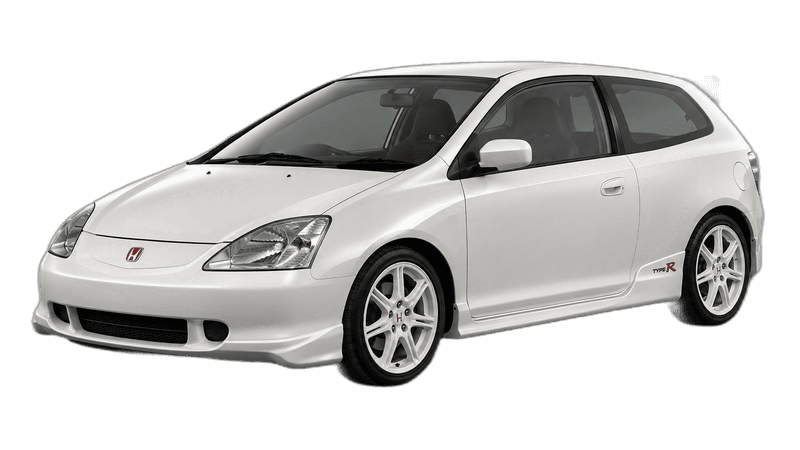
Honda Civic Type R (EP3)
£12,000
usedIndicative market price, updated periodically.
197bhp
Power
6.6s
0-100 km/h
235km/h
Top Speed
£12,000
Price Used
The Honda Civic Type R (EP3) produces 197 bhp, reaches 100 km/h in 6.6 seconds and has a top speed of 235 km/h. A representative example is worth about £12,000.
How hard it pulls.
Peak g-force the instant you bury the throttle, estimated from the car's 0–100 time and drivetrain.
Honda Civic Type R (EP3)Estimated peak launch g from the 0–100 time and drivetrain: an honest approximation, not a measured figure.
Dream Car Garage Editorial · Edited by José Teo Lorente Vallecillos · Last updated 30 October 2026
Overview
We have not driven this car. This review is based on published specifications and the sources listed below.
The EP3 turns the Type R into an everyday hot hatch
The EP3 moved the Civic Type R from a special Japanese homologation flavour into a car sold in Britain and Europe in meaningful numbers. Honda dates the generation to 2001–2005 and describes European cars with a 198 hp 2.0-litre i-VTEC engine, Swindon production and running changes that included steering and suspension revisions plus a lighter flywheel. We have not driven this model for this article. This is a desk-researched ownership guide using Honda's Type R history, the PistonHeads EP3 buying guide and the DVSA recall service. Their advice should be turned into checks, not treated as a verdict on every car.
Our catalogue represents the UK and European manual car: a 1998 cc K20A naturally aspirated four-cylinder, 197 bhp from the factory's 198 hp metric figure, 196 Nm, 0 to 100 km/h in 6.6 seconds and a 235 km/h maximum, with front-wheel drive. The Japanese EP3 used a different output and a Torsen limited-slip differential; PistonHeads is explicit that UK cars did not have that differential. Do not let a seller describe a UK car as having the JDM hardware unless the differential and related identity have been verified.
Oil discipline protects the high-revving engine
The K20 engine is robust only when the maintenance matches its operating speed. PistonHeads calls for regular oil checks and top-ups, quality fully synthetic oil and prompt attention to consumption. Do not wait for an oil warning light. Ask how much oil the owner adds between services, when the level was last checked and whether the car has a consistent warm-up routine. A small top-up habit may be normal; unexplained use, smoke or a noisy top end is not.
Cam-chain tensioners, valve clearances and top-end noise deserve specialist attention as mileage accumulates. PistonHeads notes that chains and tensioners may need attention around higher mileages and that heat shields and manifold rattles can be inexpensive distractions from more significant faults. A cold start, a fully warmed idle and a controlled run through the rev range are more informative than a short blast. The point is not to fear the engine. It is to avoid paying a strong-car price for an engine with undocumented oil history and unresolved valvetrain noise.
The six-speed gearbox has specific checks
The close-ratio six-speed should be assessed gear by gear. PistonHeads identifies smooth engagement of second gear and freedom from jumping out as particular checks, along with a Honda recall affecting some 2004 cars. Ask for recall evidence, then test the gearbox when warm and cold. A stiff second-to-third change, reluctance to select reverse or graunching under normal use all need to be priced as mechanical work, not excused as character.
Clutch and flywheel history also matter. Honda's 2003 update included a lighter flywheel, and the PistonHeads guide identifies lighter clutch and flywheel changes in the facelift. Confirm what is actually fitted and why it was replaced. Engine and gearbox mounts can show damage after hard use or track work. If the car has been modified, ask for the original parts where available, the tuner's identity and proof that the work was completed without cutting corners on cooling, intake or engine management.
Steering and suspension need evidence, not feel alone
PistonHeads points to a steering-rack recall and failures in the wider EP3 fleet. The service record should show the relevant campaign status, and the car should track straight without tugging to one side. Uneven tyre wear, tramlining and vague centre feel can point to alignment, worn bushes, ball joints or damaged suspension. The guide notes that 2004 revisions altered steering and geometry, so a late car should not automatically be assumed to have the same feel as an early car.
The standard wheel and tyre package uses 17-inch wheels and Bridgestone RE040 tyres in the PistonHeads specification. Check for distorted wheels, cheap mismatched tyres and repeated inner-edge wear. With the car safely raised, look at the front toe-control strut, rear double wishbones, bushes, top mounts, dampers, brake discs and rear calipers. Sticking rear calipers and uneven braking are common-sense negotiation items. Fresh coilovers are not proof of a sorted chassis; they may conceal worn mounting points or a car set up too low for British roads.
A viewing order that exposes risk
Begin with cold-start behaviour before the seller has time to warm the car. Listen for chain rattle, top-end tapping and uneven idle, then check under the oil cap and around the cam cover for sludge or neglected seals. Ask to see the oil level and service stickers. A well-kept K20 should come with evidence, not stories.
Move to the gearbox and clutch on a full warm-up. Select every gear repeatedly, including reverse and second from a low speed, and note any graunch, resistance or tendency to spring back. Walk around the car checking panel gaps, paint depth and signs of track contact under the front splitter. On a lift, inspect the steering rack area, suspension mounting points, brake lines, rear calipers and tyre shoulders. Finish with the paperwork: service stamps, recall evidence, previous owners and any invoices for clutch, flywheel, chain tensioner or steering work. The EP3 is approachable, but the cheapest example is rarely the simplest one.
Buy the least complicated EP3 you can verify
The EP3's appeal is that it combines a high-revving naturally aspirated engine with five-door-free three-door packaging and everyday usability. The risks are mundane: oil history, gearbox selection, steering evidence, suspension wear and previous hard use. Honda's history gives the generation its boundaries and market-specific outputs, while PistonHeads supplies the inspection priorities. Use the DVSA recall service and Honda's records to close the campaign file before purchase.
Value follows verifiable maintenance and originality more than cosmetic freshness. A clean EP3 with invoices, straight panels, healthy transmission selection and a believable service rhythm is a different proposition from a polished car with noisy valves, vague steering and no recall evidence. This guide combines Honda's historical specifications and the sources listed below. It assigns no exact production count to the UK derivative.
Specifications
| Engine | 2.0L K20A inline-4 naturally aspirated petrol (i-VTEC) |
|---|---|
| Displacement | 2.0L |
| Power | 197 bhp |
| Torque | 196 Nm |
| 0-100 km/h | 6.6s |
| Top Speed | 235 km/h |
| Drivetrain | FWD |
| Country | Japan |
| Body Style | 3-door hatchback |
| Years | 2001–2005 |
| Price Used | £12,000 |
Specifications are manufacturer-published figures.
Compare with
Frequently Asked Questions
What is a Honda Civic Type R (EP3) worth?
A representative example is worth about £12,000. Actual values vary with specification, condition and history.
How much power does the Honda Civic Type R (EP3) have?
The Honda Civic Type R (EP3) produces 197 bhp and 196 Nm of torque.
How fast is the Honda Civic Type R (EP3) from 0 to 100 km/h?
The Honda Civic Type R (EP3) accelerates from 0 to 100 km/h in 6.6 seconds.
What is the top speed of the Honda Civic Type R (EP3)?
The Honda Civic Type R (EP3) has a top speed of 235 km/h.
What engine does the Honda Civic Type R (EP3) have?
The Honda Civic Type R (EP3) uses a 2.0L K20A inline-4 naturally aspirated petrol (i-VTEC).
When was the Honda Civic Type R (EP3) built?
The Honda Civic Type R (EP3) was built from 2001 to 2005.
Is the Honda Civic Type R (EP3) all-wheel drive?
No. The Honda Civic Type R (EP3) is configured with front-wheel drive.