
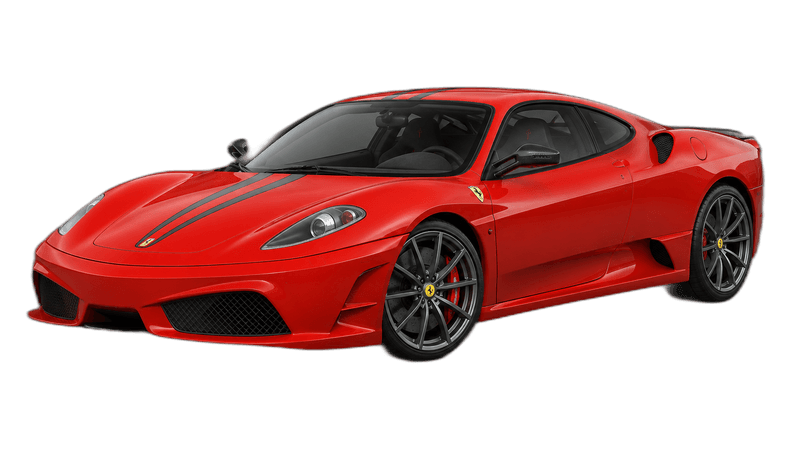
Ferrari F430 Scuderia
£250,000
usedIndicative market price, updated periodically.
503bhp
Power
3.6s
0-100 km/h
320km/h
Top Speed
£250,000
Price Used
How hard it pulls.
Peak g-force the instant you bury the throttle, estimated from the car's 0–100 time and drivetrain.
Ferrari F430 ScuderiaEstimated peak launch g from the 0–100 time and drivetrain: an honest approximation, not a measured figure.
The Ferrari F430 Scuderia is a 2-door coupe by Ferrari, with 503 bhp, 471 Nm of torque, a 0-100 km/h time of 3.6 seconds and a top speed of 320 km/h. Indicative used value: approximately £250,000. Actual values vary with specification, condition and history.
Dream Car Garage Editorial · Last updated 29 October 2026
Overview
We have not driven this car. This review is based on published specifications and the sources listed below.
The track special of the F430 era
The F430 Scuderia was unveiled at Frankfurt in 2007 with Michael Schumacher presenting, as the successor to the 360 Challenge Stradale and the sharpened derivative of the F430. Its engine is the 4,308 cc flat-plane V8 in 503 bhp and 471 Nm tune, with drive to the rear wheels through the F1 SuperFast2 single-clutch automated manual. The catalogue figures are 3.6 seconds to 100 km/h and 320 km/h. Around 100 kilograms were removed over the standard car, bringing dry weight to about 1,350 kilograms, and Ferrari quoted the Scuderia two seconds quicker than the F430 at Fiorano, a gap that put it ahead of the Enzo in the same test. The 16M Spider followed a year later; this guide covers the coupe.
We have not driven this model for this article. This desk-researched ownership guide relies on Ferrari's official 430 Scuderia page, the PistonHeads used buying guide for the 430 Scuderia and the DVSA vehicle recall service. The PistonHeads article is a general guide rather than a fault census of one specific car, so treat its observations as inspection prompts for the individual example, not as predictions that every Scuderia will behave the same way.
The engine and what was fixed
The V8 is derived from the F136 family, with development roots in Maserati's V8 and valve-timing lessons from the Enzo programme. The Scuderia revision raised output by twenty horsepower over the F430, mainly through new manifolds that deleted the standard car's problematic pre-catalysts, a carbon-fibre intake, higher compression and improved breathing and oil control. Those manifolds matter to a buyer: the pre-cat failures that haunt early F430s are largely designed out of the Scuderia. Coolant leaks are nonetheless a known check, and the cam chains deserve attention on higher-mileage cars, with specialist quotes for chain work in the low thousands.
The F1 SuperFast2 gearbox halves the F430's shift time to around sixty milliseconds and shortens the top four ratios. No manual was offered. Clutch life depends heavily on use; the single clutch is a consumable with a replacement cost in the low thousands plus the opportunity to inspect the bearing and flywheel. The hydraulic actuators can leak, betrayed by damp undertrays and a repair bill in the mid-thousands, and the E-Diff solenoids are a further known item. A diagnostic session on a cold car tells most of this story quickly.
Chassis, brakes and aero
The Scuderia rides around fifteen millimetres lower than the F430 on titanium springs and hollow anti-roll bars, with the Skyhook magnetic dampers retained and a magic-carpet button softening the road mode. The five-position manettino includes the race-oriented settings shared with the era's bigger cars. Carbon-ceramic brakes of around four hundred millimetres are standard, and wear is measured in millimetres of disc life; cars that stand unused can seize caliper pistons, so a full brake service with measurements belongs on the checklist.
The aero package uses RTM composite panels for roughly ten percent more downforce than the F430, and the Lexan engine cover is a visual signature. Detaching rear lights and fogged headlight lenses are documented irritations with expensive remedies, so check both.
Service rhythm and the 16M Spider
The service rhythm is 6,250 miles or annually, whichever arrives first, and the Scuderia's track intent means brake fluid, pads and tyres are genuine consumables rather than line items. The carbon-ceramic discs are shared in size with the era's flagship braking hardware and wear slowly on the road, but a car with circuit time will show it in pad life and disc condition. Tyre choice matters to the character: the original equipment was chosen to complement the suspension, and a car on mismatched or aged rubber betrays little of what it should feel like.
The 16M Spider arrived a year after the coupe, slightly heavier and roughly a tenth of a second calmer in acceleration, yet it carried a substantial premium by 2023 pricing. Rarity drives that: fewer than five hundred 16Ms were built against the coupe's low thousands. For a buyer choosing between them, the coupe is the purer expression of the brief; the Spider is the rarer artefact. Neither choice needs justifying to anyone else, and both reward the same diligent inspection.
Buying and values
Production of the coupe is estimated in the low thousands, with UK numbers small, and the 16M Spider carries a substantial premium. PistonHeads' 2023 pricing put right-hand-drive coupes around 220,000 dollars and left-hand-drive cars from roughly 190,000 dollars at then-current exchange rates, figures that move with the market and are offered here only as historical context. This guide makes no investment claim.
The buying discipline follows the F430 family: service history at the 6,250-mile or annual rhythm, clutch and actuator diagnostics, chain noise assessment, coolant-trace inspection, brake measurements and a check of the Skyhook system's behaviour across its modes. A car with a track history is not automatically a problem; the Scuderia was built for circuits. What matters is that the use is documented and the consumables renewed honestly.
We have not driven this model for this article. No present valuation, investment assurance or universal failure rate is offered. The F430 Scuderia's value as an ownership proposition is the combination of the sharpest naturally aspirated V8 Ferrari sold in its decade, genuine weight reduction and a gearbox that rewards proper maintenance. Buy on clutch and actuator health, chain condition and brake measurements, and the track-car character will look after the rest.
Specifications
Engine
4.3L (4308 cc) naturally aspirated V8 petrol
Displacement
4.3L
Power
503 bhp
Torque
471 Nm
0-100 km/h
3.6s
Top Speed
320 km/h
Drivetrain
RWD
Country
Italy
Body Style
2-door coupe
Years
2007–2009
Price Used
£250,000
Specifications are manufacturer-published figures.
More from Ferrari
Frequently Asked Questions
What are the specifications of the Ferrari F430 Scuderia?
The Ferrari F430 Scuderia is a 2-door coupe by Ferrari, with 503 bhp, 471 Nm of torque, a 0-100 km/h time of 3.6 seconds and a top speed of 320 km/h. Indicative used value: approximately £250,000. Actual values vary with specification, condition and history.
How much does a Ferrari F430 Scuderia cost?
Indicative used value: approximately £250,000. Actual values vary with specification, condition and history.
What drivetrain does the Ferrari F430 Scuderia use?
The Ferrari F430 Scuderia is configured with rear-wheel drive.
What type of car is the Ferrari F430 Scuderia?
The Ferrari F430 Scuderia is a supercars manufactured by Ferrari in Italy. Production ran from 2007 to 2009.