
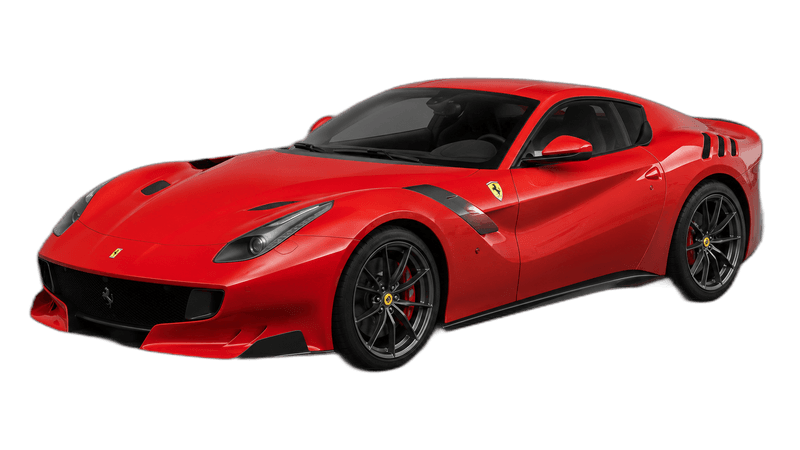
Ferrari F12tdf
£550,000
usedIndicative market price, updated periodically.
770bhp
Power
2.9s
0-100 km/h
340km/h
Top Speed
£550,000
Price Used
How hard it pulls.
Peak g-force the instant you bury the throttle, estimated from the car's 0–100 time and drivetrain.
Ferrari F12tdfEstimated peak launch g from the 0–100 time and drivetrain: an honest approximation, not a measured figure.
The Ferrari F12tdf is a 2-door coupe by Ferrari, with 770 bhp, 705 Nm of torque, a 0-100 km/h time of 2.9 seconds and a top speed of 340 km/h. Indicative used value: approximately £550,000. Actual values vary with specification, condition and history.
Dream Car Garage Editorial · Last updated 27 October 2026
Overview
We have not driven this car. This review is based on published specifications and the sources listed below.
A separate 799-car F12 development
The F12tdf was built from 2015 to 2017 in a run of 799 cars. Its 6.3-litre naturally aspirated V12 produces 780 PS, about 770 bhp, and 705 Nm. Ferrari quotes 0-100 km/h in 2.9 seconds and a top speed above 340 km/h. Wider tracks, a 110 kg weight reduction, shorter final gearing and four-wheel steering distinguish it from the standard F12berlinetta.
This is a desk-researched ownership guide. We have not driven this model for this article. The 799 figure applies to the tdf and must not be assigned to the wider F12 family. For an individual car, chassis provenance, factory equipment, service coverage and measured condition remain the useful evidence.
High-output V12 and shorter gearing
The engine reaches 8,900 rpm and should be inspected cold and warm, with oil, coolant and intake systems checked. Ask for annual service invoices and records of any engine, sensor or warning-related work. The tdf's different output and gearing should not be used to excuse an abnormal noise or inconsistent running condition.
The shorter final drive and sharper calibration can change how the seven-speed dual-clutch gearbox feels. That character is not automatically a defect, but warnings, hesitation or inconsistent engagement need Ferrari-level diagnosis. Request software, clutch and gearbox records rather than relying on a cleared dashboard.
Verify the actual dates of the seven-year service package and any later warranty. The package name alone does not establish current coverage. A clear invoice should identify the work, parts and technician findings, especially if the car has recently been recommissioned after storage.
Four-wheel steering and wider-track geometry
Rear-wheel steering was added to the tdf's chassis package. Inspect the front and rear steering systems through appropriate diagnostics and a specialist evaluation. Do not judge their condition solely by a straight-line drive. Warning messages or inconsistent assistance need investigation.
Wider tracks and revised suspension make measured geometry particularly important. Compare the alignment report with tyre age, size and wear across all four wheels. New tyres can hide a previous wear pattern, so ask for earlier measurements and suspension invoices where available.
Check dampers, springs, bushes and the underbody with the trays removed where practical. The optional front lift should be tested if fitted. Inspect the splitter, undertrays and rear aero surfaces for contact or non-standard repairs.
A road-registered tdf can still have spent its life on circuit. Neither usage is intrinsically good or bad; the useful distinction is whether the seller can support the account with invoices, brake measurements, tyre history and chassis inspection. Ask for any damage repairs to be described in writing and compare them with the factory build record.
Active aerodynamics and measured braking
The tdf's active rear diffuser and other aero surfaces are part of its model identity. Ferrari quoted 230 kg of downforce at 200 km/h, 107 kg more than the standard F12. That figure is less useful to a buyer than evidence that the visible vanes, mechanisms and underbody are intact and operating correctly.
Carbon-ceramic brakes should be measured and documented. Include discs, pads, fluid and any brake or chassis warnings in the inspection. Correct wheel and tyre specification matters, particularly with the tdf's wider tracks and revised geometry.
Ask whether the car has been used on circuit and request the associated inspection and service records. Circuit use does not automatically prove poor condition, but it makes consumable measurements and alignment evidence more important.
Body, seats and factory equipment
The standard F12 guide reports rear-wing vent paint corrosion on some cars; treat that as an inspection prompt here, not as evidence of a tdf-wide fault. Ask for any rectification invoices. Check the fuel flap, windows, parking brake and cabin screens for correct operation. Electrical symptoms that disappear after a restart should still be recorded and diagnosed if they recur.
Seat choice affects entry, support and adjustment. Carbon and Daytona-style seats should be tried in person. Test the JBL system, passenger display, USB and camera functions. Rattles or loose trim should be traced rather than dismissed as expected behaviour.
The tdf's stripes, wheels, carbon components and cabin specification should be tied to the build record. Later modifications and replacement parts need separate documentation. Original parts supplied with the car should be listed.
Circuit history should be established through evidence rather than treated as either automatic damage or proof of careful maintenance. Ask for alignment reports, brake and tyre measurements, fluid invoices and any inspections carried out after track use. The tdf's additional aerodynamic load and track-focused tyre fitment make those records useful when comparing otherwise similar cars. If original aero components, wheels or exhaust parts were removed, confirm whether they are included and how the current setup affects factory settings. A seller who cannot document those changes should not be asked to prove a negative; the uncertainty should simply remain visible in the inspection report.
Inspection scope and production identity
Arrange an independent Ferrari inspection that includes diagnostics, steering, geometry, brakes, aero mechanisms, underbody and records. The report should state what was measured and what remained inaccessible. A cold-start observation and full document review add evidence that photographs cannot provide.
The 799-car figure is a production fact, not a substitute for provenance. Confirm the VIN, original equipment and service continuity. Keep the tdf separate from the standard F12berlinetta, whose total was not officially published.
Sources and limitations
We have not driven this model for this article. Ferrari's official F12tdf page supplies the engine, aerodynamic and chassis identity, while the PistonHeads F12 guide supplies the production and ownership evidence. Ferrari's recall page explains how to check open campaigns with the full 17-digit VIN. This guide makes no claim about transaction prices, future value or universal reliability. VIN-based campaign checks and an independent Ferrari inspection remain necessary.
Specifications
Engine
6.3L (6262 cc) naturally aspirated V12
Displacement
6.3L
Power
770 bhp
Torque
705 Nm
0-100 km/h
2.9s
Top Speed
340 km/h
Drivetrain
RWD
Country
Italy
Body Style
2-door coupe
Years
2015–2017
Production
799
Price Used
£550,000
Specifications are manufacturer-published figures.
More from Ferrari
Frequently Asked Questions
What are the specifications of the Ferrari F12tdf?
The Ferrari F12tdf is a 2-door coupe by Ferrari, with 770 bhp, 705 Nm of torque, a 0-100 km/h time of 2.9 seconds and a top speed of 340 km/h. Indicative used value: approximately £550,000. Actual values vary with specification, condition and history.
How much does a Ferrari F12tdf cost?
Indicative used value: approximately £550,000. Actual values vary with specification, condition and history.
How many Ferrari F12tdf were made?
Ferrari produced 799 units of the Ferrari F12tdf.
What drivetrain does the Ferrari F12tdf use?
The Ferrari F12tdf is configured with rear-wheel drive.
What type of car is the Ferrari F12tdf?
The Ferrari F12tdf is a supercars manufactured by Ferrari in Italy. Production ran from 2015 to 2017.