
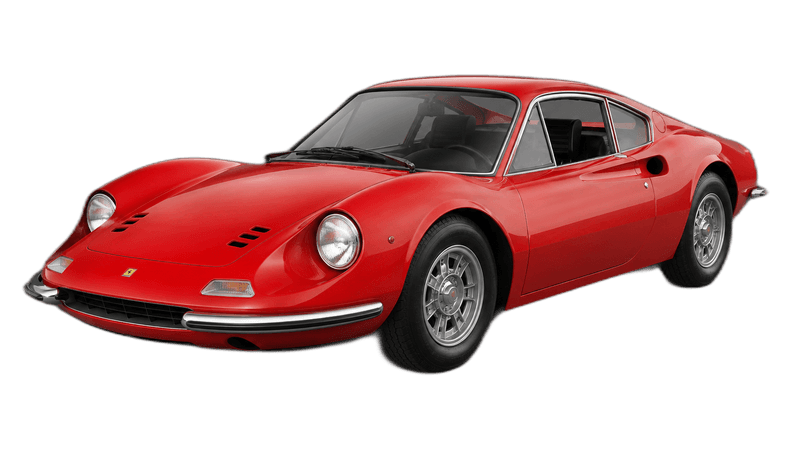
Ferrari Dino 246 GT
£350,000
usedIndicative market price, updated periodically.
195bhp
Power
6.7s
0-100 km/h
235km/h
Top Speed
£350,000
Price Used
How hard it pulls.
Peak g-force the instant you bury the throttle, estimated from the car's 0–100 time and drivetrain.
Ferrari Dino 246 GTEstimated peak launch g from the 0–100 time and drivetrain: an honest approximation, not a measured figure.
The Ferrari Dino 246 GT is a 2-door coupe by Ferrari, with 195 bhp, 226 Nm of torque, a 0-100 km/h time of 6.7 seconds and a top speed of 235 km/h. Indicative used value: approximately £350,000. Actual values vary with specification, condition and history.
Dream Car Garage Editorial · Last updated 29 October 2026
Overview
We have not driven this car. This review is based on published specifications and the sources listed below.
The junior Ferrari that became an icon
The Dino 246 GT was built from 1969 to 1974 as the more usable, more affordable entry to the Ferrari range, and it outgrew that brief entirely. Its engine is a 2,419 cc 65-degree V6 with three Weber carburettors, quoted here in European tune at 195 bhp and 226 Nm, driving the rear wheels through a five-speed transaxle. The catalogue figures are 6.7 seconds to 100 km/h and 235 km/h. Mid-engined, compact and light, it was the first mid-engine Ferrari road car, and the first Ferrari-badged car with a V6. Enzo Ferrari sold it under the Dino name to protect the twelve-cylinder flagship, and the market has long since forgiven the badge. This guide covers the fixed-head GT; the 246 GTS targa arrived in 1972 and commands a premium.
We have not driven this model for this article. This desk-researched ownership guide relies on Ferrari's official Dino 246 GT page, the Hagerty buyer's guide for the 1969-74 Dino 246 GT and GTS and the DVSA vehicle recall service. Hagerty's article is a model-year buyer's guide rather than a survey of one specific car, so treat its observations as inspection prompts for the individual example, not as predictions that every 246 will behave the same way.
The three series and what changed
Production divides into three recognisable series. The L Series covers 1969 to 1970, serial numbers 00400 to 01116, with 357 cars built, all left-hand drive, knock-off centre-bolt Cromodora wheels and Girling brakes. Most L cars kept aluminium doors, bonnet and engine cover, a carry-over from the short-lived 206 GT; the 246 itself replaced the 206's aluminium structure with a steel monocoque. The M Series of 1970 to 1971, serial numbers 01118 to 02130, brought 507 cars, conventional five-lug Cromodoras, ATE brakes and, from October 1970, the first right-hand-drive cars. The E Series ran from 1971 to 1974 with over 2,800 cars, including both the GT and, from 1972, the GTS targa. Flared arches with wider Campagnolo wheels were a period option, as were the deeply bolstered Daytona seats; a car with both is often described by enthusiasts as chairs and flares.
Knowing which series a car is matters because parts, brake specifications and even driving position differ. A claimed matching-numbers car should carry the correct wheels, brakes and interior for its serial number range, and a specialist can verify this quickly.
The V6 and its character
The engine is Ferrari's own design: a cast-iron block, aluminium heads, twin overhead camshafts driven by chains, and triple Weber carburettors feeding a 65-degree vee chosen so the intake runners could run straight. Separate crankpins give even firing. It is a free-revving, vocal engine that rewards warm-up discipline and clean carburation. The chains rarely fail but should not be noisy, and the carburettors want regular balancing; flat spots under load usually mean tuning, not trouble.
Cooling is the discipline that separates cared-for cars from neglected ones. The water pump is a service item on roughly a 30,000-mile rhythm, air can become trapped in the long hoses, and the electric cooling fans are known to fail. On a healthy car the temperature gauge should settle around 195 degrees Fahrenheit; a car that runs towards 225 degrees or climbs in traffic has a cooling problem that will not fix itself. Ask when the pump was last rebuilt and watch the gauge behaviour on a test run.
Rust, the real deal-breaker
The switch to a steel monocoque made the 246 affordable and made corrosion its defining risk. The central chassis tube, lower doors, wheel arches and the sandwiched panels behind the rear wheels all trap water and all deserve close inspection, ideally on a ramp with panels removed where possible. Scabs at the bottoms of the doors or bubbles over the rear arches are rarely cosmetic. Structural corrosion in the centre tube is effectively fatal to the car's value. The market prices honest, restored metal correctly and punishes hidden rot severely, so a higher asking price with documented metalwork is often the cheaper car in the long run.
Ignition, gearbox and controls
The Dinoplex capacitive-discharge ignition has a transformer that hums with the key on, and its power transistor is a known failure point; a specialist community documents testing procedures. Wiring behind the ignition switch can scorch, so check the switch area for heat damage. The unassisted rack steering is direct and communicative, and rebuilt racks are available at sensible cost. In the gearbox, first-to-second grinding means synchromesh work; a healthy box slots cleanly when warm and the clutch should not drag.
Buying and values
Hagerty's valuation work shows the 246 climbing steeply through the 2010s, easing since 2017, with the GTS traditionally worth a clear premium over the GT. None of that is a promise for the future. What is consistent is that the best cars are documented: engine and gearbox work, corrosion repairs with photographs, a continuous ownership file and correct series details. A pre-purchase inspection by a marque specialist is close to mandatory at this age.
We have not driven this model for this article. No present valuation, investment assurance or universal failure rate is offered. The Dino 246 GT's value as an ownership proposition is the combination of a genuinely usable classic Ferrari, a characterful V6 and a driving experience modern cars do not reproduce. Buy on structural metal, cooling health, gearbox condition and the integrity of the file, and the icon status takes care of itself.
Specifications
Engine
2.4L (2419 cc) naturally aspirated V6 petrol
Displacement
2.4L
Power
195 bhp
Torque
226 Nm
0-100 km/h
6.7s
Top Speed
235 km/h
Drivetrain
MR
Country
Italy
Body Style
2-door coupe
Years
1969–1974
Price Used
£350,000
Specifications are manufacturer-published figures.
More from Ferrari
Frequently Asked Questions
What are the specifications of the Ferrari Dino 246 GT?
The Ferrari Dino 246 GT is a 2-door coupe by Ferrari, with 195 bhp, 226 Nm of torque, a 0-100 km/h time of 6.7 seconds and a top speed of 235 km/h. Indicative used value: approximately £350,000. Actual values vary with specification, condition and history.
How much does a Ferrari Dino 246 GT cost?
Indicative used value: approximately £350,000. Actual values vary with specification, condition and history.
What drivetrain does the Ferrari Dino 246 GT use?
The Ferrari Dino 246 GT is configured with a mid-mounted engine and rear-wheel drive.
What type of car is the Ferrari Dino 246 GT?
The Ferrari Dino 246 GT is a gts manufactured by Ferrari in Italy. Production ran from 1969 to 1974.