
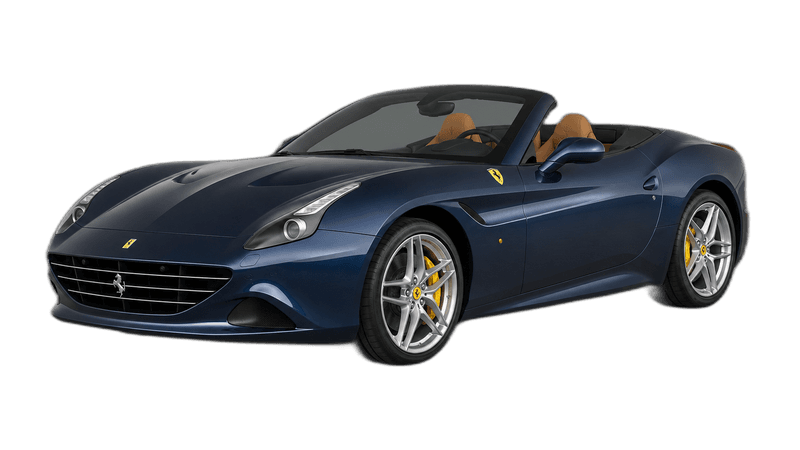
Ferrari California T
£95,000
usedIndicative market price, updated periodically.
552bhp
Power
3.6s
0-100 km/h
316km/h
Top Speed
£95,000
Price Used
How hard it pulls.
Peak g-force the instant you bury the throttle, estimated from the car's 0–100 time and drivetrain.
Ferrari California TEstimated peak launch g from the 0–100 time and drivetrain: an honest approximation, not a measured figure.
The Ferrari California T is a 2-door convertible by Ferrari, with 552 bhp, 755 Nm of torque, a 0-100 km/h time of 3.6 seconds and a top speed of 316 km/h. Indicative used value: approximately £95,000. Actual values vary with specification, condition and history.
Dream Car Garage Editorial · Last updated 29 October 2026
Overview
We have not driven this car. This review is based on published specifications and the sources listed below.
The turbocharged successor
The California T replaced the original California in 2014, announced online in February that year and built until the Portofino took over in 2017. Its engine is a 3,855 cc twin-scroll turbocharged V8 producing 552 bhp and 755 Nm, seventy horsepower more than the final California 30 it succeeded, with drive to the rear wheels through a seven-speed dual-clutch gearbox. The catalogue figures are 3.6 seconds to 100 km/h and 316 km/h. The T brought new sheet metal, a revised interior, longer gearing for refinement, stiffer suspension and quicker steering, keeping the folding hard-top format and the 2+2 cabin that defined the model as Ferrari's everyday GT.
We have not driven this model for this article. This desk-researched ownership guide relies on Ferrari's official California T page, the PistonHeads used buying guide for the California, which is first-generation focused and explicitly notes the turbocharged T awaited its own guide at publication, and the DVSA vehicle recall service. The PistonHeads article is therefore strongest on the platform's shared checks, and its observations should be read as inspection prompts for the individual example rather than predictions that every California T will behave the same way.
The engine and the checks that carry over
The twin-scroll turbo V8 belongs to the F154 family that has since powered the 488, Portofino and Roma lines, which means strong specialist familiarity. Turbo plumbing, intercooler condition and wastegate behaviour are modern rather than exotic checks. From the first-generation guide, several items carry over as platform themes: engine mounts can sag, and the Getrag-supplied dual-clutch unit suffered connector failures on early cars, with a soldered-connection fix now routine at specialists. Any hesitation, slow shifts or oil traces around the gearbox argue for a diagnostic session. The crankshaft recall that affected a small number of 2009 cars belongs to the first generation, but verifying recall completion on any candidate through the DVSA service remains a two-minute check worth making.
The cooling system, hoses and undertray condition deserve a look on any turbo car, and a smoke or pressure test on the intake is cheap assurance. There is no cambelt to worry about; the timing chains are durable with clean oil history.
Roof, chassis and specification
The folding hard top opens in about fourteen seconds and was intended to operate with the car stationary; forcing it while rolling stresses the mechanism. Check it through several complete cycles, listening for strained motors and watching the seals for trapped debris, which is the usual cause of faults. The multi-link rear suspension and transaxle layout give a rearward weight bias. The HS-style handling specification transforms the car; verify which suspension the example carries and test the damper modes.
Specification swings value on this model more than most Ferraris, because option weight varied dramatically between press cars and real orders. Daytona seats, carbon trim, handling packs and colour combinations all move the needle. The service plan attached to the car and any remaining Ferrari Approved warranty coverage materially change the first years' costs, so ask for the file rather than assumptions.
The turbo engine's character
The twin-scroll architecture was chosen specifically to answer the criticism that turbocharging dulled response: one scroll per cylinder bank, with boost shaping that varies by gear so the torque delivery feels progressive rather than stepped. Ferrari's Variable Boost Management maps torque differently in successive gears, which is why published road tests found the T more linear than its predecessor despite the huge torque increase. For an owner the practical notes are simple: let the engine warm before asking for boost, use the correct oil grade and change it on schedule, and listen for wastegate rattle on a cold start. A healthy engine pulls cleanly from low revs and whistles rather than hisses under load.
Handling options and the used position
The Handling Speciale option, carried over from the later first-generation cars, brought stiffer springs, magnetorheological dampers and a quicker steering rack, and it transforms the car's responses without ruining the ride. Many Ts were ordered without it, assuming the folding roof and GT brief made it irrelevant; that assumption is worth revisiting on a test drive, because the standard car is comfort-biased in a way the HS car is not. On the used market the T has followed the predictable path of a turbocharged grand-touring Ferrari: steeper early depreciation than the mid-engine cars, then a long plateau as the value case against its successor became obvious. Depreciation is not guaranteed to continue, and this guide makes no investment claim either way.
Buying and values
The California T sits at the accessible end of the modern Ferrari market, bought by people who intend to use it. That is a virtue: cars with continuous annual servicing, honest mileages and working roofs are common, and the specialist network is broad. The checks that protect a buyer are unglamorous: gearbox behaviour, engine mounts, roof health, air-conditioning performance, tyre age and a complete set of invoices. An engine failure on this family is a five-figure event, so a compression and leak-down assessment plus a scan for stored fault codes is money well spent on any candidate without a recent major service.
We have not driven this model for this article. No present valuation, investment assurance or universal failure rate is offered. The California T's value as an ownership proposition is the combination of genuine turbocharged performance, open-top usability and running costs closer to a sports car than a supercar. Buy on roof and gearbox health, suspension specification and the completeness of the service file, and the everyday-Ferrari brief is exactly what the car delivers.
Specifications
Engine
3.9L (3855 cc) twin-turbo V8 petrol
Displacement
3.9L
Power
552 bhp
Torque
755 Nm
0-100 km/h
3.6s
Top Speed
316 km/h
Drivetrain
RWD
Country
Italy
Body Style
2-door convertible
Years
2014–2017
Price Used
£95,000
Specifications are manufacturer-published figures.
More from Ferrari
Frequently Asked Questions
What are the specifications of the Ferrari California T?
The Ferrari California T is a 2-door convertible by Ferrari, with 552 bhp, 755 Nm of torque, a 0-100 km/h time of 3.6 seconds and a top speed of 316 km/h. Indicative used value: approximately £95,000. Actual values vary with specification, condition and history.
How much does a Ferrari California T cost?
Indicative used value: approximately £95,000. Actual values vary with specification, condition and history.
What drivetrain does the Ferrari California T use?
The Ferrari California T is configured with rear-wheel drive.
What type of car is the Ferrari California T?
The Ferrari California T is a hyper gts manufactured by Ferrari in Italy. Production ran from 2014 to 2017.