
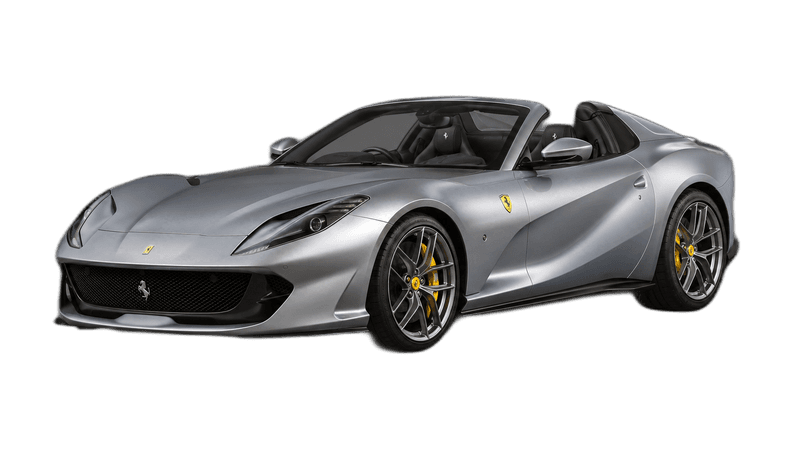
Ferrari 812 GTS Spider
£340,000
usedIndicative market price, updated periodically.
789bhp
Power
2.9s
0-100 km/h
340km/h
Top Speed
£340,000
Price Used
How hard it pulls.
Peak g-force the instant you bury the throttle, estimated from the car's 0–100 time and drivetrain.
Ferrari 812 GTS SpiderEstimated peak launch g from the 0–100 time and drivetrain: an honest approximation, not a measured figure.
The Ferrari 812 GTS Spider is a 2-door convertible by Ferrari, with 789 bhp, 718 Nm of torque, a 0-100 km/h time of 2.9 seconds and a top speed of 340 km/h. Indicative used value: approximately £340,000. Actual values vary with specification, condition and history.
Dream Car Garage Editorial · Last updated 29 October 2026
Overview
We have not driven this car. This review is based on published specifications and the sources listed below.
The V12 returns to open form
The 812 GTS was unveiled in September 2019 as the convertible companion to the 812 Superfast, and it carried a significance beyond its specification: it was the first series-production front-engined V12 spider Ferrari had built in fifty years. Production ran to 2023. The engine is the F140 GA, a 6,496 cc naturally aspirated V12 producing 789 bhp and 718 Nm, revving to 8,900 rpm and driving the rear wheels through a seven-speed dual-clutch gearbox. Ferrari quotes 2.9 seconds to 100 km/h and 340 km/h, matching the Superfast despite the open car's extra weight of roughly 90 kilograms. The retractable hard top opens or closes in about 14 seconds at speeds of up to 45 km/h.
We have not driven this model for this article. This desk-researched ownership guide draws on Ferrari's official 812 GTS page, the PistonHeads used buying guide for the 812 Superfast that covers the GTS, and the DVSA vehicle recall service. The PistonHeads article concentrates on the coupe but explicitly extends to the GTS, and everything it records about the engine, gearbox and running gear applies to both.
The F140 engine and its known weak points
The F140 is the most powerful naturally aspirated production engine Ferrari has offered, and it is the defining reason to buy this car. The 6,496 cc displacement is a stroked development of the F12's 6,262 cc unit, with direct injection at 350 bar. Peak power arrives at 8,500 rpm and 718 Nm of torque is delivered at 7,000 rpm, though 80 percent is available from 2,500 rpm. Cars first registered after January 2020 carry a petrol particulate filter, which slightly softens the exhaust note and is worth knowing before a test drive.
PistonHeads records a specific oil-leak pattern on pre-2020 cars: oil pooling on the engine's left side, traced to a warped solenoid valve holder cover. Gaskets and revised plates are the fix, though the guide notes that plates can warp again and that porous intake manifold castings have also been blamed for similar symptoms. Coolant overflow after a hot run appears in the same files. Check the engine bay for fresh weep lines, ask for photographic evidence of any top-end work, and treat a spotless engine with recent degreasing as a prompt for closer inspection rather than reassurance. Fuel-system components also appear in the fault records, including replaced fuel rails and a high-pressure pump on one 2020 car.
Gearbox and electrical systems
The seven-speed Magna dual-clutch unit shifts 30 percent more quickly on upshifts and 40 percent more quickly on downshifts than the F12's box, with the ability to drop three gears in about a second. Verify clean engagement from cold and no shudder at parking speeds.
The electrical ledger is longer. PistonHeads describes one car generating more than fifty warning lights over three years, ultimately traced to battery condition and, tellingly, to an aftermarket exhaust and immobiliser that had compromised the electronics. That last point deserves emphasis: unauthorised modifications can void warranty cover on this generation. Other recorded complaints include alternator voltage regulators, false start-stop warnings, a battery-cable connection causing dashboard failure, a brake-fluid reservoir cap recall, USB and camera glitches cured by a control-module reset after fifteen minutes of rest, and a speed-warning buzzer fixed at the dealer. Headlight lenses have been reported to crack at their edges. Run the DVSA check for open recalls, confirm all software campaigns are complete, and walk away from cars with unexplained electrical histories.
Body, roof and running gear
The GTS carries a redesigned rear diffuser compared with early Superfasts, addressing a complaint on pre-spring-2019 coupes where the diffuser sat visibly low on one side. Confirm the body panels are even, inspect the paint for prior repairs, and cycle the hard top several times watching for smooth hydraulic operation. Hatch rattles are recorded on the family, so test over broken surfaces with the roof raised and lowered.
Tyres are 275-series front and 315-series rear on 20-inch wheels; carbon-ceramic brakes are standard. Check date codes as carefully as tread, measure the discs, and confirm the wear-sensor software is current.
The Competizione shadow and the GTS's place
The 812 range closed with the Competizione, a limited run of 999 coupes plus 599 open cars, whose engine was tuned to 830 horsepower with a 9,250 rpm power peak. Those cars command their own market and are a different buying exercise entirely. For the standard GTS, the Competizione's existence matters in one practical way: it confirms the F140 engine had headroom, and the standard tune is the long-life specification rather than a stressed special. GTS values relative to the Superfast coupe follow the usual convertible pattern of a modest premium, and the GTS's smaller production run gives it a distinct identity. As with any recently-ended Ferrari, presentation and completeness drive the market more than mileage alone.
Warranty, servicing and buying order
When new, the 812 carried a four-year warranty in the UK extendable to seven years or 120,000 kilometres, and Ferrari's seven-year maintenance programme transfers with the car, covering routine servicing on an annual or 20,000-kilometre basis. Confirm what remains on the individual example. Orders were stopped in early 2022, so late cars are uncommon and presentation matters.
We have not driven this model for this article. No present valuation, investment assurance or universal failure rate is offered. The 812 GTS's value as an ownership proposition is the combination of the most highly developed naturally aspirated V12 Ferrari has built with open-air use, at the cost of genuine diagnostic discipline on the electrical side. Buy on documented top-end work, a clean electrical history free of unauthorised modification, roof condition and service continuity.
Specifications
Engine
6.5L (6496 cc) naturally aspirated V12 petrol
Displacement
6.5L
Power
789 bhp
Torque
718 Nm
0-100 km/h
2.9s
Top Speed
340 km/h
Drivetrain
RWD
Country
Italy
Body Style
2-door convertible
Years
2019–2023
Price Used
£340,000
Specifications are manufacturer-published figures.
More from Ferrari
Frequently Asked Questions
What are the specifications of the Ferrari 812 GTS Spider?
The Ferrari 812 GTS Spider is a 2-door convertible by Ferrari, with 789 bhp, 718 Nm of torque, a 0-100 km/h time of 2.9 seconds and a top speed of 340 km/h. Indicative used value: approximately £340,000. Actual values vary with specification, condition and history.
How much does a Ferrari 812 GTS Spider cost?
Indicative used value: approximately £340,000. Actual values vary with specification, condition and history.
What drivetrain does the Ferrari 812 GTS Spider use?
The Ferrari 812 GTS Spider is configured with rear-wheel drive.
What type of car is the Ferrari 812 GTS Spider?
The Ferrari 812 GTS Spider is a hyper gts manufactured by Ferrari in Italy. Production ran from 2019 to 2023.