
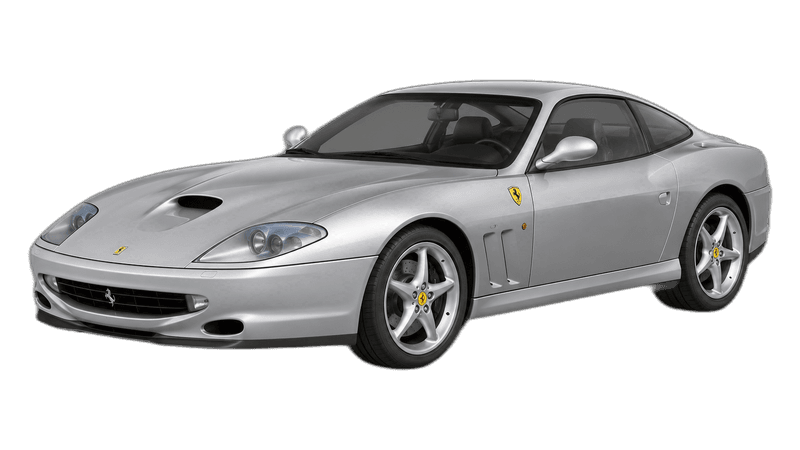
Ferrari 550 Maranello
£165,000
usedIndicative market price, updated periodically.
478bhp
Power
4.4s
0-100 km/h
320km/h
Top Speed
£165,000
Price Used
How hard it pulls.
Peak g-force the instant you bury the throttle, estimated from the car's 0–100 time and drivetrain.
Ferrari 550 MaranelloEstimated peak launch g from the 0–100 time and drivetrain: an honest approximation, not a measured figure.
The Ferrari 550 Maranello is a 2-door coupe by Ferrari, with 478 bhp, 570 Nm of torque, a 0-100 km/h time of 4.4 seconds and a top speed of 320 km/h. Indicative used value: approximately £165,000. Actual values vary with specification, condition and history.
Dream Car Garage Editorial · Last updated 28 October 2026
Overview
We have not driven this car. This review is based on published specifications and the sources listed below.
A front-engine V12 with a rear transaxle
The 550 Maranello is a two-seat, rear-wheel-drive coupe powered by a 5,474 cc naturally aspirated dry-sump V12. Ferrari quotes 485 CV, approximately 478 bhp, 570 Nm and 320 km/h. The PistonHeads guide lists 420 lb ft and 4.4 seconds to 62 mph. Its single-plate clutch, six-speed manual gearbox and rear transaxle are central to the car's layout.
We have not driven this model for this article. The sources are Ferrari's model history, the multi-part PistonHeads 550 buying guide and Ferrari's VIN recall service. The PistonHeads material dates from 2012, so prices, warranty statements and ownership-cost examples are not current quotations. Its production figure is not adopted here because an independent estimate is not an official model allocation.
Belts, seals and coolant in the V
Inspect cambelt history by date as well as mileage and request invoices for associated seal work. PistonHeads notes that camshaft seals can leak and are sensible to address during belt replacement. Access is better than on some mid-engine Ferraris, but accessibility does not establish that the work was completed. Ask exactly which belts, seals, tensioners and fluids were changed.
Coolant hoses beneath the intake V can age and split. The guide also describes water from blocked scuttle drains reaching the engine-control unit. Inspect for dampness, staining and previous electrical investigation rather than assuming a dry engine bay on the viewing day proves the drains are clear. Oil around the cam covers or under the car should be traced to its source.
Manual gearbox and clutch behaviour
Assess the clutch and gear selection cold and warm. PistonHeads discusses early gearboxes that could refuse selection or jump out of first, third or fifth. These are prompts to test and diagnose the individual gearbox, not evidence that every 550 will fail. Record any noise, reluctance or movement out of gear for a Ferrari specialist rather than accepting a restart or a short demonstration as resolution.
The guide mentions a gearbox oil-cooler pipe recall. Verify the actual chassis through Ferrari's VIN service and dealer records instead of treating the model-wide production dates as proof of completion. Inspect the transaxle, cooler pipes and underside for leaks or contact. Historic clutch-life and gearbox-cost figures in the article are not reliable estimates for a present repair.
Suspension, steering and wheel history
Tyres make a significant difference to the 550's balance. Check approved sizes, matching type, date and wear, and compare the results with an alignment report. PistonHeads lists 225/40 ZR18 front and 295/35 ZR18 rear tyres. A fresh set is not evidence that earlier wear, steering free play or suspension deterioration has been resolved.
Early magnesium wheels and later alloys warrant close inspection for cracks, corrosion and kerbing. The guide describes a wheel recall involving insert bolts and overtightening. It also mentions steering-rack and handbrake-ratchet campaigns. Treat these as reasons to check the VIN and dealer history, not as a complete list of everything affecting every car. Inspect the rack, bushes and hub bearings for wear.
Brakes, underside and fluid leaks
The original specification uses 330 mm front and 310 mm rear brakes. Measure pad and disc condition and inspect hoses and fluid history. PistonHeads advises checking undertrays for cuts and damage, including evidence that the oil drain plug has contacted the ground. Removing a tray where appropriate reveals more than a photograph taken from outside the car.
Look for oil, coolant and hydraulic leaks after the car has stood following a run. A clean undertray can hide evidence above it, so the inspection should cover both visible surfaces and the source of any residue. Ask the specialist to distinguish a cosmetic issue from a leak requiring immediate work and to provide a current estimate rather than relying on the old article's prices.
Aluminium body and accident repairs
The 550 combines aluminium body panels with a tubular steel structure and composite bumpers. Inspect panel gaps, overspray, fastener marks and paint finish for accident repairs. Oxidation can appear along the bonnet's leading edge, boot lip and wheelarches. Radiator-shroud oxidation may be cosmetic, but the inspector should identify the affected material and extent rather than dismissing every white deposit.
A bonnet warning at speed can relate to seal or adjustment issues, but any warning deserves diagnosis. Do not continue a road test with an unresolved concern about the bonnet. Check latch operation, seals and previous adjustment. The useful question is whether the individual car closes and remains secure correctly, not whether an old guide mentioned a similar symptom.
Cabin, equipment and ownership file
Test electric seats, steering-column adjustment, glovebox, windows and air conditioning. PistonHeads notes steering-column lock and free-play concerns, glovebox hinge failures and window mechanisms that can become slow or sticky. Inspect leather bolsters and dashboard condition, particularly where an aftermarket stereo has been fitted. Confirm that the tyre inflator, tools, keys and manuals are present.
Dampness in the boot after wet opening is a reason to inspect seals and drainage, not proof of a structural leak. Regular use and documented maintenance are preferable to prolonged inactivity. Match invoices with inspection findings and ownership history, and record anything that could not be demonstrated during the viewing.
Sources and campaign checks
Ferrari's recall tool requires the full VIN and displays open campaigns. Retain dealer confirmation of completed work and check any outstanding recall directly with an authorised centre. The guide's examples do not establish that this chassis is affected, and a clear result does not verify unrelated repairs or service quality.
We have not driven this model for this article. This guide offers no present valuation, investment prediction or universal reliability claim. The production count remains unset because the available independent figure is not treated as an official allocation. A specialist inspection, continuous belt and fluid history, careful gearbox assessment and documented recall status provide more useful evidence than a low odometer or polished engine bay alone.
Specifications
Engine
5.5L (5474 cc) naturally aspirated V12
Displacement
5.5L
Power
478 bhp
Torque
570 Nm
0-100 km/h
4.4s
Top Speed
320 km/h
Drivetrain
RWD
Country
Italy
Body Style
2-door coupe
Years
1996–2001
Price Used
£165,000
Specifications are manufacturer-published figures.
More from Ferrari
Frequently Asked Questions
What are the specifications of the Ferrari 550 Maranello?
The Ferrari 550 Maranello is a 2-door coupe by Ferrari, with 478 bhp, 570 Nm of torque, a 0-100 km/h time of 4.4 seconds and a top speed of 320 km/h. Indicative used value: approximately £165,000. Actual values vary with specification, condition and history.
How much does a Ferrari 550 Maranello cost?
Indicative used value: approximately £165,000. Actual values vary with specification, condition and history.
What drivetrain does the Ferrari 550 Maranello use?
The Ferrari 550 Maranello is configured with rear-wheel drive.
What type of car is the Ferrari 550 Maranello?
The Ferrari 550 Maranello is a gts manufactured by Ferrari in Italy. Production ran from 1996 to 2001.