
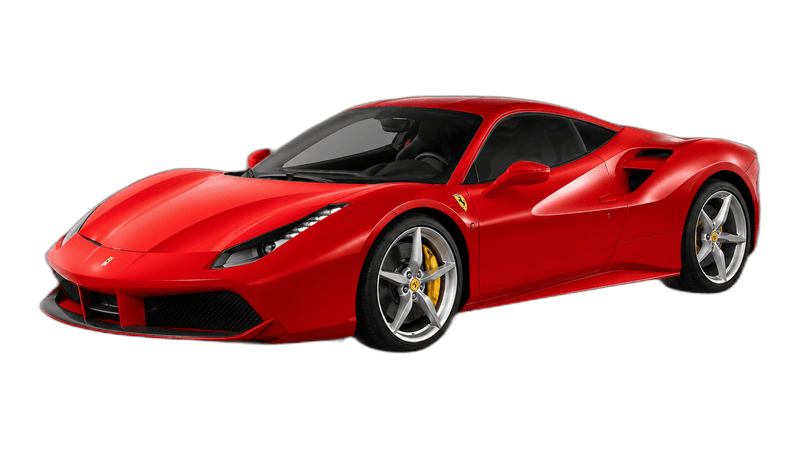
Ferrari 488 GTB
£195,000
usedIndicative market price, updated periodically.
661bhp
Power
3s
0-100 km/h
330km/h
Top Speed
£195,000
Price Used
How hard it pulls.
Peak g-force the instant you bury the throttle, estimated from the car's 0–100 time and drivetrain.
Ferrari 488 GTBEstimated peak launch g from the 0–100 time and drivetrain: an honest approximation, not a measured figure.
The Ferrari 488 GTB is a 2-door coupe by Ferrari, with 661 bhp, 760 Nm of torque, a 0-100 km/h time of 3 seconds and a top speed of 330 km/h. Indicative used value: approximately £195,000. Actual values vary with specification, condition and history.
Dream Car Garage Editorial · Last updated 29 October 2026
Overview
We have not driven this car. This review is based on published specifications and the sources listed below.
From 458 to turbocharged 488
The 488 GTB arrived in 2015 as the turbocharged successor to the 458 Italia. It is a rear-wheel-drive coupe powered by a 3,902 cc twin-turbocharged V8. Ferrari lists 661 bhp, 760 Nm, 3 seconds to 100 km/h and 330 km/h, with power sent through a seven-speed dual-clutch gearbox. This guide covers the standard coupe built between 2015 and 2019. The Spider shares the mechanical core, the Pista is a lighter, more powerful track model and the F8 Tributo replaced the GTB for 2020. A seller who describes a car simply as a 488 may mean any of those, so confirm the exact variant from the build record before anything else.
We have not driven this model for this article. This desk-researched ownership guide uses Ferrari's official 488 GTB page, the PistonHeads used buying guide for the 488 family and the DVSA vehicle recall service. The PistonHeads article is a general 488 guide rather than a fault census of the GTB specifically, so its observations are prompts for inspection of the individual car, not predictions that every example will develop the same faults.
The F154 V8 and its known checks
The F154 flat-plane V8 uses IHI turbochargers with gamma-titanium turbine vanes, and reviewers repeatedly praised its immediate throttle response for a turbocharged engine. PistonHeads records one mechanical failure pattern worth knowing: a faint fan-like flutter from a rear air intake accompanied by a loss of power can indicate a failed turbocharger, and the guide quoted replacement unit prices of around 10,000 pounds each at the time, excluding fitting. Treat that figure as historical context and obtain a current written quotation if the fault is suspected. The same guide notes that a manufacturing flaw in a low-pressure fuel line was found on very early cars and rectified before customer delivery, which means it should not appear on a road-registered example, but the episode is a reminder to confirm that all campaign work is documented.
Check for oil and coolant staining around the engine bay and undertrays, and inspect the intake plumbing for secure joints. Ask for diagnostic records from before any warning lights were cleared, and establish the reason for any replaced turbocharger, intercooler or fuel-system component rather than accepting that the work is simply done.
Gearbox, brakes and the AVH question
The seven-speed Getrag dual-clutch transmission has a strong reputation, but verify clean engagement from a cold start, smooth parking-speed behaviour and an absence of hydraulic warning messages. Carbon-ceramic brakes were standard, developed with technology from the LaFerrari programme. Measure disc condition and thickness, confirm the wear-sensor software is current and obtain a written estimate for any disc or pad work before relying on it in the price.
PistonHeads reports that an Automatic Vehicle Hold failure on a 488 can require replacing a significant number of brake-related parts, at a cost the guide put at around 15,000 pounds. Test the AVH function, confirm the electronic parking brake applies and releases cleanly and ask whether any such work has been done. The guide also records a small number of cars where the software warning for worn brake discs did not function, which was addressed by recall, and some reported steering-rack failures. Neither becomes a general claim about the model; both become specific questions in an inspection.
Chassis, aerodynamics and tyres
The 488's chassis works with active aerodynamic flaps, an electronic differential and the second-generation Side Slip Control system, with a bumpy-road damper setting that reviewers found useful on British roads. None of that complexity should be taken on trust. Look for error codes in the stability and damping systems, confirm the dampers respond to mode changes and inspect the underbody and intakes for damage.
Tyres wear quickly at the outer edges on hard-driven cars, so read the tread across the full width, check date codes and relate any inner-edge wear to an alignment report. A geometry printout from a marque specialist is worth more than a visual estimate, because the car's high-grip setup makes wear patterns informative.
Body, interior and recall paperwork
The 488 was affected by the Takata airbag recall, so the paperwork should show the inflator replacement. The battery sits behind a flap in the passenger footwell, and Ferrari provided a trickle-charger socket in the tail; ask how the car was stored and how often it was charged. The air conditioning is adequate rather than generous in hot climates, which makes a full system check sensible. Inspect seat bolsters for the wear that follows tight cabin access, and check that the LED shift-light steering wheel, parking camera and infotainment all work as fitted.
Warranty, servicing and buying order
When new, the 488 came with a three-year warranty and a seven-year main-dealer servicing package that transfers with the car. Ferrari's New Power warranties extend cover on eligible cars for up to 15 years from first registration. Confirm what remains on the individual car, and match annual service invoices to the dates and mileages in the file. A pre-purchase inspection by a Ferrari specialist, with a written report separating measured findings from the seller's account, is the correct basis for negotiation.
We have not driven this model for this article. No present valuation, investment assurance or universal failure rate is offered. The 488 GTB's value as an ownership proposition is its combination of a proven twin-turbo V8, a strong transmission and a chassis that rewards measured use. Buy on documented turbo health, completed recall work and continuity of maintenance, not on the badge's reputation alone.
Specifications
Engine
3.9L (3902 cc) twin-turbo V8 petrol
Displacement
3.9L
Power
661 bhp
Torque
760 Nm
0-100 km/h
3s
Top Speed
330 km/h
Drivetrain
RWD
Country
Italy
Body Style
2-door coupe
Years
2015–2019
Price Used
£195,000
Specifications are manufacturer-published figures.
More from Ferrari
Frequently Asked Questions
What are the specifications of the Ferrari 488 GTB?
The Ferrari 488 GTB is a 2-door coupe by Ferrari, with 661 bhp, 760 Nm of torque, a 0-100 km/h time of 3 seconds and a top speed of 330 km/h. Indicative used value: approximately £195,000. Actual values vary with specification, condition and history.
How much does a Ferrari 488 GTB cost?
Indicative used value: approximately £195,000. Actual values vary with specification, condition and history.
What drivetrain does the Ferrari 488 GTB use?
The Ferrari 488 GTB is configured with rear-wheel drive.
What type of car is the Ferrari 488 GTB?
The Ferrari 488 GTB is a supercars manufactured by Ferrari in Italy. Production ran from 2015 to 2019.