
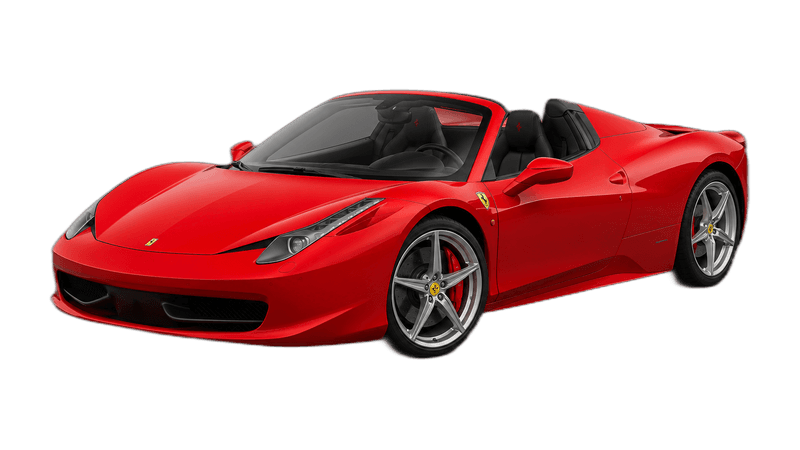
Ferrari 458 Spider
£195,000
usedIndicative market price, updated periodically.
562bhp
Power
3.4s
0-100 km/h
320km/h
Top Speed
£195,000
Price Used
How hard it pulls.
Peak g-force the instant you bury the throttle, estimated from the car's 0–100 time and drivetrain.
Ferrari 458 SpiderEstimated peak launch g from the 0–100 time and drivetrain: an honest approximation, not a measured figure.
The Ferrari 458 Spider is a 2-door convertible by Ferrari, with 562 bhp, 540 Nm of torque, a 0-100 km/h time of 3.4 seconds and a top speed of 320 km/h. Indicative used value: approximately £195,000. Actual values vary with specification, condition and history.
Dream Car Garage Editorial · Last updated 29 October 2026
Overview
We have not driven this car. This review is based on published specifications and the sources listed below.
The last naturally aspirated open V8
The 458 Spider was sold from 2011 to 2015 and shares the F136 engine with the Italia coupe: a 4,499 cc naturally aspirated V8 producing 562 bhp at 9,000 rpm and 540 Nm, good for 3.4 seconds to 100 km/h and 320 km/h through a seven-speed dual-clutch gearbox and rear-wheel drive. It is a defining model because it is the last of Ferrari's naturally aspirated mid-engine V8 spiders. This guide covers the Spider; the Italia is the coupe and the Speciale Aperta is the limited, more powerful derivative. Confirm the variant from the documentation.
We have not driven this model for this article. This desk-researched ownership guide uses Ferrari's official 458 Spider page, the PistonHeads buying guide for the 458 family and the DVSA vehicle recall service. The PistonHeads article is centred on the Italia coupe, so coupe observations are applied here only where the mechanical package is shared; Spider-specific points are identified as such.
The F136 engine and its history
PistonHeads records that a number of early cars, around 2012, left the factory with incorrectly fitted crankshafts, leading to engine seizure and a recall covering a few hundred cars. At least one high-mileage example has shown excessive camshaft wear. These are not predictions about every 458; they are reasons to read the engine's service history carefully. Ask for evidence that the crankshaft campaign was completed where applicable, inspect for oil leaks and listen for valvetrain noise from cold. The engine's character depends on valve clearances and cam timing being right, so a specialist's mechanical report matters more here than a test of outright performance.
The 90-litre tank and chain-driven cams remove any cambelt question. The exhaust routing and silencers were changed for the Spider to manage turbulence with the roof down, so any replacement exhaust should follow the Spider pattern, and a system modified for noise alone deserves a technical and insurance explanation.
Dual-clutch gearbox and clutch health
The seven-speed Getrag dual-clutch is strong in service but PistonHeads notes that transmission failures in early 458s are not unknown, while observing that Ferrari supported customers experiencing serious gearbox problems. Clutch issues were often resolved through software updates or a reset of the clutch position sensors; the guide contrasted that with the cost of a full clutch assembly, at not far short of 20,000 pounds at the time. Establish whether the car has had software updates, a sensor reset or clutch work, and treat a juddering take-up or slow engagement as a reason for diagnosis rather than acceptance.
Carbon-ceramic brakes, steering and alignment
Carbon-ceramic brakes were standard. PistonHeads quoted an original disc at 2,500 pounds plus VAT each at the time, with a minimum working thickness marked on the disc of 35.5 mm, and noted that a millimetre of wear goes a long way. Measure rather than estimate. The guide also records that the 458's geometry can produce accelerated inner-edge tyre wear, so read the full tread width, check date codes and obtain an alignment report from a marque specialist. The magnetorheological dampers are expensive components; the guide put a pair at around 3,000 pounds. Confirm they respond to mode changes and show no leakage.
Spider roof, body and known recalls
The Spider's roof does not open on the move, and with it lowered the shallow aperture gives more of a targa feel than a full convertible. PistonHeads describes the Spider body as extremely solid, with at most a mild tremor over rough ground. Test the roof through full cycles, check seals and drainage and look for water marking in the cabin and boot.
Two recall families matter. The earliest cars had a combustible adhesive fixing the rear wheelarch liners, which led to a small number of engine-bay fires in warm climates and a recall replacing the glue with fasteners. Separately, a passenger airbag recall, the Takata campaign, was in progress when the guide was written. Check the DVSA service with the registration or VIN and ask for the manufacturer's campaign evidence for both.
Interior, electronics and paperwork
Expect age-related rather than fundamental cabin issues: rippling in the leather across the dash, sticky soft-touch coatings on switches in hot climates, and a headlining that can detach from the roof panel. PistonHeads also records faulty fuel senders and occasional TFT screen and warning-light faults, plus a headlight module warning that may need a modestly priced module or, failing that, a complete headlight unit at a much higher cost. Test every function and record intermittent faults for diagnosis.
From 2012 the 458 came with a seven-year service package, and powertrain warranties have been available for eligible cars. Specialist service pricing quoted by the guide is historical, so obtain current quotations. Match invoices to dates and mileages, and prefer a car with 10,000 to 20,000 miles of documented use over an ultra-low-mileage car whose early problems may never have surfaced.
Seller questions and documentation checks
Ask the seller how long they have owned the car and why it is being sold, then match the answer to the paperwork. Verify that the service book stamps correspond to the invoices and that the registered keeper on the registration document matches the seller. A history check should confirm the vehicle identification number, reveal any outstanding finance and flag insurance write-offs. Check the number of keepers against the advertisement, and treat a mismatch as a question for the seller rather than an accusation. Cars with several recent short-term owners deserve a closer look at the service file and a longer specialist inspection before any deposit changes hands.
We have not driven this model for this article. No present valuation, investment assurance or universal failure rate is offered. The 458 Spider's ownership case is its engine: Ferrari's last naturally aspirated V8 in an open body. Buy on engine and gearbox history, completed recalls and measured brakes, not on mileage alone.
Specifications
Engine
4.5L (4499 cc) naturally aspirated V8 petrol
Displacement
4.5L
Power
562 bhp
Torque
540 Nm
0-100 km/h
3.4s
Top Speed
320 km/h
Drivetrain
RWD
Country
Italy
Body Style
2-door convertible
Years
2011–2015
Price Used
£195,000
Specifications are manufacturer-published figures.
More from Ferrari
Frequently Asked Questions
What are the specifications of the Ferrari 458 Spider?
The Ferrari 458 Spider is a 2-door convertible by Ferrari, with 562 bhp, 540 Nm of torque, a 0-100 km/h time of 3.4 seconds and a top speed of 320 km/h. Indicative used value: approximately £195,000. Actual values vary with specification, condition and history.
How much does a Ferrari 458 Spider cost?
Indicative used value: approximately £195,000. Actual values vary with specification, condition and history.
What drivetrain does the Ferrari 458 Spider use?
The Ferrari 458 Spider is configured with rear-wheel drive.
What type of car is the Ferrari 458 Spider?
The Ferrari 458 Spider is a supercars manufactured by Ferrari in Italy. Production ran from 2011 to 2015.