
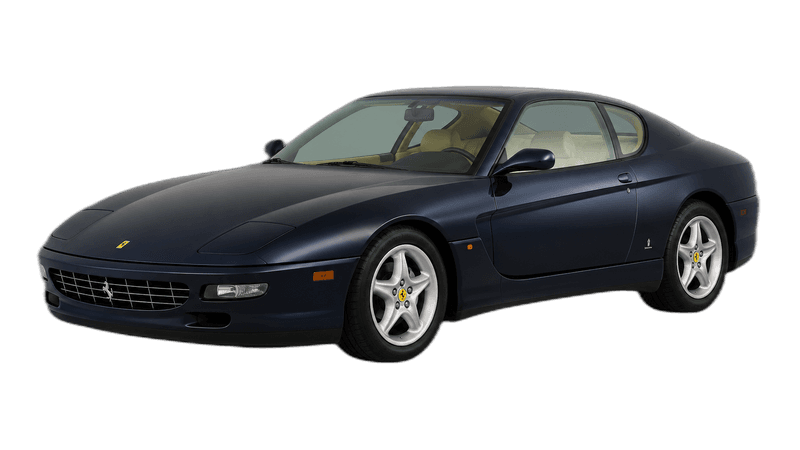
Ferrari 456 GT
£55,000
usedIndicative market price, updated periodically.
436bhp
Power
5.2s
0-100 km/h
300km/h
Top Speed
£55,000
Price Used
How hard it pulls.
Peak g-force the instant you bury the throttle, estimated from the car's 0–100 time and drivetrain.
Ferrari 456 GTEstimated peak launch g from the 0–100 time and drivetrain: an honest approximation, not a measured figure.
The Ferrari 456 GT is a 2+2 coupe by Ferrari, with 436 bhp, 550 Nm of torque, a 0-100 km/h time of 5.2 seconds and a top speed of 300 km/h. Indicative used value: approximately £55,000. Actual values vary with specification, condition and history.
Dream Car Garage Editorial · Last updated 28 October 2026
Overview
We have not driven this car. This review is based on published specifications and the sources listed below.
Establish which 456 is being sold
The 456 GT is a front-engine, rear-wheel-drive 2+2 coupe with a 5,474 cc naturally aspirated V12. Ferrari quotes 442 CV, approximately 436 bhp, 550 Nm and a top speed above 300 km/h. PistonHeads lists 5.2 seconds to 62 mph for the manual. The earlier GT has pop-up headlights; the later 456M changed the body and lighting treatment.
We have not driven this model for this article. This desk-researched guide uses Ferrari's history page, the PistonHeads 456 buying guide and Ferrari's VIN recall service. The GTA automatic uses a GM torque-converter gearbox, not the later F1 single-clutch system. Confirm the exact car rather than applying manual or automatic advice interchangeably. The guide dates from 2022, so its prices and warranty comments are historical context.
Cambelts, oil and coolant
The V12 uses cambelts. PistonHeads recommends replacement every five years irrespective of mileage, with attention to oil leaks and valve clearances. Ask for dated invoices identifying the belts, seals and any additional work rather than accepting a recent service stamp as proof. One advantage is that the belts can be replaced without removing the engine, but that does not make omitted work acceptable.
Check for oil and coolant leaks, including the cam covers and hoses beneath the intake V. Heat and age can affect hoses that are difficult to see during a casual inspection. The guide also calls out corrosion of aluminium parts near the exhaust manifold. Ask the specialist to inspect with appropriate access and record where undertrays or covers limited visibility.
Throttle, fuel and gearbox inspection
Stretch in the two throttle cables can prevent full throttle opening. PistonHeads describes adjustment as a routine remedy, but the inspection should establish free movement, correct adjustment and full opening rather than assuming every slow car has the same fault. Fuel delivery also deserves attention: the in-tank pump mounting can fail and spill fuel into the tank. A fuel smell or evidence of the plastic mount floating in the fuel requires proper diagnosis.
Inspect engine mounts and the manual gearbox oil cooler. Listen for bearing noise and assess clutch take-up and gear selection when cold and warm. The buying guide describes reverse-gear circlip failure and possible loss of reverse engagement. That is a reason for a model-familiar inspection, not a prediction that every 456 will lose reverse or require a gearbox rebuild.
Self-levelling suspension and brakes
A self-levelling rear suspension system was standard. PistonHeads discusses accumulator diaphragm failure and leaking dampers. Ask what has actually been replaced, when and why, and test the system's operation. Worn bushes and dampers can affect a heavy coupe even when the body sits at an apparently normal height.
A faulty brake-pressure switch can leave the suspension in a firmer setting. Investigate warning behaviour and ride concerns through diagnosis rather than replacing parts by guesswork. Inspect brake condition, tyre age and even wear alongside the suspension. The useful evidence is a coherent set of measurements and invoices, not a seller's assertion that the system was recently repaired without supporting detail.
Pop-up lamps, windows and cabin
Demonstrate both pop-up headlight mechanisms and the lamps themselves. The guide discusses seized mechanisms, rust and diode-related failure. A motor that eventually moves the lamp does not prove correct alignment or healthy wiring. Check the headlamp surrounds and panel fit for previous repairs, and inspect the bonnet and underside for contact consistent with the car's history.
Window regulators and glass alignment deserve a full up-and-down test on both sides. Poorly sealed glass can lead to wind noise or water ingress. Inspect the windscreen for delamination and the cabin for water marks. Try seat adjustment, handbrake operation, air conditioning and the small controls. Sticky switches and shrinking leather are age-related inspection prompts rather than reasons to dismiss an otherwise well-documented car.
Wheels, body and regular use
Look for distortion, cracks and corrosion around the wheels, and verify approved tyres on all four corners. Oxidation can affect the leading edge of the bonnet and other aluminium panels. Ask for paint and repair records where panel gaps or finish suggest earlier work. A cosmetic refinish and structural repair should not be described as the same thing in the inspection report.
Regular use and continuous specialist care are more useful than an exceptionally low odometer with long unexplained gaps. Match service entries to MOT history, storage and recommissioning work. Ask whether the car has been started and driven sufficiently to reveal charging, cooling and sealing issues, while avoiding an unplanned road test that substitutes speed for diagnosis.
Recall and provenance checks
Where prior repairs are described, ask which measurements supported the recommendation and whether the same specialist inspected the car afterwards. An estimate is not proof that work was completed, and an invoice without its diagnostic context cannot establish the condition of related systems.
Use the full VIN in Ferrari's recall service and ask a dealer to confirm any applicable work. Ferrari's tool lists open campaigns and directs outstanding recalls to an authorised dealer for free repair. A campaign affecting another 456 or another Ferrari does not establish this car's status, and a clear online result does not replace service documentation.
We have not driven this model for this article. No current price, future appreciation or universal failure rate is offered. Production estimates quoted by independent guides are not assigned as official totals. The most useful purchase file combines a cold inspection, belt and suspension records, functional checks and a clear explanation of anything that could not be tested.
Specifications
Engine
5.5L (5474 cc) naturally aspirated V12
Displacement
5.5L
Power
436 bhp
Torque
550 Nm
0-100 km/h
5.2s
Top Speed
300 km/h
Drivetrain
RWD
Country
Italy
Body Style
2+2 coupe
Years
1992–1998
Price Used
£55,000
Specifications are manufacturer-published figures.
More from Ferrari
Frequently Asked Questions
What are the specifications of the Ferrari 456 GT?
The Ferrari 456 GT is a 2+2 coupe by Ferrari, with 436 bhp, 550 Nm of torque, a 0-100 km/h time of 5.2 seconds and a top speed of 300 km/h. Indicative used value: approximately £55,000. Actual values vary with specification, condition and history.
How much does a Ferrari 456 GT cost?
Indicative used value: approximately £55,000. Actual values vary with specification, condition and history.
What drivetrain does the Ferrari 456 GT use?
The Ferrari 456 GT is configured with rear-wheel drive.
What type of car is the Ferrari 456 GT?
The Ferrari 456 GT is a gts manufactured by Ferrari in Italy. Production ran from 1992 to 1998.