
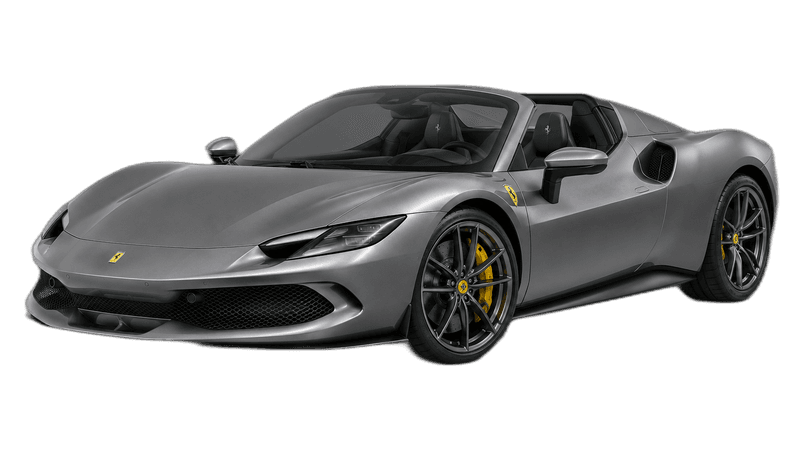
Ferrari 296 GTS
£260,000
usedIndicative market price, updated periodically.
819bhp
Power
2.9s
0-100 km/h
330km/h
Top Speed
£260,000
Price Used
How hard it pulls.
Peak g-force the instant you bury the throttle, estimated from the car's 0–100 time and drivetrain.
Ferrari 296 GTSEstimated peak launch g from the 0–100 time and drivetrain: an honest approximation, not a measured figure.
The Ferrari 296 GTS is a 2-door convertible by Ferrari, with 819 bhp, 740 Nm of torque, a 0-100 km/h time of 2.9 seconds and a top speed of 330 km/h. Indicative used value: approximately £260,000. Actual values vary with specification, condition and history.
Dream Car Garage Editorial · Last updated 29 October 2026
Overview
We have not driven this car. This review is based on published specifications and the sources listed below.
The open version of the V6 hybrid
The 296 GTS arrived in 2022 alongside the 296 GTB and shares its powertrain completely. The F163 engine is a 2,992 cc V6 with a 120-degree bank angle and turbos mounted inside the vee, making 654 bhp on its own. A single electric motor between engine and gearbox brings the combined output to 819 bhp and 740 Nm, with a quoted 2.9 seconds to 100 km/h and 330 km/h. The mid-mounted engine drives the rear wheels. The difference is the roof: where the GTB is a fixed coupe, the GTS carries a retractable hard top that opens or closes in around 14 seconds and can be operated on the move. The 296 Speciale derivative followed later in focused form.
We have not driven this model for this article. This desk-researched ownership guide uses Ferrari's official 296 GTS page, the PistonHeads review of the 296 GTB for the shared powertrain engineering, and the DVSA vehicle recall service. The PistonHeads article addresses the coupe rather than the spider specifically, so everything it records about the engine, hybrid system and chassis applies equally here, while roof-specific points come from the official specification and general inspection practice.
Powertrain checks carried over from the GTB
Every mechanical and electrical check that applies to the GTB applies to the GTS. The 120-degree crank is built by heating and twisting the forging three times, maximum engine speed is 8,500 rpm, and the IHI turbos are rated to 180,000 rpm. The 7.4 kWh battery sits low behind the seats, around 6 kWh of it useable, feeding an electric motor some 54 millimetres thick. Electric-only range is about 15 miles and a full charge takes roughly two and a half hours. Total hybrid hardware adds around 130 kilograms. Confirm battery state of health with a diagnostic readout, verify the charging cable and wallbox compatibility, and treat any turbo noise, oil weep or stored high-voltage fault as a specialist inspection item.
The eight-speed dual-clutch gearbox shares its architecture with the SF90 and includes a mechanical reverse. Check for clean engagement from cold, smooth low-speed behaviour and an absence of clutch-slip shudder under part throttle.
The retractable hard top and open-air structure
The roof is the GTS-specific item and it earns its own inspection. Cycle it several times, warm and cold, watching for even movement and listening for hydraulic strain. Check the seals around the header rail and side glass for compression set, and inspect the roof stowage area for water staining that would indicate a drainage problem. Cars that live outside deserve closer scrutiny here than garage-kept examples. With the roof open, confirm that the rear window and wind management work as intended, and check the heated rear screen where fitted.
Structurally, removing the fixed roof costs some rigidity, which Ferrari addresses with revised underbody bracing. On a test drive this shows up as cowl shake over broken surfaces rather than as a fault. An unusually floppy example may have worn suspension bushes rather than a weak structure, but the distinction is for a specialist to make.
Battery state of health matters on the GTS exactly as on the GTB. Ask for the diagnostic capacity readout, confirm the charging cable is included, and check the high-voltage system for stored fault history. With the roof open, the engine note is more present, which makes any turbo whistle or drivetrain drone easier to detect on a test session; use that. Tyres age out before they wear out on this kind of car, so check date codes and storage history as carefully as tread depth, and measure the carbon-ceramic discs before negotiating.
Chassis and brakes
The GTS carries the same ABS EVO braking system with its six-way chassis dynamics sensor as the GTB, and the same active rear spoiler contributing to a claimed maximum downforce of 360 kilograms at 155 mph. The Assetto Fiorano pack was offered on the GTS as on the coupe, trimming weight with a Lexan screen and adding Cup 2 R tyres. Measure the carbon-ceramic discs and pads, confirm the wear-monitoring software is current, and verify that the active aero and damper systems show no stored warnings.
The GTS-specific character
The roof conversion changes more than the silhouette. With the hard top open, the V6's exhaust note gains presence, and the car's grand-touring character comes to the front; with it closed, the GTS is as quiet and sealed as the coupe. Ferrari engineered the chassis to compensate for the open structure, so the handling penalty over the GTB is smaller than the kerb weight difference suggests. The gearbox is the same eight-speed dual-clutch unit that debuted on the SF90, and it retains a mechanical reverse gear, which keeps parking manoeuvres conventional. In electric mode the GTS behaves like a quiet rear-wheel-drive convertible, an appealing way to leave a residential street early in the morning. Consider how the car will actually be used: if the roof will rarely open, the GTB's lighter, stiffer body is the more coherent choice, and the premium for the GTS buys hardware that goes unused.
Servicing, warranty and buying order
As with the GTB, the seven-year main-dealer servicing package attaches to the car and can be extended annually up to its fifteenth birthday, and the manufacturer warranty can be extended through Ferrari's programmes in most markets. Hybrid components carry their own longer coverage, tied to documented servicing. Match every invoice to recorded mileages and confirm that roof mechanism lubrication appears in the maintenance record where the schedule calls for it.
We have not driven this model for this article. No present valuation, investment assurance or universal failure rate is offered. The 296 GTS's value as an ownership proposition is that it keeps the GTB's novel V6 hybrid character while adding open-air use without a fabric roof. Buy on battery health, roof condition, software currency and an unbroken service file, and have the roof mechanism inspected by someone who knows it.
Specifications
Engine
3.0L (2992 cc) twin-turbo V6 plug-in hybrid petrol
Displacement
3.0L
Power
819 bhp
Torque
740 Nm
0-100 km/h
2.9s
Top Speed
330 km/h
Drivetrain
MR
Country
Italy
Body Style
2-door convertible
Years
2022–present
Price Used
£260,000
Specifications are manufacturer-published figures.
More from Ferrari
Frequently Asked Questions
What are the specifications of the Ferrari 296 GTS?
The Ferrari 296 GTS is a 2-door convertible by Ferrari, with 819 bhp, 740 Nm of torque, a 0-100 km/h time of 2.9 seconds and a top speed of 330 km/h. Indicative used value: approximately £260,000. Actual values vary with specification, condition and history.
How much does a Ferrari 296 GTS cost?
Indicative used value: approximately £260,000. Actual values vary with specification, condition and history.
What drivetrain does the Ferrari 296 GTS use?
The Ferrari 296 GTS is configured with a mid-mounted engine and rear-wheel drive.
What type of car is the Ferrari 296 GTS?
The Ferrari 296 GTS is a supercars manufactured by Ferrari in Italy. Production started in 2022.