
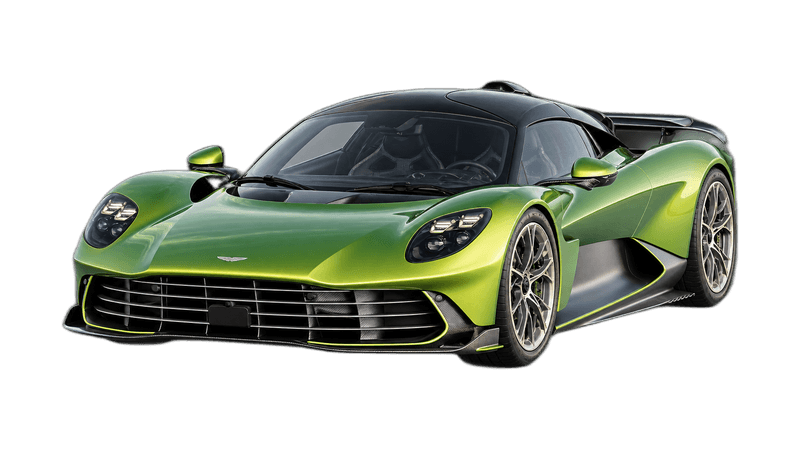
Aston Martin Valhalla
1064bhp
Power
2.5s
0-100 km/h
350km/h
Top Speed
How hard it pulls.
Peak g-force the instant you bury the throttle, estimated from the car's 0–100 time and drivetrain.
Aston Martin ValhallaEstimated peak launch g from the 0–100 time and drivetrain: an honest approximation, not a measured figure.
The Aston Martin Valhalla is a 2-door coupé by Aston Martin, with 1064 bhp, 1100 Nm of torque, a 0-100 km/h time of 2.5 seconds and a top speed of 350 km/h.
Dream Car Garage Editorial · Last updated 28 October 2026
Overview
We have not driven this car. This review is based on published specifications and the sources listed below.
Aston Martin's first series-production mid-engine hybrid
The Valhalla is Aston Martin's first series-production mid-engine supercar. It combines a bespoke 4.0-litre twin-turbo flat-plane V8 with three electric motors for a combined 1079 PS and 1100 Nm. Aston Martin plans 999 cars. The coupe was revealed in production form in December 2024, and the Spider version was announced in October 2026 with deliveries expected from the third quarter of 2027.
This is a desk-researched ownership guide. We have not driven this model for this article. The Valhalla is a new model with a short public history, so the guide focuses on the systems that can be inspected and the documents that should exist. Final homologation details and market-specific equipment should be confirmed with Aston Martin.
The V8 and the electric powertrain
The petrol engine is a 4.0-litre flat-plane twin-turbo V8 producing 828 PS. It uses a dry-sump lubrication system, which suits a low-mounted mid-engine layout. Two electric motors drive the front wheels and provide torque vectoring, while a third motor is integrated into the eight-speed dual-clutch transmission. The electric system contributes up to 251 PS.
The battery is a 6.1 kWh pack running at 400 volts. The car has no conventional reverse gear. Reverse is provided by the front electric axle, which means the hybrid system is involved in every low-speed manoeuvre. A fault in the front drive or the battery can therefore affect basic parking behaviour, not just performance.
Ask for a high-voltage diagnostic report, a battery health check and evidence that the cooling circuits have been maintained. The car should be driven through a complete warm-up cycle and tested in electric, hybrid and performance modes where the market specification allows. Any isolation fault, cooling warning or inconsistent power delivery needs factory-level diagnosis.
Carbon tub, suspension and brakes
The Valhalla uses a carbon-fibre tub developed by Aston Martin Performance Technologies. The front suspension is a pushrod arrangement with inboard Bilstein DTX adaptive dampers, and the rear uses a multilink layout. The brakes are carbon-ceramic units with brake-by-wire, measuring 410 mm at the front and 390 mm at the rear.
Inspect the carbon tub and the suspension mounting points for damage. A low-speed impact can crack carbon fibre without obvious bodywork deformation. Ask for a lift inspection and photographs of the underbody. Check the dampers for leaks and the hydraulic system for correct operation.
Brake-by-wire systems need a diagnostic check, not just a pedal feel. Ask for the brake fluid history, disc and pad measurements and any fault codes. The regenerative braking and friction braking must blend correctly. A car that has been stored may have surface corrosion on the discs, which should be assessed rather than assumed to be harmless.
Active aerodynamics and tyres
Aston Martin says the Valhalla produces more than 600 kg of downforce at 240 km/h in Race mode. The front wing is active, and the rear wing can rise to act as an air brake. Inspect the visible aero surfaces, the actuators and the underbody for damage. Operate the systems through their range where the diagnostic procedure permits.
The car uses 20-inch front and 21-inch rear wheels with Michelin Pilot Sport S 5 AML tyres, 285/30 at the front and 335/30 at the rear. Check the date codes, the tread and the sidewalls. A high-performance tyre that has aged out is not suitable for a car with this performance envelope.
A front lift system is fitted to help with speed bumps and ramps. Test it, listen for pump noise and check the front splitter for contact damage. The ride height and aero settings should be returned to the correct road configuration after any demonstration.
Cabin and usability
The Valhalla has a low, Formula 1-inspired seating position and a 10.25-inch infotainment display. Check the seat adjustment, the pedal position and the visibility before assuming the car will suit every driver. The cabin is compact, and the dihedral doors require space to open.
Entry and exit are part of the ownership experience. Try them in a confined space, not just in a showroom. Check the door seals, the sill height and the position of the seat relative to the steering wheel. A car that is difficult to enter may still be rewarding, but the buyer should know what they are taking on.
Test the climate control, cameras, parking sensors, audio and charging points. Check the trim and the carbon finishes for damage. Any personalisation should be documented in the build record. The Spider's roof and stowage arrangement should be demonstrated if that version is under consideration.
Homologation, warranty and factory support
Because the Valhalla is a new model, the delivery specification and homologation status are important. Confirm the market specification, the emissions and economy figures for the relevant country, and the warranty terms. Aston Martin's 2024 launch material described the car as being in final validation, so a buyer should confirm the current market specification rather than assume that every published figure applies everywhere.
Ask for the service schedule, the approved fluids and the high-voltage maintenance procedure. Confirm whether the car can be serviced by a local Aston Martin dealer or must go to a specialist centre. The 999-car production plan should be documented through the VIN and the build sheet.
Inspection and ownership planning
Use an Aston Martin specialist with high-voltage training and access to factory diagnostics. The inspection should cover the engine, the hybrid system, the battery, the transmission, the brakes, the suspension, the structure, the aero and the electrical functions.
Ask for a cold start, a full scan and a written report. Confirm the recall and campaign status against the VIN. Insurance, storage and transport should be arranged before delivery, and the car should be maintained according to the factory schedule rather than a generic supercar checklist.
Sources and limitations
Aston Martin's official Valhalla model page, the 2024 launch release and the 2026 Valhalla Spider release supply the performance, chassis and production information. The guide makes no claim about transaction prices, future values or reliability. Final homologation and market specification should be confirmed with Aston Martin.
Specifications
Engine
4.0 L twin-turbocharged V8 plug-in hybrid
Displacement
4.0L
Power
1064 bhp
Torque
1100 Nm
0-100 km/h
2.5s
Top Speed
350 km/h
Drivetrain
AWD
Country
UK
Body Style
2-door coupé
Years
2025–present
Production
999
Specifications are manufacturer-published figures.
More from Aston Martin


Frequently Asked Questions
What are the specifications of the Aston Martin Valhalla?
The Aston Martin Valhalla is a 2-door coupé by Aston Martin, with 1064 bhp, 1100 Nm of torque, a 0-100 km/h time of 2.5 seconds and a top speed of 350 km/h.
How many Aston Martin Valhalla were made?
Aston Martin produced 999 units of the Aston Martin Valhalla.
What drivetrain does the Aston Martin Valhalla use?
The Aston Martin Valhalla is configured with all-wheel drive.
What type of car is the Aston Martin Valhalla?
The Aston Martin Valhalla is a hypercars manufactured by Aston Martin in UK. Production started in 2025.