
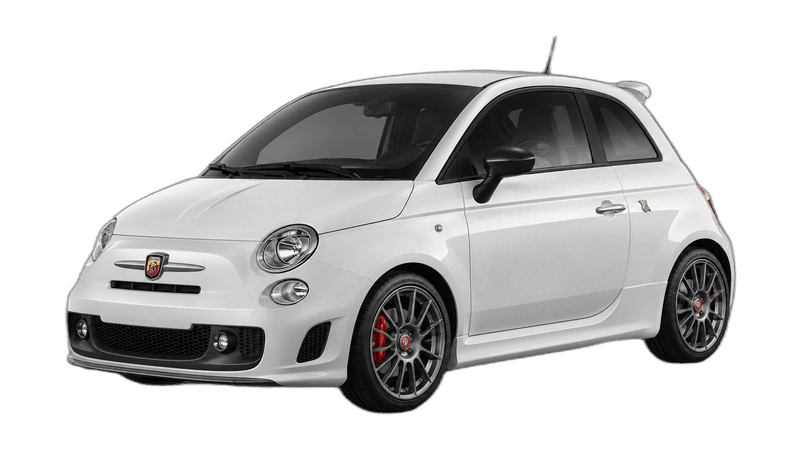
Fiat 500 Abarth 595 Competizione
£18,000
usatoIndicative market price, updated periodically.
178cv
Potenza
6.7s
0-100 km/h
225km/h
Velocita Massima
£18,000
Prezzo Usato
Quanto spinge.
La forza g di picco nell'istante in cui affondi l'acceleratore, stimata dal tempo 0–100 e dalla trazione.
Fiat 500 Abarth 595 CompetizioneG di partenza stimata dal tempo 0–100 e dalla trazione: un'approssimazione onesta, non un dato misurato.
The Fiat 500 Abarth 595 Competizione is a 3-door hatchback by Fiat, with 178 bhp, 250 Nm of torque, a 0-100 km/h time of 6.7 seconds and a top speed of 225 km/h. Indicative used value: approximately £18,000. Actual values vary with specification, condition and history.
Dream Car Garage Editorial · Edited by José Teo Lorente Vallecillos · Last updated 2 November 2026
Panoramica
We have not driven this car. This review is based on published specifications and the sources listed below.
Scope of this guide
This guide is scoped to the Abarth 595 Competizione three-door hatchback with the 180 PS (about 178 bhp) 1.4L turbo (T-Jet) inline-4 petrol engine, front-wheel drive and the five-speed manual gearbox, built on the Fiat 500 (type 312) and sold from the 2015 power increase onwards. It is not a guide to the 595C Competizione convertible, to the lower-powered 595, Pista and Turismo cars, to the Trofeo and Esseesse, to the 695 models such as the Rivale and the Biposto, or to the first 595 Competizione of 2012 to 2014 that had less power. Where those cars differ we say so below, because an advert that says only "Abarth 595" can describe any of them. The stored body style in our catalogue read sedan or saloon, which is wrong: it is a small three-door hatchback with a tailgate.
We have not driven this model for this article. Everything here comes from three cited sources: Fiat and Abarth press material reproduced on Automotive World (3 September 2018), PistonHeads' used buying guide to the Abarth 595 (10 September 2022), and the government recall checker. We also read PistonHeads' October 2016 review of the Competizione, a reprint of the June 2015 Abarth UK press release on Conceptcarz, the Zeperfs data sheet, Wikipedia, evo's reports on the end of petrol production, and a Go Auto report on the 2022 model year, and we flag every point that rests on them. The official Stellantis media page for the 2015 announcement returned an access refusal, so we did not use it and did not try to get round the block.
The figures at a glance
- Engine: 1.4L turbo (T-Jet) inline-4 petrol, a transverse, front-mounted 16-valve engine of 1368 cc with a Garrett turbocharger, according to PistonHeads. It is the same basic unit used across the 595 range, with different tuning.
- Power: 178 bhp at 5500 rpm. Abarth quotes 180 hp, which we read as metric horsepower (PS). Converted, 180 PS is about 177.5 bhp, or 132 kW, so we store 178 bhp. Zeperfs also lists 178 brake horsepower for the 180 PS car.
- Torque: 250 Nm, which Abarth's 2015 release gave as a maximum at 2500 rpm. PistonHeads prints 184 lb ft at 3000 rpm, and 184 x 1.3558 is about 249.5 Nm, so the two agree on the figure but not on the speed at which it arrives.
- 0-100 km/h: 6.7 seconds. This is a figure for 0-62 mph, which is how Abarth and PistonHeads print it. We treat it as the 0-100 km/h time, and a true 0-100 km/h time would be a few hundredths of a second slower. We found one 2022 Australian listing that gave about 6.9 seconds, which we did not use.
- Top speed: 225 km/h, which is the 140 mph claimed by Abarth and PistonHeads (140 x 1.609 is about 225 km/h). Zeperfs lists a single measured top speed of 209 km/h, so treat the claim as a claim.
- Drive: front-wheel drive. The five-speed manual is standard, with no sixth gear. An automated manual with paddles was an option, and PistonHeads says it adds about 0.2 seconds to the 0-62 mph time of the base T-Jet; we have no separate figure for the Competizione.
- Weight: 1,035 kg according to PistonHeads' 2016 review and Zeperfs (DIN), with Zeperfs also giving 1,110 kg on the EU basis.
What makes the Competizione different
The Competizione sits at the top of the regular 595 range. PistonHeads' 2022 buying guide lists the power ladder as 145 hp for the T-Jet, 165 hp for the Turismo and 180 hp for the Competizione, with 0-62 mph times of 7.8, 7.3 and 6.7 seconds respectively. Three items separate it from the cheaper cars. First, the Koni FSD (frequency selective damping) dampers are fitted at the front and rear, where the Turismo has them only at the rear. Second, the Brembo brakes use four-piston aluminium monobloc fixed calipers on 305 mm front discs, according to the 2018 Fiat press material. Third, the valved Record Monza exhaust, which has an active valve controlled by the Sport button, is standard. PistonHeads' 2016 review calls it unique to the Competizione, although its 2022 guide also lists it on the Trofeo.
PistonHeads' 2016 review praised the sound, the brakes and the improved low-speed ride, but criticised the rubbery gearshift, the widely spaced five ratios and a car that feels as though its centre of gravity is high. It also found the optional mechanical limited-slip differential, part of the Performance Pack, less effective than the one in the 695 Biposto. None of that is a fault, but it is the character you are buying: a short, tall, firm, loud car.
Which cars to tell apart
The Abarth 595 range launched in 2012, and Wikipedia says it came at 135, 160 and 180 PS. Our own reading is that the earliest Competizione and Turismo cars were mechanically close, at roughly 158 to 160 hp. One search summary of a Carkeys report gave 158 bhp at the 2012 launch, and Abarth's June 2015 release said the Competizione went from 160 hp to 180 hp with 250 Nm. That is why this guide starts at 2015, not 2012. A car built before then has less power and may have less equipment.
The 2016 facelift changed the bumpers, lights and cabin and kept the engine. Zeperfs dates the 180 PS Competizione 2016 to 2022 and PistonHeads gives 2015 to 2021 for the facelifted 595 generally, so the exact start date of an individual car should come from its registration papers. The 595C is the folding fabric roof version; Go Auto's 2022 report shows it with the same 132 kW and 250 Nm, but we found no 0-100 km/h or weight figures for it. The 695 is a separate, more expensive range. evo calls it the flagship and says it does not have a limited-slip differential as standard, whereas the Biposto and the Performance Pack Competizione do. The Rivale was still in the 2018 range alongside the Competizione.
The end of the car
The stored year range for this car ended in 2023, and we keep that. Our sources do not agree. evo's 2026 review says production of the petrol 595 and 695 ended at the end of 2023 as the range moved to electric, while its August 2024 news story quotes Abarth saying that production of the petrol-powered Abarth 500, the 595, had concluded, with dealers able to sell new stock until the end of that year and the electric Abarth 500e as the only car left to order. Go Auto reported that for the 2022 model year in Australia the Competizione and its convertible twin were the only 595s kept. Treat 2023 as the end of regular production and 2024 as the end of new sales.
What to check before buying
PistonHeads' used buying guide is the best single checklist, and the points below follow it.
- Service history. Abarth's manual calls for oil changes at 10,000 miles or 12 months at most, and PistonHeads suggests about 9,300 miles in practice. Ask for stamps and invoices.
- Timing belt. PistonHeads cites six years or 75,000 miles, although some sources say four years. Ask when it was last changed.
- Modifications. Many owners tuned these cars. PistonHeads warns to check the paperwork for any remap or exhaust change, and a poor remap or an air leak ahead of the oxygen sensor can set off the engine warning light.
- Engine. Reported problems include coolant weeping at the water pump outlet, a loose air inlet pipe bolt and, in one case, an engine replaced after an oil leak within 12,000 miles.
- Gearbox and clutch. Listen for chatter on a cold start. PistonHeads reports some gearbox failures linked to a bad batch of third and fourth gear synchros, and engine cut-outs linked to gearbox earthing.
- Exhaust. The Record Monza sounds good but can become rattly. Mid-section mounts can fail and the valves can stick.
- Front end. Front tyres wear quickly, and the guide mentions tramlining and a wobble above about 40 mph, which can point to worn driveshafts.
- Suspension. Check the rear shocks, top mounts, drop links and rear wheel bearings. Top strut mounts were quoted at about 200 pounds a side in 2022.
- Brakes. PistonHeads mentions a recall for reduced brake performance, so confirm the work was done.
- Body and cabin. Check the facelift bumper, rear lights, tailgate wiring, door mirrors, screenwash motors and the Sabelt seat backrest release levers.
Running costs from the same guide, dated 2022: up to 300 pounds for an 18,000 mile or two-year service, under 350 pounds for the 36,000 mile service with brake fluid and filters, and about 100 pounds a corner for premium 16-inch tyres. The Competizione runs 17-inch wheels, so expect tyres to cost more than those quoted. PistonHeads put the cheapest 2017 Competizione at 12,250 pounds in 2022, and a late, low-mileage one at about 21,000 pounds. Those are history, not valuations.
Recalls and the government check
We did not run the government checker, because it needs a registration number or the make, model and year of a specific car, and we are not looking at one. The page says a car's safety recalls that have not been checked or fixed can be viewed with its registration number, and that the manufacturer will tell you about a recall for a reason other than safety. We cite PistonHeads' mention of a brake recall but did not find the campaign numbers, and a car imported from another market may not appear in the UK database. Run the registration before you buy.
About the photograph
The picture at the top of this page shows a red Competizione with the facelift styling, photographed on 31 May 2025 in Germany. Commons credits it to M 93 under a Creative Commons licence. We cropped and resized it. The number plate on the car was already blank in the original file, and the plate frame carries only a dealer name.
Verdict
The Abarth 595 Competizione in this guide is the 178 bhp, 250 Nm, 6.7 seconds to 62 mph, 225 km/h claimed front-wheel drive hot hatch, with Koni dampers, Brembo brakes and a Record Monza exhaust. It is a noisy, firm and fun little car whose ownership risks are mostly about tuning and a hard life. Buy on the history file and a specialist inspection, check the brake recall and the timing belt date, and confirm that the car is a 180 PS Competizione, not a cheaper 595 with a badge. We have not driven it, so use the sources and a proper inspection to decide.
Specifiche
Motore
1.4L turbo (T-Jet) inline-4 petrol
Cilindrata
1.4L
Potenza
178 cv
Coppia
250 Nm
0-100 km/h
6.7s
Velocita Massima
225 km/h
Trazione
FWD
Paese
Italy
Carrozzeria
3-door hatchback
Anni
2015–2023
Prezzo Usato
£18,000
Specifications are manufacturer-published figures.
Altre di Fiat
In evidenza su Carpedia
Domande Frequenti
What are the specifications of the Fiat 500 Abarth 595 Competizione?
The Fiat 500 Abarth 595 Competizione is a 3-door hatchback by Fiat, with 178 bhp, 250 Nm of torque, a 0-100 km/h time of 6.7 seconds and a top speed of 225 km/h. Indicative used value: approximately £18,000. Actual values vary with specification, condition and history.
How much does a Fiat 500 Abarth 595 Competizione cost?
Indicative used value: approximately £18,000. Actual values vary with specification, condition and history.
What drivetrain does the Fiat 500 Abarth 595 Competizione use?
The Fiat 500 Abarth 595 Competizione is configured with front-wheel drive.
What type of car is the Fiat 500 Abarth 595 Competizione?
The Fiat 500 Abarth 595 Competizione is a hot hatches manufactured by Fiat in Italy. Production ran from 2015 to 2023.