
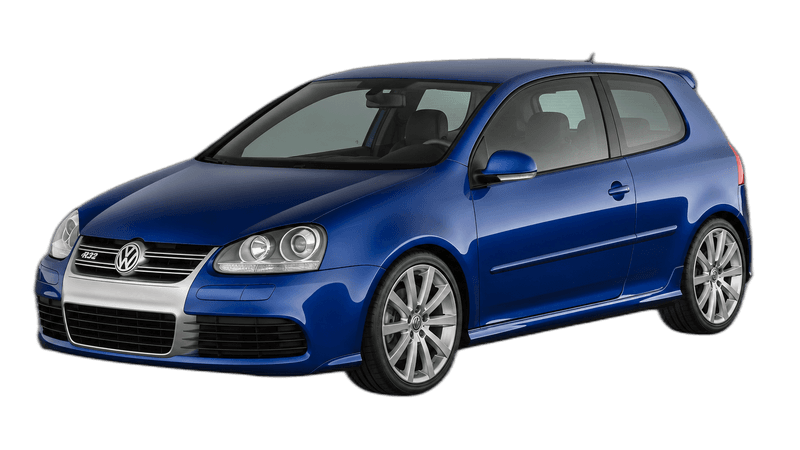
Volkswagen Golf R32 (Mk5)
£14,000
usadoIndicative market price, updated periodically.
247cv
Potencia
6.5s
0-100 km/h
250km/h
Velocidad Máxima
£14,000
Precio Usado
Cómo empuja.
La fuerza g máxima en el instante en que pisas a fondo, estimada a partir del 0–100 y la tracción del coche.
Volkswagen Golf R32 (Mk5)G de salida estimada a partir del 0–100 y la tracción: una aproximación honesta, no una cifra medida.
The Volkswagen Golf R32 (Mk5) is a 4/5 seater hatchback by Volkswagen, with 247 bhp, 320 Nm of torque, a 0-100 km/h time of 6.5 seconds and a top speed of 250 km/h. Indicative used value: approximately £14,000. Actual values vary with specification, condition and history.
Dream Car Garage Editorial · Edited by José Teo Lorente Vallecillos · Last updated 2 November 2026
Visión General
We have not driven this car. This review is based on published specifications and the sources listed below.
A V6 Golf with all-wheel drive
The Golf R32 of the fifth generation (Mk5, Volkswagen type 1K) is a three-door or five-door hatchback with a six-cylinder engine, 4MOTION all-wheel drive and a choice of manual or DSG gearbox. This guide is scoped to the Mk5 Golf R32 sold from 2005 to the end of Golf V production in 2008. It is not about the earlier Mk4 R32, and it is not about any other Golf R. Our catalogue lists a 3.2L naturally aspirated VR6 petrol engine producing 247 bhp and 320 Nm, with 0 to 100 km/h in 6.5 seconds, a top speed of 250 km/h and all-wheel drive. We have not driven this model for this article. This is a desk-researched ownership guide built from Volkswagen's own history page for the Golf V, a PistonHeads used buying guide published in September 2018 and the government recall check. Where those sources are silent we say so, and we do not fill the gap from memory.
Do not read this car as a turbocharged Golf. The R32 is the naturally aspirated six-cylinder Golf, and everything below follows from that. PistonHeads presents it as the last Volkswagen to use the company's VR6 engine, and as a car that improved on the Mk4 R32 by giving its chassis a better chance of handling the power.
Checking the figures
Volkswagen's page for the Golf V gives the R32 an output of 184 kW or 250 PS, and a torque figure of 320 Nm. The metric horsepower rating converts to the 247 bhp in our catalogue, because 250 PS is about 247 bhp. PistonHeads prints the same output as 250 hp at 6,300 rpm and gives the torque as 236 lb ft from 2,500 rpm, which is the same 320 Nm. An advert that says 250 and one that says 247 are describing the same engine in different units. PistonHeads adds that the engine makes 10 hp more than the Mk4 version, with the torque arriving 300 rpm lower in the rev range.
For acceleration, Volkswagen states 6.5 seconds from 0 to 100 km/h with the manual gearbox and 6.2 seconds with DSG. PistonHeads quotes 6.5 seconds from 0 to 62 mph as the figure at launch, which it says was 0.5 seconds quicker than a Golf GTI, and it does not give separate times for each gearbox. We therefore use 6.5 seconds, the manual car's figure, as the catalogue value and treat 6.2 seconds as the DSG figure from Volkswagen alone. PistonHeads gives the top speed as 155 mph, electronically limited, which is the 250 km/h we list. Volkswagen's history page does not state a top speed, so that figure rests on PistonHeads.
Two other numbers differ between our sources or cannot be settled. PistonHeads gives a weight of 1,541 kg. Volkswagen's page gives no weight. On dates, PistonHeads says the R32 was launched in March 2005, while Volkswagen's history page says the Golf V R32, which it calls the most powerful Golf ever, returns in September 2005 as a model update. We read this as a launch and a later update, but neither source explains the gap, so check the first registration date and the paperwork of any car you are considering. Volkswagen says Golf V production ended in October 2008 with about 3.4 million cars built in total. Neither source gives an end date for the R32 itself, and neither gives an R32 production figure.
Engine and gearbox
The engine is a 3.2-litre V6, which PistonHeads says was carried over from the Mk4. Because it is naturally aspirated, there is no turbocharger to inspect, and power is delivered as the engine revs. PistonHeads describes the car as sonorous, and calls the engine generally robust. Its list of weak points is short and specific. The coil packs can fail and cause a misfire, so a rough or flat-sounding idle deserves attention. The engine is chain-driven, and the plastic chain tensioner wears over time, which can make the engine sound rattly. PistonHeads says a replacement tensioner and bolt are inexpensive, plus the labour to fit them, so ask whether it has been done and listen on a cold start.
Servicing matters more than anything else on this car. PistonHeads recommends oil changes every 10,000 miles. It says the rear differential and the Haldex coupling need an oil service every 40,000 miles, and that spark plugs are due at about the same interval. The DSG gearbox also needs an oil change every 40,000 miles. Ask for invoices that show each of these jobs, with dates and mileages, because a missing record is a reason to negotiate or to walk away.
The two gearboxes are a six-speed manual and DSG. Volkswagen says the six-speed manual is standard, while PistonHeads says the DSG is more robust in the R32 than in earlier Volkswagen Group cars. It tells buyers to check that a DSG car shifts smoothly and pulls away from a standstill without jerking, and to confirm that the recall work on the Mechatronic control module has been done. PistonHeads also notes that a common modification is an exhaust flapper that adds engine noise. It is easy to fit or remove, so ask whether the car has one and listen to how it sounds.
Chassis, brakes and wheels
Volkswagen says the R32 has 4MOTION all-wheel drive. PistonHeads describes it as Haldex four-wheel drive that can send power to the front or the rear wheels as required. It reports that contemporary road tests praised the cornering grip, that the steering gave less feedback than a Subaru Impreza's but turned in quickly, and that it has 2.9 turns between the locks. The guide does not cover the condition of the dampers, so check for leaks, knocking over bumps and uneven tyre wear on any car you view.
On the steering and suspension, PistonHeads says creaks or grinding from the front can point to a worn steering rack, and that the front and rear top mounts can start to rattle and need replacing. The R32 has 345 mm front discs and 310 mm rear discs. PistonHeads suggests changing the brake fluid every two years or 24,000 miles, and advises listening for rubbing or grinding from the rear brakes, which can bind. The standard wheels are 18-inch alloys. Look at the inner edges of the front tyres for wear, check all four wheels for kerb damage, and ask when the all-wheel-drive system last received its oil service, since the coupling and the rear differential share that interval.
Body, interior and electronics
The R32 was offered as a three-door and a five-door hatchback, and PistonHeads does not describe mechanical differences between them. Volkswagen lists large front air intakes, a rear roof spoiler, a central twin tailpipe and a black apron in a diffuser look. PistonHeads adds a chromed grille shell, a deeper front bumper with three air inlets, bi-Xenon headlights, extended side sills, and twin exhaust pipes. Check that the bumpers and sills have not been repaired badly, and that the car still has the front bumper, sills and tailpipes that belong to the R32.
PistonHeads says rust can appear on the front wheelarches, that this is common to all Mk5 Golfs, and that it is linked to the plastic arch liner wearing against the arch lip. Look under the liners as well as at the visible paint.
Inside, the list of features includes aluminium pedals, a flat-bottomed steering wheel, climate control and a six-disc CD changer. Recaro seats were an expensive option. PistonHeads tells buyers to check that the side bolsters are not badly worn, and says the Recaro seat mounts can rattle even when the seat is securely fitted. For the electrics, it lists a failing high-level LED brake light, a rear windscreen wiper that can need a new motor, automatic Xenon headlight height adjustment that can need new motors, and air conditioning that can stop working. Test every switch, the climate control, the wipers and the headlight levelling, because each of these is a reported fault.
Recalls and history
PistonHeads refers to recall work on the DSG Mechatronic control module, but neither of our sources supplies a full recall list for this car. Enter the registration in the DVSA recall service and ask the seller for dealer paperwork showing that any open work was completed. Ask also for a full service history, any accident repair records and a note of every modification, including exhaust changes. The guide also does not cover carbon build-up, cam chain and timing work beyond the tensioner, or water pump problems, so a car whose history shows nothing on these items has not been proved sound by our sources.
Buying decision
The PistonHeads verdict is that the Mk5 R32 is a sonorous, practical performance car with four-wheel drive, and a worthy used purchase. It tells buyers to focus on the known weak points, particularly the DSG and Haldex service history, the coil packs, the engine tensioner and the suspension mounts. The September 2018 prices are not repeated here, because they are dated: compare current adverts, and compare cars with each other rather than with a figure from an old article. Prefer a car with a documented service history that includes the 40,000-mile oil services, a gearbox that shifts or pulls away cleanly, no rattle from the engine at start-up, evenly worn tyres, dry arch liners and wheelarches and every recall closed. If the car is a DSG, the evidence that the Mechatronic recall work has been done is the first thing to ask for.
Especificaciones
Motor
3.2L naturally aspirated VR6 petrol
Cilindrada
3.2L
Potencia
247 cv
Par Motor
320 Nm
0-100 km/h
6.5s
Velocidad Máxima
250 km/h
Tracción
AWD
País
Germany
Carrocería
4/5 seater hatchback
Años
2005–2008
Precio Usado
£14,000
Specifications are manufacturer-published figures.
Más de Volkswagen
Destacado en Carpedia
Preguntas Frecuentes
What are the specifications of the Volkswagen Golf R32 (Mk5)?
The Volkswagen Golf R32 (Mk5) is a 4/5 seater hatchback by Volkswagen, with 247 bhp, 320 Nm of torque, a 0-100 km/h time of 6.5 seconds and a top speed of 250 km/h. Indicative used value: approximately £14,000. Actual values vary with specification, condition and history.
How much does a Volkswagen Golf R32 (Mk5) cost?
Indicative used value: approximately £14,000. Actual values vary with specification, condition and history.
What drivetrain does the Volkswagen Golf R32 (Mk5) use?
The Volkswagen Golf R32 (Mk5) is configured with all-wheel drive.
What type of car is the Volkswagen Golf R32 (Mk5)?
The Volkswagen Golf R32 (Mk5) is a hot hatches manufactured by Volkswagen in Germany. Production ran from 2005 to 2008.