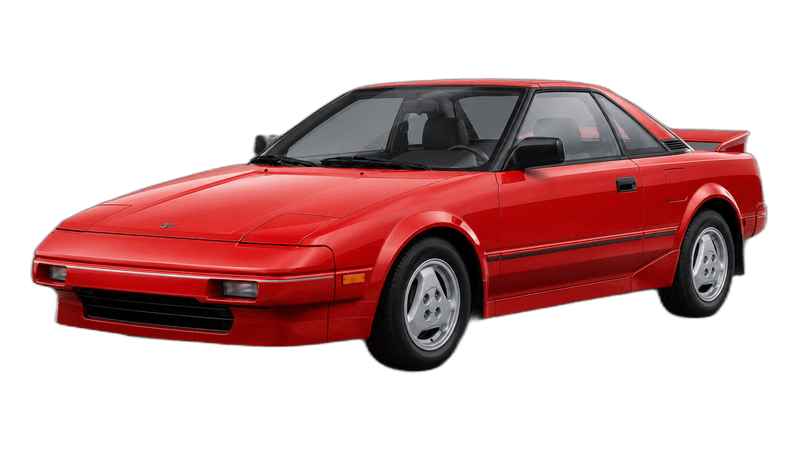
Toyota MR2 Turbo (SW20)
£18,000
usadoIndicative market price, updated periodically.
222cv
Potencia
5.7s
0-100 km/h
241km/h
Velocidad Máxima
£18,000
Precio Usado
The Toyota MR2 Turbo (SW20) produces 222 bhp, reaches 100 km/h in 5.7 seconds and has a top speed of 241 km/h. A representative example is worth about £18,000.
Cómo empuja.
La fuerza g máxima en el instante en que pisas a fondo, estimada a partir del 0–100 y la tracción del coche.
Toyota MR2 Turbo (SW20)G de salida estimada a partir del 0–100 y la tracción: una aproximación honesta, no una cifra medida.
Dream Car Garage Editorial · Edited by José Teo Lorente Vallecillos · Last updated 2 November 2026
Visión General
We have not driven this car. This review is based on published specifications and the sources listed below.
Scope of this guide
This guide is scoped to the Japanese-market Toyota MR2 Turbo (SW20), the two-seat, mid-engined coupe with the 2.0L turbocharged inline-4 petrol (3S-GTE) engine of 1998 cc and rear-wheel drive, in the form Toyota launched on 17 October 1989 and sold until about November 1993. Enthusiasts call these cars Rev 1 and Rev 2. It is not a guide to the naturally aspirated SW20 cars, to the 200 bhp class American-market MR2 Turbo, to the later Japanese cars with the higher power rating, or to the Rev 4 and Rev 5 cars of 1996 to 1999. We say below where each of those differs, so you can tell which car an advert is really describing.
We have not driven this model for this article. Everything here comes from three cited sources: Toyota's own October 1989 announcement of the new MR2, a PistonHeads market watch on the second-generation MR2, and the government recall checker. We also read several other pages, including a Toyota history page, a RAC used-car review, a reference-site summary, an MR2 enthusiast database and two buying guides, and we flag each point that rests on them. Where sources disagree, we say so rather than choose quietly.
The figures at a glance
- Engine: 2.0L turbocharged inline-4 petrol (3S-GTE), 1998 cc, twin cam, with a ceramic twin-entry turbocharger and an air-cooled intercooler.
- Power: 222 bhp. Toyota rated the engine at 225 PS net, and 225 PS converts to about 222 bhp (225 x 0.98632 = 221.9). The conversion is ours.
- Torque: 304 Nm. Toyota printed 31 kg-m, which is 304 Nm (31 x 9.80665). PistonHeads prints 224 lb ft for the early turbo, which is about 304 Nm as well.
- 0-100 km/h: 5.7 seconds. That is a 0-60 mph time from PistonHeads and RAC, not a 0-100 km/h time, and 60 mph is about 97 km/h, so a true 0-100 km/h run would be a little slower.
- Top speed: 241 km/h, about 150 mph. That figure is the weakest on this page and is discussed below.
- Drive: rear-wheel drive, with the engine mounted behind the seats. Toyota calls the car a midship type.
- Body: two-door coupe, with a standard roof or a T-bar roof, according to Toyota.
- Weight and size (Toyota history page, not cited): 1,240 kg for the Japanese GT, 4,170 mm long, 1,695 mm wide, 1,240 mm high, on a 2,400 mm wheelbase.
What Toyota said at launch
Toyota's announcement says the company would put the new MR2 on the market from 17 October 1989, calling it the only midship-type car in Japan. It describes a unitized body with four-wheel strut suspension, a drag coefficient of 0.31, ventilated discs all round with two-pot front calipers, and ABS as standard on the turbocharged car. It gives the 3S-GTE 225 ps net, which it calls the highest output for a 2.0-litre engine at the time, and 31 kg-m of torque. It gives tyre sizes of 195/60R14 at the front and 205/60R14 at the rear, electro-hydraulic power steering and a 54 litre fuel tank.
The announcement does not give a top speed, an acceleration time, a weight or the engine speeds for peak torque. A separate Toyota history page gives the peak power as 225 PS at 6,000 rpm for the GT and the curb mass above. That is the only manufacturer document we found that states the weight, and we did not find a Toyota page that prints a top speed for the turbo.
Why the power and torque numbers vary
The numbers for these cars are not one clean set. Toyota's 225 PS is a Japanese net rating. Wikipedia lists 221 PS for the earlier Japanese turbo, a car guide says 221 bhp early and 242 bhp later, RAC says 220 bhp for Rev 1 and Rev 2, and PistonHeads says 228hp, which is higher than our conversion. A PS is a metric horsepower and a bhp is a brake horsepower, so the same engine gives a slightly lower bhp than PS number, and different publications round differently. Our catalogue value of 222 bhp follows Toyota's printed rating. If an advert says 220, 221 or 225, it is almost certainly the same engine.
The catalogue previously carried 242 bhp for this model. That is the figure for the later Japanese cars rated at 245 PS, which converts to about 242 bhp, so it did not match the 1989 to 1993 cars. The torque of 304 Nm, by contrast, matches the early cars exactly.
Performance claims and what they mean
PistonHeads says the initial turbo made 228hp and 224 lb ft and reached 60 mph in 5.7 seconds, and that later cars with 248hp took 5.4 seconds. RAC gives 5.7 seconds and 152 mph for Rev 1 and Rev 2. A reference page lists 6.1 seconds for the American MR2 Turbo, which has a lower rating, and the production figure of 6.1 seconds in our catalogue appears to have come from that car, so we have changed it to 5.7 seconds. An older web article quotes 150 mph and 5.9 seconds as official figures and 142 mph and 6.3 seconds as a magazine test. These are published or claimed figures, not our measurements.
For top speed we keep 241 km/h, which is 150 mph. RAC says 152 mph, which is about 245 km/h by our conversion, and the older web article gives a tested 142 mph, about 229 km/h. RAC also says most Japanese-market cars carry a limiter at 112 mph, about 180 km/h, so a standard import may never reach the claimed speed without it being removed. Treat the top speed as a rough claim, not a specification.
Model years and production numbers
Toyota's announcement dates the launch to October 1989 in Japan. An enthusiast database gives December 1989 as the start of the Rev 1 Japanese turbo and December 1991 for Rev 2, while Wikipedia gives January 1992 for Rev 2 and PistonHeads says Rev 2 was model year 1993. The sources agree that the 245 PS Rev 3 arrived in November 1993, so we use 1989 to 1993 for this guide. The exact change date for a given car depends on its build month, so read the chassis plate.
We left the production count out. PistonHeads says about 140,000 second-generation MR2s were sold worldwide and 17,647 in the UK, but those totals cover every engine and market, and we found no source that counts Japanese turbos alone. The earlier catalogue value of 1,984 does not match anything we read and looks like a year, so we have replaced it with nothing rather than guess.
How this car differs from the other SW20 turbos
The later Japanese turbo, from November 1993, was rated at 245 PS with the CT20B turbocharger according to an enthusiast database and Wikipedia, about 242 bhp by our conversion. PistonHeads says 248hp and RAC says 241 bhp, so the sources again disagree by a few units. Rev 4 and Rev 5 turbos are poorly documented: the database says the Rev 4 turbo is unchanged, and the Rev 5 Japanese highlight is a naturally aspirated engine rated at 200 PS.
The American MR2 Turbo is a different proposition. Wikipedia lists it at 200 bhp and 200 lb ft, about 271 Nm, with a 0-60 mph time of 6.1 seconds, and says it kept the earlier engine through Rev 3 and was sold only until 1995. It also used the revised T-bar roof from Rev 2.
The UK never had an official turbo. PistonHeads says Toyota worried about its Celica GT-Four sales, and Toyota UK's own archive page lists only 119 and 158 bhp launch engines and a 173 bhp engine from 1994. Every UK turbo is therefore a private import, in most cases a Japanese car like the ones described here.
Chassis and handling
PistonHeads says early Mk2 cars went from understeer to oversteer very quickly, especially in the wet or on ice, and that many were crashed. A buying guide from Car Throttle says the cars built from 1990 to 1992 are the most prone to snap oversteer and that later cars break away more progressively. Wikipedia and PistonHeads tie the Rev 2 changes to that complaint: revised rear suspension geometry, lowered ride height, quicker steering, larger brakes and 15-inch wheels, though the sources do not list identical changes.
Check the alignment, tyre wear and any history of accident repair before anything else. Look at the front tyres for heavy inner-edge wear, which can point to too much negative camber. The Car Throttle guide also says the 1990 to 1992 brake discs are smaller and can warp, so a judder under braking may mean new discs. A limited-slip differential was an option on turbo cars from Rev 2 and standard on the Japanese turbo from Rev 3 according to Wikipedia, so do not assume an early car has one.
Engine, turbo and gearbox
The cambelt is due every 60,000 miles according to both RAC and Car Throttle, and both say the engine is non-interference, so a snapped belt should not wreck the valves. RAC adds that the job is an engine-out one. PistonHeads says service intervals were every 6,000 miles for the earlier cars, so ask for evidence of regular oil changes. Car Throttle recommends synthetic oil only and a short idle after hard driving to cool the turbo.
Heat in the engine bay shortens turbo life, and white smoke under boost points to a failing turbo. RAC recommends a warm-up before full boost and a boost test at purchase. PistonHeads warns that turbo cars have been tuned beyond 400 bhp and that some owners have swapped in V6 engines, so a car with no history may be a different car under the bonnet from the one in the advert. Also check for signs of a blown head gasket and make sure the electrics work, as PistonHeads advises.
The five-speed gearbox is described by Car Throttle as stronger than the naturally aspirated one, and an enthusiast database lists second and third gear synchro wear as common with age. Wikipedia says Rev 2 upgraded the synchros, so a Rev 1 car is the more likely to be worn.
Body, roof and imports
PistonHeads and Toyota both list T-bar roof cars, and the enthusiast database calls T-bar seal leaks very common, so look for water marks and damp in the cabin. The same database flags copper coolant pipes above the fuel tank, which it calls a critical fire risk, and says rear subframe cracking is unverified. We read these points in a summary and could not confirm them against a primary document, so treat them as things to ask about, not facts. None of our cited sources describes rust in detail, so ask to see the sills, wheelarches and underbody for yourself.
RAC says Japanese-market cars with a km/h speedometer or no rear fog lamp needed a conversion for UK use and that imports faced an SVA test. That article is from 2005 and the registration rules have changed since, so check the current rules with the DVLA or a specialist before you buy. RAC also says Rev 1 and Rev 2 air conditioning may use the old R12 refrigerant and need converting.
What to check before buying
- Confirm the engine and the build date from the chassis plate, so you know whether the car is a 225 PS early car or a later 245 PS one.
- Ask for the cambelt, oil and service history and whether the car has been tuned or has had an engine swap.
- Look at tyre wear, alignment and brake discs, and ask about any accident repair.
- Check the T-bar seals for leaks and the footwells for damp.
- Inspect the coolant pipes above the fuel tank and the coolant condition, since muddy brown coolant points to poor servicing according to RAC.
- Test the gearbox, the clutch, the air conditioning and the electrics.
- Check the speedometer units, the lights and the paperwork for a Japanese import.
- Confirm every recall is closed, using the check below.
Recalls and the DVSA check
We did not find a recall list for the SW20 turbo in the sources we read, and PistonHeads does not list any. That does not mean there are none. Run the registration number or VIN through the DVSA vehicle recall check on GOV.UK, and ask a Toyota dealer or MR2 specialist about open campaigns. For a Japanese import, ask whether a UK recall record exists at all, because the UK check may not know the car.
Verdict
The Japanese Rev 1 and Rev 2 MR2 Turbo is a compact, mid-engined, rear-wheel drive coupe whose appeal rests on its layout and its 3S-GTE engine rather than on its tested numbers. If you are shopping for one, confirm the revision, check the alignment and the cambelt history, and treat the 222 bhp, 304 Nm, 5.7 seconds and 241 km/h figures as published or catalogue values, with the caveats above. We have not driven it, so use the sources and a proper inspection to decide.
Especificaciones
| Motor | 2.0L turbocharged inline-4 petrol (3S-GTE) |
|---|---|
| Cilindrada | 2.0L |
| Potencia | 222 cv |
| Par Motor | 304 Nm |
| 0-100 km/h | 5.7s |
| Velocidad Máxima | 241 km/h |
| Tracción | RWD |
| País | Japan |
| Carrocería | 2-door coupe or T-bar |
| Años | 1989–1993 |
| Precio Usado | £18,000 |
Specifications are manufacturer-published figures.
Preguntas Frecuentes
What is a Toyota MR2 Turbo (SW20) worth?
A representative example is worth about £18,000. Actual values vary with specification, condition and history.
How much power does the Toyota MR2 Turbo (SW20) have?
The Toyota MR2 Turbo (SW20) produces 222 bhp and 304 Nm of torque.
How fast is the Toyota MR2 Turbo (SW20) from 0 to 100 km/h?
The Toyota MR2 Turbo (SW20) accelerates from 0 to 100 km/h in 5.7 seconds.
What is the top speed of the Toyota MR2 Turbo (SW20)?
The Toyota MR2 Turbo (SW20) has a top speed of 241 km/h.
What engine does the Toyota MR2 Turbo (SW20) have?
The Toyota MR2 Turbo (SW20) uses a 2.0L turbocharged inline-4 petrol (3S-GTE).
When was the Toyota MR2 Turbo (SW20) built?
The Toyota MR2 Turbo (SW20) was built from 1989 to 1993.
Is the Toyota MR2 Turbo (SW20) all-wheel drive?
No. The Toyota MR2 Turbo (SW20) is configured with rear-wheel drive.