
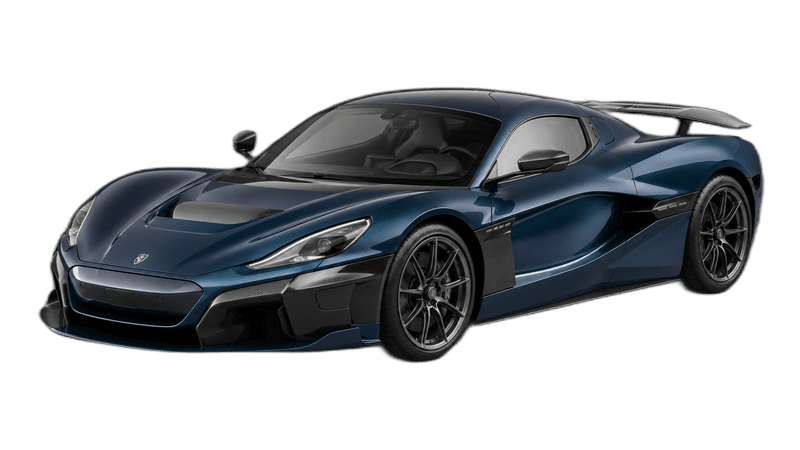
Rimac Nevera
£1,450,000
usadoIndicative market price, updated periodically.
1888cv
Potencia
1.81s
0-100 km/h
412km/h
Velocidad Máxima
£1,450,000
Precio Usado
The Rimac Nevera produces 1888 bhp, reaches 100 km/h in 1.81 seconds and has a top speed of 412 km/h. A representative example is worth about £1,450,000.
Cómo empuja.
La fuerza g máxima en el instante en que pisas a fondo, estimada a partir del 0–100 y la tracción del coche.
Rimac NeveraG de salida estimada a partir del 0–100 y la tracción: una aproximación honesta, no una cifra medida.
Dream Car Garage Editorial · Edited by José Teo Lorente Vallecillos · Last updated 2 November 2026
Visión General
We have not driven this car. This review is based on published specifications and the sources listed below.
Scope of this guide
This guide is scoped to the standard Rimac Nevera, the two-door electric hypercar with four permanent-magnet motors and a 120 kWh battery, revealed in production form in June 2021 and limited by Rimac to 150 cars. It is not a guide to the Nevera R (the faster 2024 update), the Time Attack edition or the 15th Anniversary Edition. We say below where those cars differ, so that you can tell which car an advert describes.
We have not driven this model for this article. Everything here comes from three cited sources: Rimac's own Nevera page, PistonHeads' launch report by Sam Sheehan (1 June 2021), and the government recall checker. We also read the Wikipedia article on the car, Rimac's press release on the battery warranty (18 January 2024) and the US safety recall filing for the car, and we flag the points that rest on them. Where sources disagree we say so rather than choose quietly. Prices are history, not valuations.
The figures at a glance
- Powertrain: Quad permanent-magnet electric motors, 120 kWh battery. There is no combustion engine, so there is no engine size to quote.
- Power: 1888 bhp, which is our conversion of the claimed 1914 PS (1408 kW). Rimac's page prints 1914 hp next to 1408 kW, and Wikipedia prints 1,888 hp and 1,914 PS together.
- Torque: 2340 Nm, as Rimac's page prints it. Wikipedia and PistonHeads give 2,360 Nm (1,741 lb ft), so the sources differ by 20 Nm.
- 0-100 km/h: 1.81 seconds, the figure on Rimac's page.
- Top speed: 412 km/h, claimed by Rimac and shown in Wikipedia's account of the Papenburg testing.
- Drive: all-wheel drive, with one motor at each wheel and software torque vectoring that Rimac calls R-AWTV.
- Battery: 120 kWh in Rimac's page, PistonHeads' launch report and Wikipedia.
- Weight: 2,300 kg on Rimac's page and in Wikipedia. PistonHeads said at launch that there was no official figure.
What the Nevera is
The Nevera is the production successor to the C_Two concept and is built in-house by Rimac in Croatia. Rimac's page says the car is limited to 150 units. PistonHeads' launch report quoted a price of 2 million euros and three trims called GT, Signature and Timeless, with 19 dealer sites worldwide at that time. Those details are 2021 history and we have not confirmed them today.
PistonHeads describes a lithium, manganese and nickel battery of 6,960 cells integrated into the monocoque, which it says weighs under 200 kg. Wikipedia describes the motors as liquid-cooled, each with a single-speed gearbox. We have not inspected any of this and report it as the sources' account.
How many were built
The limit of 150 comes from Rimac's page, and we use it as the catalogue figure. It is a cap, not a count of cars delivered. Wikipedia says the first production car was delivered in August 2022, that deliveries in the United States began in June 2023, and that more than 50 cars had been delivered by May 2024, which it reports Mate Rimac describing as slower than expected. Assembly was described as roughly one car a week, at the same factory as the Pininfarina Battista. Those are Wikipedia's statements and we have not checked them against Rimac.
Note also the dates. Our catalogue starts the car in 2021 because that is when the production version was revealed, but the first customer delivery was in 2022. An advert quoting a 2021 or 2022 year may mean either.
Why the quoted figures vary
Power is quoted in PS or in horsepower depending on the outlet. Metric horsepower (PS) and brake horsepower differ by about 1.4 per cent, so 1914 PS is about 1888 bhp, and 1408 kW converts to the same 1888 bhp. We use bhp because that is how this catalogue states power. For an electric car the number depends on how and where it is measured, so treat it as the maker's claim.
Acceleration has several versions. Rimac's page prints 1.81 seconds to 100 km/h. Wikipedia gives 1.82 seconds to 100 km/h and 1.74 seconds to 60 mph (97 km/h) for records set in May 2023. PistonHeads' launch report printed 1.85 seconds to 60 mph. Rimac's page also shows a second block of figures, 1.72 seconds and 430 km/h with a 108 kWh battery, which is not labelled by model but appears to belong to the Nevera R. We use 1.81 seconds.
Top speed has a similar wrinkle. PistonHeads' headline says 258 mph, but 412 km/h converts to about 256 mph, and we use 412 km/h as Rimac's claim. Treat it as a figure reached by the factory on a closed track, not something any customer car is likely to repeat.
Range is another disagreement. Rimac's page quotes 489 km on the WLTP cycle based on final testing. PistonHeads' launch report quoted 340 miles, which is about 547 km, and Wikipedia quotes 490 km on WLTP and 647 km on the older NEDC cycle. We do not resolve this and give no range figure for the catalogue. Real-world range at speed will be lower than any cycle figure.
Drivetrain and charging
The standard car is all-wheel drive with four independent motors, so there is no mechanical link between axles. Rimac's page says torque is shared between the wheels by software. PistonHeads reports regeneration of up to 300 kW at launch.
For charging, Rimac's page says a 500 kW DC fast charger takes the battery from 0 to 80 per cent in 19 minutes, a 350 kW charger takes 25 minutes and a 250 kW charger takes 30 minutes. The car also has a three-phase 22 kW on-board charger. PistonHeads reported the same 19 minutes at 500 kW and estimated under 30 minutes at 350 kW. These are manufacturer claims for a battery in good condition, and we have not tested them. Few public chargers deliver 500 kW, so plan for slower real sessions.
Battery and the warranty
This is a high-voltage battery car, and the battery is the most expensive part to get wrong. Rimac's press release of 18 January 2024 says the Nevera battery warranty became 8 years with unlimited mileage, covering all major faults of the battery pack, and that the battery must still hold 75 per cent of its as-delivered capacity at the end of the period. The release says it applies to all cars delivered so far and is included for new buyers. We read that release as a summary and have not seen the warranty document itself.
We have not found published information on what happens when a car changes hands, on how capacity is measured, or on what the warranty excludes. Ask the seller for the written terms and ask Rimac or an authorised partner to confirm in writing that the cover applies to the specific car and to a second owner. Also ask for the battery health record and for the history of any software updates, because we found no source describing either.
Recalls and the DVSA check
We found one recall record. The United States safety filing (NHTSA 24V-783, submitted by Rimac d.o.o. on 23 December 2024) covers 9 cars, 2023 and 2024 Neveras built between 25 April 2023 and 26 July 2024. It concerns the C19 low-voltage cable, which could be incorrectly tightened or routed. The filing says this could damage the cable insulation, allow a short circuit with the monocoque, and melt the cable, potentially increasing the risk of fire. The remedy is a visual inspection and, if the routing is wrong, a repair by Rimac at no cost to the customer. The filing says affected owners would be told not to drive the car until it had been inspected. It gives a root cause of human error.
That filing is for the United States and for a small group of cars, and it does not say anything about UK cars. PistonHeads does not mention recalls. We did not run the government checker, because it needs a registration number or the manufacturer, model and year, and we are not looking at a specific car. The page says the MOT checking service shows outstanding safety recalls for a car with a registration, and the vehicle recalls checker needs the make, model and year. It says non-safety recalls come from the manufacturer directly. Run the registration through GOV.UK and ask Rimac to confirm in writing that every campaign for the car has been completed.
How the Nevera differs from other versions
The Nevera R was unveiled on 17 August 2024. Wikipedia gives it 2,107 PS, the same 2,360 Nm torque figure, a weight of about 2,265 kg and a top speed of 431.6 km/h, with aerodynamic and chassis changes. Rimac's page appears to give it a 108 kWh battery. The Time Attack edition, which PistonHeads says was limited to 12 cars, set a Nurburgring lap of 7:05.298 in August 2023. The 15th Anniversary Edition was a limited batch within the 150, according to a PistonHeads search summary that we did not read in full. If an advert mentions a higher power figure, a different battery or an edition name, it describes a different car from the one in this guide.
Running costs
None of our sources gives service, insurance, tyre or parts prices for the Nevera, so we give none and make no estimate. Do not assume a figure from other hypercars. Ask the seller for the service history, the invoices for any high-voltage work and a quote from an authorised Rimac partner for the next scheduled visit. Rimac's page links to a dealer and partner map and to a technical service documentation area, but gives no detail on either.
What to check before buying
- Confirm the chassis number, the build number within the 150 and that the car is the standard Nevera, not a Nevera R or a special edition.
- Ask for evidence that the C19 cable inspection was carried out if the car was built between April 2023 and July 2024, and ask whether any other recall applies.
- Obtain the written battery warranty terms and confirmation that they transfer to you.
- Ask for a battery health report from Rimac or an authorised partner, and the software update history.
- Ask how the car was stored and charged, and which chargers it has used. This is our advice, not a figure from a source.
- Insist that any inspection is carried out by a technician qualified for high-voltage systems.
- Look for accident repair around the carbon monocoque and ask what any repair involved.
- Run the registration through the recall check described above.
Verdict
The Rimac Nevera is a claimed 1888 bhp and 2340 Nm of electric power, a claimed 1.81 seconds to 100 km/h and 412 km/h, with all-wheel drive, in a run limited to 150 cars. Our sources give little on running costs, so the main risk is the unknown: the battery warranty terms, the recall history and the true state of a car that has few direct rivals for comparison. If you are shopping for one, confirm which version it is, insist on written warranty and recall evidence, and treat every published figure as a claim with the caveats above. We have not driven it, so use the sources and a proper inspection to decide.
Especificaciones
| Motor | Quad permanent-magnet electric motors, 120 kWh battery |
|---|---|
| Potencia | 1888 cv |
| Par Motor | 2340 Nm |
| 0-100 km/h | 1.81s |
| Velocidad Máxima | 412 km/h |
| Tracción | AWD |
| País | Croatia |
| Carrocería | 2-door coupe |
| Años | 2021–present |
| Producción | 150 |
| Precio Usado | £1,450,000 |
Specifications are manufacturer-published figures.
Preguntas Frecuentes
What is a Rimac Nevera worth?
A representative example is worth about £1,450,000. Actual values vary with specification, condition and history.
How much power does the Rimac Nevera have?
The Rimac Nevera produces 1888 bhp and 2340 Nm of torque.
How fast is the Rimac Nevera from 0 to 100 km/h?
The Rimac Nevera accelerates from 0 to 100 km/h in 1.81 seconds.
What is the top speed of the Rimac Nevera?
The Rimac Nevera has a top speed of 412 km/h.
What engine does the Rimac Nevera have?
The Rimac Nevera uses a Quad permanent-magnet electric motors, 120 kWh battery.
How many Rimac Nevera were made?
Rimac produced 150 units of the Rimac Nevera.
When was the Rimac Nevera built?
Production of the Rimac Nevera began in 2021.
Is the Rimac Nevera all-wheel drive?
Yes. The Rimac Nevera is configured with all-wheel drive.
Destacado en Carpedia
Best Hypercars 2026
From Koenigsegg's 2,000bhp Regera to the twin-turbocharged fury of the Hennessey Venom F5, these are the ten hypercars that define the absolute limit of automotive engineering in 2026.
The 25 Fastest Cars from 0-100 km/h, Ranked
The 25 fastest production and limited-production cars ranked by 0-100 km/h time. From the 1.81-second Rimac Nevera to the 2.5-second Chevrolet Corvette E-Ray, every car backed by verified data.
What Cars Should I Put in My Dream Garage?
A comprehensive guide to building a dream garage at every budget. Five balanced 5-car garages, from under GBP 100K total to unlimited, each covering daily driving, weekends, track days, road trips, and special occasions.