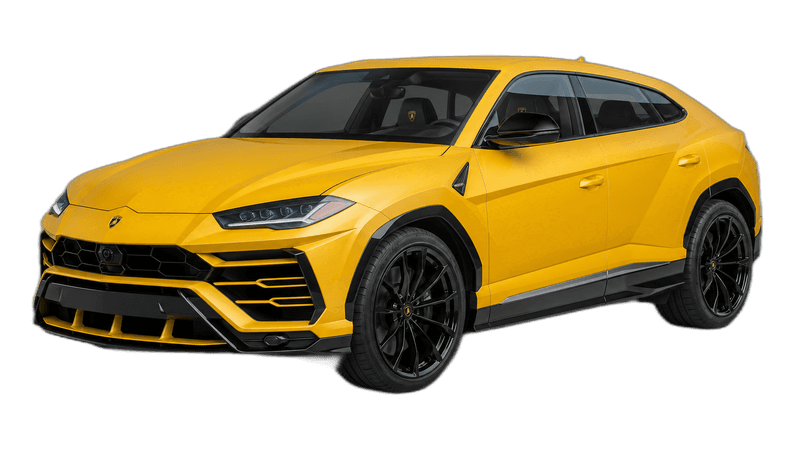
Lamborghini Urus
£175,000
usadoIndicative market price, updated periodically.
641cv
Potencia
3.6s
0-100 km/h
305km/h
Velocidad Máxima
£175,000
Precio Usado
The Lamborghini Urus produces 641 bhp, reaches 100 km/h in 3.6 seconds and has a top speed of 305 km/h. A representative example is worth about £175,000.
Cómo empuja.
La fuerza g máxima en el instante en que pisas a fondo, estimada a partir del 0–100 y la tracción del coche.
Lamborghini UrusG de salida estimada a partir del 0–100 y la tracción: una aproximación honesta, no una cifra medida.
Dream Car Garage Editorial · Edited by José Teo Lorente Vallecillos · Last updated 2 November 2026
Visión General
We have not driven this car. This review is based on published specifications and the sources listed below.
The first Lamborghini super SUV
The Lamborghini Urus was the Italian maker's first modern production SUV, built around a twin-turbocharged V8 and permanent all-wheel drive. This guide is scoped to the original 2018 to 2022 Urus, the car that carried no letters after its name. Later cars share the bodyshell and the basic engine family but are different models with different figures, and they are explained in the next section so that an advert for one is not mistaken for another. Our catalogue lists a 4.0L twin-turbocharged V8 petrol engine producing 641 bhp and 850 Nm, with 0 to 100 km/h in 3.6 seconds, a top speed of 305 km/h and an eight-speed automatic gearbox driving all four wheels. We have not driven this model for this article. This is a desk-researched ownership guide built from Lamborghini's own Urus and Urus Performante model pages, a PistonHeads used buying guide published in August 2022 and the government recall check, with a few clearly named secondary reads where those three are silent.
Checking the figures
Lamborghini rates the engine at 650 CV (478 kW) at 6,000 rpm, and CV here is the metric horsepower, the same unit as PS. Converted to the British brake horsepower measure, 650 PS is about 641 bhp, which is the figure in our catalogue, so an advert quoting 650 PS, 650 hp, 478 kW or 641 bhp describes one engine. Lamborghini's own Urus page gives 3.6 seconds for 0 to 100 km/h and 305 km/h, and PistonHeads lists 3.6 seconds for 0 to 62 mph, 190 mph and 627 lb ft of torque from 2,250 to 4,500 rpm. That torque converts to the 850 Nm in our catalogue. ADAC, the German motoring club, also gives 3.6 seconds, 305 km/h and 850 Nm for the 2018 to 2022 car. A third-party database lists the same power and torque. We did not find any manufacturer source for a 3.4 second time for this car, so we have used 3.6 seconds, and we note that 3.4 seconds is what Lamborghini quotes for the much later plug-in hybrid.
Do not confuse the original with its relatives. The Urus Performante, shown by Lamborghini at 666 CV, 850 Nm, 3.3 seconds and 306 km/h, is lighter by 47 kg than its predecessor according to Lamborghini's page, with carbon-fibre body parts, a titanium exhaust, a new Torsen central differential and a Rally drive mode. The Urus S, announced in September 2022, uses the same 666 PS calibration as the Performante and 850 Nm, with 12.5 seconds to 200 km/h and 305 km/h, and Motor1 describes it as the true successor to the basic Urus. It does not have the Performante's weight saving. The Urus SE, revealed in April 2024, is a plug-in hybrid with a 4.0-litre twin-turbo V8 making 620 hp on its own, 800 hp combined, 950 Nm combined, a 25.9 kWh battery and about 60 km of electric range, according to Autocar India's report of Lamborghini's figures. Those are all separate cars from the one in this guide. The weight is also approximate: PistonHeads gives 2,197 kg and ADAC lists 2,200 kg EU kerb weight, and PistonHeads itself says weight and power figures for this car are hard to pin down.
Engine and gearbox
The engine is a 3,996 cc, 32-valve V8 with two turbochargers, which PistonHeads says it shares with the Porsche Cayenne Turbo and Audi RS Q8 along with the Volkswagen Group platform. The gearbox is a ZF eight-speed automatic. PistonHeads says it is set up for performance in the lower six ratios and for cruising in the top two, and that start-stop is standard. Power goes through a permanent all-wheel drive system with a Torsen centre differential, which PistonHeads says sends 60 per cent of torque to the rear normally and up to 87 per cent at the extreme, and Lamborghini describes active rear torque vectoring on its Urus page. PistonHeads praises the pick-up from just about any speed, and says an exhaust valve and a digitally enhanced engine sound through the speakers are fitted, and that aftermarket exhausts were available. Ask whether the car has been modified, and be cautious about anything that alters the tune.
PistonHeads calls the reliability picture rosy, but it lists two specific issues. In December 2020 there was a recall of 2019 and 2020 model-year cars because fuel-line quick-connector materials could soften at high engine-bay temperatures, creating a fire risk. In spring 2021 there was a cylinder bore cracking problem linked to a misaligned block casting stamp, which PistonHeads says affected only 12 cars across Lamborghini, four of them Uruses built in a two-week period in October 2020. PistonHeads reports no other common problems. Official dealers publish annual and major service schedules: the annual service covers oil and filter, brake and clutch fluid, a wheel alignment check and a safety check, while the major service adds spark plugs, an air filter and transmission oil. Because the guide says independent specialists published no prices online, ask any seller to itemise exactly what was done and by whom.
Chassis, brakes and wheels
PistonHeads lists active air suspension, active anti-roll bars, rear-wheel steering and an active limited-slip rear differential with torque vectoring. Drive modes include Strada, which is soft enough for relaxed cruising, Sport, which firms things up while still riding acceptably, and the Ego custom mode with three adaptive damper settings. An off-road pack added 40 mm of ride height and two extra driving modes, so confirm which cars have it. PistonHeads says the steering has little road feedback but is fast and accurate.
Carbon-ceramic brakes are standard, with ten-piston front calipers on 440 mm discs, which PistonHeads says were the largest fitted to a production car at the time, and six-piston rear calipers on 370 mm discs. Ask for a brake wear report and a quote for replacement discs before you buy, because the cost depends on condition and a worn set is a negotiating point. Standard wheels are 21 inch, 9.5 by 21 at the front and 10.5 by 21 at the rear, with Pirelli P Zero tyres, and PistonHeads says the arches can take 24-inch wheels. The sources disagree on the rear tyre: PistonHeads lists 285/45 front and 315/40 rear, while ADAC lists 285/45 ZR21 front and 325/30 ZR21 rear, so read the sidewall of the car you are viewing and do not rely on either list. No spare wheel is supplied, which matters on a car with large, expensive tyres. Check each wheel for kerb damage, because large alloys are easily scuffed.
Body, interior and electronics
PistonHeads says the front resembles the Aventador, and that thick pillars and shallow frameless windows limit visibility, though large mirrors help. Soft-close doors were a dealer-fit option, and the guide reports some sticking and windows not dropping when the doors close, so test every door several times. A gesture-controlled tailgate was an option with a kneeling mode. Boot space is 616 litres with the seats up, with ADAC giving 1,596 litres and PistonHeads about 1,600 litres with the seats folded. A four-seat layout with two buckets and a centre console was an option, so the seat count should match the paperwork.
Inside there are three screens, for instruments, infotainment and comfort functions, plus a virtual keyboard with handwriting recognition. PistonHeads reports screens occasionally blacking out, and says much of the switchgear is shared with Audi. Options include Bang & Olufsen audio, massage seats, a 360-degree camera, a trailer coupling pack and night vision, which PistonHeads calls very useful. PistonHeads believes DAB radio was an option on pre-2020 model-year cars. It also says the electric front seats feel low for an SUV and the pedals are offset to the right, so take a long test drive before committing. Switch everything on and off during the viewing and ask for any stored fault codes to be read.
Recalls and history
PistonHeads' guide names the December 2020 fuel-line recall for 2019 and 2020 model-year cars and the 2021 bore-cracking issue affecting four Uruses. We did not find a complete UK recall list for this model that we could read from Lamborghini, so we cannot say what campaigns exist beyond those two. Enter the registration in the DVSA vehicle recall service and ask an authorised Lamborghini dealer to check the VIN for open campaigns, and ask for paperwork showing that any recall work was completed. Also ask for a full service history, evidence of any accident repair, and a list of modifications. The body can take wide wheels and the car is heavy, so inspect the underside and arches for scrapes.
Buying decision
PistonHeads' verdict is that the Urus identifies more strongly as an SUV than a traditional Lamborghini, but still offers plenty of Lamborghini character, and it calls the car a fantastic vehicle. It also notes the towing capability, estimating the UK figure at under 2 tonnes, which is a PistonHeads estimate and not a verified rating. Compared with the Audi RS Q8, the guide says the Urus is lighter and has slightly more power and torque.
The main decision is which Urus you want. The original car is the 641 bhp, 3.6 second version covered here, built from 2018 until the Urus S replaced it in late 2022 according to ADAC's listing and Motor1's coverage. If you want the extra 16 PS and the later styling, look at the Urus S. If you want the lightest and sharpest, look at the Performante. If you want plug-in hybrid, that is the Urus SE. We did not find a verified total production figure for the original car, so we do not give one. Compare current adverts instead of relying on a price quoted here. Prefer a car with a documented dealer service history, a clear recall record, brakes with measured life left, matching tyres in good condition, and screens and doors that behave.
Especificaciones
| Motor | 4.0L twin-turbocharged V8 petrol |
|---|---|
| Cilindrada | 4.0L |
| Potencia | 641 cv |
| Par Motor | 850 Nm |
| 0-100 km/h | 3.6s |
| Velocidad Máxima | 305 km/h |
| Tracción | AWD |
| País | Italy |
| Carrocería | 4/5 seater suv/sports utility vehicle |
| Años | 2018–2022 |
| Precio Usado | £175,000 |
Specifications are manufacturer-published figures.
Preguntas Frecuentes
What is a Lamborghini Urus worth?
A representative example is worth about £175,000. Actual values vary with specification, condition and history.
How much power does the Lamborghini Urus have?
The Lamborghini Urus produces 641 bhp and 850 Nm of torque.
How fast is the Lamborghini Urus from 0 to 100 km/h?
The Lamborghini Urus accelerates from 0 to 100 km/h in 3.6 seconds.
What is the top speed of the Lamborghini Urus?
The Lamborghini Urus has a top speed of 305 km/h.
What engine does the Lamborghini Urus have?
The Lamborghini Urus uses a 4.0L twin-turbocharged V8 petrol.
When was the Lamborghini Urus built?
The Lamborghini Urus was built from 2018 to 2022.
Is the Lamborghini Urus all-wheel drive?
Yes. The Lamborghini Urus is configured with all-wheel drive.