
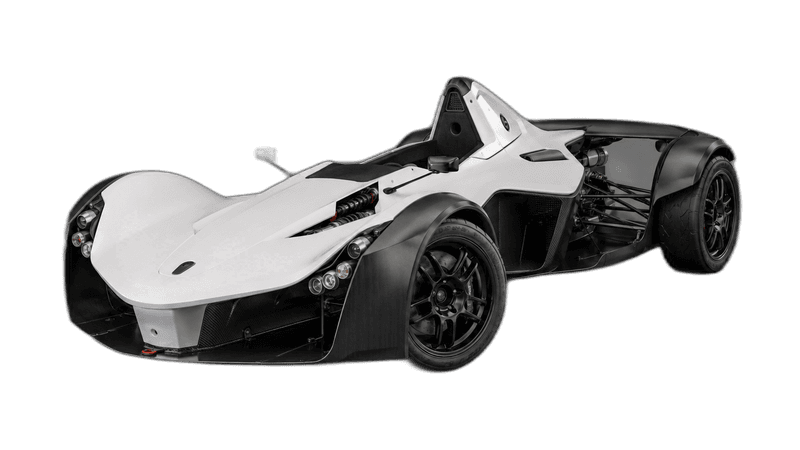
BAC Mono
£150,000
usadoIndicative market price, updated periodically.
280cv
Potencia
2.8s
0-100 km/h
274km/h
Velocidad Máxima
£150,000
Precio Usado
Cómo empuja.
La fuerza g máxima en el instante en que pisas a fondo, estimada a partir del 0–100 y la tracción del coche.
BAC MonoG de salida estimada a partir del 0–100 y la tracción: una aproximación honesta, no una cifra medida.
The BAC Mono is a single-seat open roadster (mid-engine track car) by BAC, with 280 bhp, 280 Nm of torque, a 0-100 km/h time of 2.8 seconds and a top speed of 274 km/h. Indicative used value: approximately £150,000. Actual values vary with specification, condition and history.
Dream Car Garage Editorial · Edited by José Teo Lorente Vallecillos · Last updated 3 November 2026
Visión General
We have not driven this car. This review is based on published specifications and the sources listed below.
Scope of this guide
This guide is scoped to the original BAC Mono with the 2.3L naturally aspirated inline-4 petrol (Cosworth Duratec) engine, the 280 bhp, rear-wheel drive, mid-engine, single-seat open car that Briggs Automotive Company built in Liverpool from 2011. It is not a guide to the 2.5 litre Mono that replaced it, which Mountune built with 305 bhp and a quoted weight of 580 kg, to the wider-chassis Mono (W), or to the Mono R with 343 bhp, which has its own entry in our catalogue. An advert that says only "BAC Mono" can describe any of them, and the engine is the quickest way to tell which one you are looking at.
We have not driven this model for this article. Everything here comes from three cited sources: the specification page on Ultimatecarpage, which reproduces BAC's own company press release from March 2011, PistonHeads' June 2012 road test of the car, and the government recall checker. We also read evo's Mono page (16 March 2020), Wikipedia's article on Briggs Automotive Company, BAC's own model heritage page and a PistonHeads auction listing for a 2.5 litre car, and we flag every point that rests on them. Where sources disagree we say so rather than choose quietly. Prices are history, not valuations.
The figures at a glance
- Engine: 2.3L naturally aspirated inline-4 petrol (Cosworth Duratec), 2261 cc, mounted longitudinally behind the driver. The press release calls it a Ford and Cosworth four, PistonHeads a 2.3 litre Cosworth engine, and Wikipedia a Cosworth-modified Ford Duratec. Mountune is the 2.5 litre car, not this one.
- Power: 280 bhp at 7700 rpm. PistonHeads printed 285 hp at the same revs, which is the metric horsepower for the same engine, since 280 bhp is about 284 PS.
- Torque: 280 Nm at 6000 rpm, from the 207 lb ft the press release and PistonHeads give. evo prints 206 lb ft, about 279 Nm.
- 0-100 km/h: 2.8 seconds. No source we read gives a 0-100 km/h time. The press release says 60 mph in 2.8 seconds and 100 mph in 6.7 seconds, PistonHeads and evo label the 2.8 as 0-62 mph, and 62 mph is within a hair of 100 km/h, so we treat it as that figure. It is a maker's claim.
- Top speed: 274 km/h, which is the claimed 170 mph. Ultimatecarpage prints 274 km/h itself, and 170 mph converts to about 273.6 km/h.
- Drive: rear-wheel drive through a Hewland six-speed sequential gearbox with a limited-slip differential.
- Weight: about 540 kg on PistonHeads, evo and Wikipedia, 545 kg on Ultimatecarpage. The later 2.5 litre car is quoted at 580 kg.
What kind of car this is
The Mono is a road-registered single-seater, which is unusual enough that it shapes everything about ownership. The driver sits on the centreline in a fixed seat set for a 48/52 front-to-rear weight distribution, according to the press release, and a locker behind the seat holds a helmet and the detachable steering wheel. An F1-style seat was an option. There is no windscreen. PistonHeads, driving it on public roads in 2012, found visibility good, the ride over rough back roads impressive and the engine unfussed at low revs, but said wind and grit are real issues and suggested wraparound sunglasses instead of a helmet. It also said the single seat and the price were the main obstacles to buying one. We have not verified how any particular car is registered or insured, so read that as a road-test observation, not as legal advice.
The powertrain is a motorsport one. The press release describes a normally aspirated 2.3 litre Cosworth unit and a six-speed sequential Hewland gearbox, Wikipedia adds that it is electronically controlled with paddle shift, and PistonHeads says the gearbox came straight out of the back of an F3 car. Sequential boxes of this kind are built for racing duty, not for stop-start commuting, so a car that has done road mileage and a car that has done only track days will have very different wear.
When the 2.3 ended
This is the loosest date in the guide. Ultimatecarpage and Wikipedia give the 2.3 car as 2011 to 2015, with the 2.5 litre Mountune engine coming in during 2015. BAC's own heritage page says the original Mono ran from 2011 to 2016 and that the Mono (W) with 305 bhp was launched in 2016. We store 2015 as the end year because two sources agree, and we flag the disagreement. If you are looking at a car from 2015 or 2016, do not trust the year: ask BAC to confirm the engine and chassis from the build record.
How many were built
We do not know. The only number in the sources is capacity: the press release says BAC had the capacity to manufacture between 50 and 100 vehicles a year, and PistonHeads reported in 2012 that BAC was selling every car it could build. Neither is a production total. Our old catalogue held 2011 in the production count field, which is the launch year entered in the wrong place, and we have removed it. Any seller who quotes a build number should be able to show it against the chassis plate.
The launch price and used values
PistonHeads listed the Mono at 74,950 pounds in June 2012, with a one-line description of it as a road car as well as a track weapon. A 2016 PistonHeads auction listing for a 2.5 litre car was a later, different specification, and a dealer comment quoted in a search result says individual parts become very expensive compared with a mass-produced vehicle. We found no published running costs, service schedule or parts price list for the 2.3 car, so anyone quoting you a figure is estimating.
What to check before buying
- Confirm the engine. The 2.3 litre car makes 280 bhp and weighs about 540 kg. The 2.5 litre Mountune car makes 305 bhp and weighs 580 kg. Ask for the build record from BAC.
- Ask about use. A car used mostly on track in its first years needs its engine, gearbox, driveshafts and dampers history checked, and a sequential Hewland box has a service life.
- A listing we read for a later car said it had been serviced by the BAC factory or a specialist with all invoices available. Ask for the same paperwork, and for any work done on the actuation system and the electronics.
- Inspect the carbon bodywork and the exposed suspension for track damage, since an open-wheel body is easy to scratch and costly to repair.
- Check how the car is registered where you live and what that means for insurance and tax.
- Get an independent inspection from someone who knows the car. There is no volume dealer network.
- Run the recall check described below.
Recalls and the DVSA check
We did not run the government checker, because it needs a registration number or the manufacturer, model and year, and we are not looking at one car. The page says it covers safety recalls for cars, and that you will be told by the manufacturer about recalls for any reason other than safety. For a low-volume, hand-built car like the Mono, the checker may hold few or no entries, and an empty result is not a clean bill of health: it only tells you that nothing safety-related is recorded. We found no recall notice for the Mono in any source. Ask BAC directly whether any service bulletin applies to the chassis you are viewing.
About the photograph
The picture at the top of this page shows a BAC Mono at the 2019 New York International Auto Show, in a dark carbon and gold finish. The 2.3 litre engine went out of production before that, so this is a later car, not the specification this guide covers, and we use it only to show the shape. We blurred a few background visitors at the top edge and cropped the original to fit.
Verdict
The original BAC Mono is a 280 bhp, 280 Nm, claimed 2.8 seconds to 100 km/h, 274 km/h, rear-wheel drive and mid-engine single-seater weighing about 540 kg, built in small numbers from 2011. It is a purpose-built track machine that can be driven on the road, whose condition depends on how it has been used and whose paperwork matters more than its headline figures. Confirm the engine, insist on a full history, treat every published figure as a claim, and get a specialist to look at it. We have not driven it, so use the sources and a proper inspection to decide.
Especificaciones
Motor
2.3L naturally aspirated inline-4 petrol (Cosworth Duratec)
Cilindrada
2.3L
Potencia
280 cv
Par Motor
280 Nm
0-100 km/h
2.8s
Velocidad Máxima
274 km/h
Tracción
RWD
País
UK
Carrocería
single-seat open roadster (mid-engine track car)
Años
2011–2015
Precio Usado
£150,000
Specifications are manufacturer-published figures.
Más de BAC
Preguntas Frecuentes
What are the specifications of the BAC Mono?
The BAC Mono is a single-seat open roadster (mid-engine track car) by BAC, with 280 bhp, 280 Nm of torque, a 0-100 km/h time of 2.8 seconds and a top speed of 274 km/h. Indicative used value: approximately £150,000. Actual values vary with specification, condition and history.
How much does a BAC Mono cost?
Indicative used value: approximately £150,000. Actual values vary with specification, condition and history.
What drivetrain does the BAC Mono use?
The BAC Mono is configured with rear-wheel drive.
What type of car is the BAC Mono?
The BAC Mono is a track focused manufactured by BAC in UK. Production ran from 2011 to 2015.