
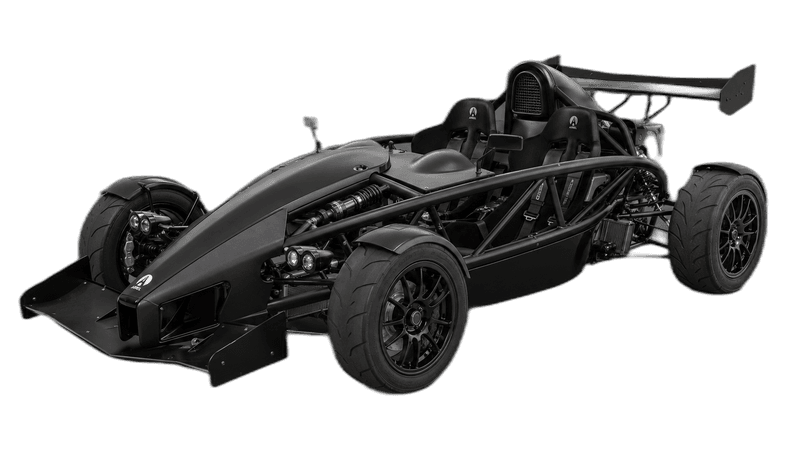
Ariel Atom 4
£65,000
usadoIndicative market price, updated periodically.
320cv
Potencia
2.8s
0-100 km/h
261km/h
Velocidad Máxima
£65,000
Precio Usado
Cómo empuja.
La fuerza g máxima en el instante en que pisas a fondo, estimada a partir del 0–100 y la tracción del coche.
Ariel Atom 4G de salida estimada a partir del 0–100 y la tracción: una aproximación honesta, no una cifra medida.
The Ariel Atom 4 is a 2-seat open roadster by Ariel, with 320 bhp, 420 Nm of torque, a 0-100 km/h time of 2.8 seconds and a top speed of 261 km/h. Indicative used value: approximately £65,000. Actual values vary with specification, condition and history.
Dream Car Garage Editorial · Edited by José Teo Lorente Vallecillos · Last updated 3 November 2026
Visión General
We have not driven this car. This review is based on published specifications and the sources listed below.
Scope of this guide
This guide is scoped to the standard Ariel Atom 4, the fourth-generation Atom with the 2.0L turbo inline-4 petrol (Honda K20C1) engine and 320 bhp, the rear-wheel drive, mid-engine, open two-seat track car that Ariel builds at Crewkerne in Somerset. Ariel showed it at the Goodwood Festival of Speed in 2018 and deliveries began in 2019. It is not a guide to the earlier Atom 3 and 3.5 cars with naturally aspirated or supercharged Honda engines, to the Atom 4R with its higher output and sequential gearbox, to the Atom 4RR, or to the Nomad and Dash, which are different vehicles. Where an advert says only "Atom 4", ask which of these it means, because the 350 bhp upgrade is common and changes what you are buying.
We have not driven this model for this article. Everything here comes from three cited sources: Ariel's 2018 launch announcement, PistonHeads' used buying guide for the Atom 4, and the government vehicle recall page. We also read Ariel's company history page, one sold used-car listing on Ariel's site and a Wikipedia summary for background, but we do not cite them as sources.
The figures at a glance
The engine is Honda's turbocharged 2.0 litre four, the same K20C1 family used in the Civic Type R, listed by PistonHeads at 1,996 cc. Ariel quotes 320 bhp, and PistonHeads gives 320 hp at 6,500 rpm and 310 lb ft at 3,000 rpm. We convert that torque to 420 Nm, so treat the Nm figure as our arithmetic rather than a number printed by Ariel. PistonHeads puts the car's claimed weight at 595 kg, which gives the 538 hp per tonne that it mentions.
PistonHeads lists 0-60 mph in 2.8 seconds, 0-100 mph in 6.8 seconds and a top speed of 162 mph, which we convert to 261 km/h. The 2.8 seconds figure is a 0-60 mph time, not a measured 0-100 km/h time, and a true 0-62 mph run would take very slightly longer. Our catalogue previously held 2.97 seconds, which we could not tie to any source we read, so we replaced it with the quoted figure and say so here. The Atom 4 has rear-wheel drive and the standard gearbox is a six-speed manual.
PistonHeads adds a caution that its own power and weight data is hard to pin down and should be treated as relative rather than definitive. We agree, and every number in this guide is a manufacturer or magazine claim, not something we measured.
What the Atom 4 is
Ariel's history page describes the Atom 4 as the first turbocharged Ariel, replacing the supercharger whine of earlier cars, with switchable boost. Simon Saunders, a director of Ariel, said at the launch that it was the biggest change to the car since it was first released in 1999, and that only three parts carried over from the previous Atom. Ariel names the pedals and the fuel cap in that announcement, and its history page lists the pedals, steering wheel and fuel cap, so the exact list varies between its own pages.
The chassis is a new tubular frame with larger tubes, double wishbone suspension with inboard coilovers and new aluminium uprights, and revised geometry that adds anti-dive and anti-squat. The engine sits behind the seats and drives the rear wheels, which is why we call it mid-engine. No source we cite uses that exact word, so it rests on the car's layout rather than a quoted specification. There are no doors, no roof and only a small windscreen, which matters for how you use it and for how you insure it.
Power settings and upgrades
PistonHeads describes three boost settings selected by a dial: 1.3 bar for the full 320 bhp, 0.6 bar for about 290 bhp and 0.3 bar for about 220 bhp. A 350 bhp upgrade using a sports catalytic converter, a decat pipe and an ECU reflash was popular, and a Quaife six-speed sequential gearbox was both an option and a common retrofit. Neither is the standard car described here, so ask the seller which engine map, exhaust and gearbox are fitted, and who did the work.
PistonHeads says the 2.0 litre produces its torque low in the rev range and that the six-speed manual works as well as it does in the Civic Type R. It also reports that a clutch replacement part is not very expensive but that the labour, which includes dropping the engine, can multiply the bill several times. That is a general comment from a magazine, not a quote for your car.
Chassis, brakes and tyres
PistonHeads lists 7 x 16 inch front and 9 x 17 inch rear wheels with 195/50 and 255/40 tyres, with the less extreme Avon ZZS as the default fitment. It describes the handling as benign, but it warns that cold or wet tyres can make the car nervous and that a little more brake pedal feel would help. PistonHeads lists factory options including AP Racing four-piston calipers with 290 mm discs, stainless brake lines, adjustable dampers and carbon ceramic brakes.
Because the options are so many, no two cars are alike. One used Ariel listing we read describes a 2020 car with a limited-slip differential, adjustable traction control with launch control, AP Racing brakes and Bilstein adjustable dampers. That is a single example, not a specification for every car.
Servicing and running costs
Many owners return their cars to Ariel in Somerset. PistonHeads also names Backdraft Motorsport in Milton Keynes as an independent option and quoted an annual oil and inspection service at 395 pounds plus VAT in its February 2025 guide. We did not obtain a current price, a full servicing schedule or a parts price list, so do not treat that figure as a budget. PistonHeads estimates about 30 mpg on a steady cruise, which fits a light car with a 2.0 litre engine.
PistonHeads also says the car is not one to leave outside, and that the chassis powder coating and rustproofing were good but deserve a check for stone chips after a drive. It adds that crazing in the lacquer can be a sign of crash damage, and that a replacement chassis was priced in the early 2010s at a figure that makes regular inspection worthwhile. That price relates to an earlier generation and should not be applied to the Atom 4.
What to check before buying
- Confirm which Atom you are looking at: standard 320 bhp, the 350 bhp upgrade, a 4R or a car converted from another specification. Ask for the build sheet and receipts for engine and gearbox work.
- Ask Ariel, or the dealer that sold the car, to confirm the chassis number, build date and options fitted.
- Check how the car was approved for the road. Ariel's 2018 announcement said the Atom 4 would be the first Ariel to go through European Small Series Type Approval, with a Certificate of Conformity from 2019, and one Ariel listing we read mentions an IVA test and road registration. Ask for the paperwork and do not assume.
- Inspect the tubular frame for lacquer crazing, stone chips, corrosion and signs of repair, and look closely at the wishbones, uprights and rod ends for track damage.
- Ask how many track days the car has done, what tyres and brake pads are fitted, and when the clutch was last changed.
- Check any infill panels for rattles, because PistonHeads reports that they can rattle and make the cabin warm in sun.
- Check the fitted extras, such as roll bar, harnesses, reversing camera and tracker, and ask your insurer about each before you commit.
- Get an independent inspection from an Atom specialist, and run the registration through the recall check described below.
Recalls and the DVSA check
We read the government recall page but we did not run the checker, because it asks for a registration number or for the manufacturer, model and year, and we are not looking at a specific car. The page says the registration route shows safety recalls that have not been checked or fixed and the MOT history, that the manufacturer will tell you about any non-safety recall, and that you can also check for faults registered with the Driver and Vehicle Standards Agency.
What it can tell an owner is whether a safety recall is recorded against a particular car or against a make, model and year. What it cannot tell you is whether a small-series, built-to-order car such as the Atom 4 is fully covered by the lookup, since we could not confirm that without entering a registration. PistonHeads said it found no recalls for the Atom 4 when it wrote its guide in February 2025. Absence of a recall in our sources is not a clean bill of health, so check the page yourself on the day you buy, and ask Ariel directly about any service bulletins.
About the photograph
The picture at the top of this page shows a blue Atom 4 photographed at a 2023 show. We modified the image by cropping it to a wide format, resizing it and blurring the number plate of a different car parked behind it. The shot does not show the options your car will have, and we cannot tell the engine map from a photograph.
Verdict
The Atom 4 in this guide is a 2.0L turbo inline-4 petrol (Honda K20C1) car with 320 bhp, 420 Nm, a claimed 2.8 seconds from 0-60 mph and a claimed 261 km/h top speed, with rear-wheel drive and a mid-engine layout in a very light open frame. It is a low-volume, built-to-order car whose value to you depends on its history, its options and the care it has had. If you are shopping for one, confirm the exact specification, insist on a full record and approval paperwork, and treat every published figure as a claim until a specialist has checked the car.
Especificaciones
Motor
2.0L turbo inline-4 petrol (Honda K20C1)
Cilindrada
2.0L
Potencia
320 cv
Par Motor
420 Nm
0-100 km/h
2.8s
Velocidad Máxima
261 km/h
Tracción
RWD
País
UK
Carrocería
2-seat open roadster
Años
2019–present
Precio Usado
£65,000
Specifications are manufacturer-published figures.
Más de Ariel
Destacado en Carpedia
Best Track Cars Under €100,000 in 2026
Eight dedicated track and performance road cars under €100,000, from an entry-level Caterham at £28,000 to the most focused naturally aspirated Porsche 718 ever made.
What Cars Should I Put in My Dream Garage?
A comprehensive guide to building a dream garage at every budget. Five balanced 5-car garages, from under GBP 100K total to unlimited, each covering daily driving, weekends, track days, road trips, and special occasions.
Preguntas Frecuentes
What are the specifications of the Ariel Atom 4?
The Ariel Atom 4 is a 2-seat open roadster by Ariel, with 320 bhp, 420 Nm of torque, a 0-100 km/h time of 2.8 seconds and a top speed of 261 km/h. Indicative used value: approximately £65,000. Actual values vary with specification, condition and history.
How much does a Ariel Atom 4 cost?
Indicative used value: approximately £65,000. Actual values vary with specification, condition and history.
What drivetrain does the Ariel Atom 4 use?
The Ariel Atom 4 is configured with rear-wheel drive.
What type of car is the Ariel Atom 4?
The Ariel Atom 4 is a track focused manufactured by Ariel in UK. Production started in 2019.