
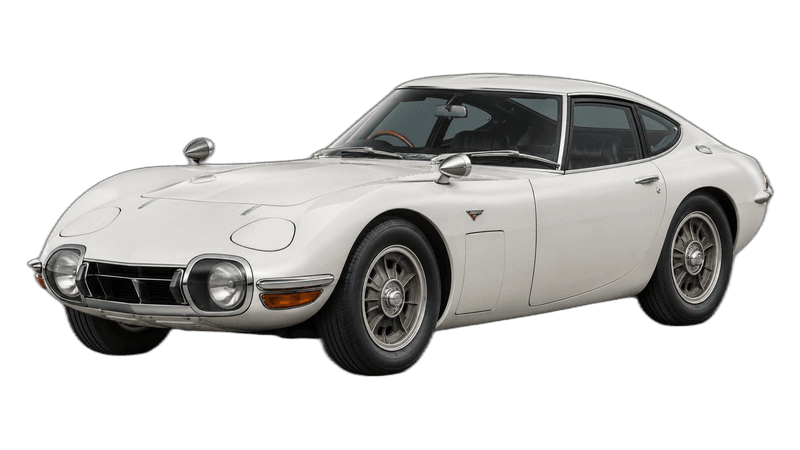
Toyota 2000GT
148bhp
Power
8.6s
0-100 km/h
220km/h
Top Speed
How hard it pulls.
Peak g-force the instant you bury the throttle, estimated from the car's 0–100 time and drivetrain.
Toyota 2000GTEstimated peak launch g from the 0–100 time and drivetrain: an honest approximation, not a measured figure.
The Toyota 2000GT is a 2-door coupé by Toyota, with 148 bhp, 176 Nm of torque, a 0-100 km/h time of 8.6 seconds and a top speed of 220 km/h.
Dream Car Garage Editorial · Last updated 3 November 2026
Overview
We have not driven this car. This review is based on published specifications and the sources listed below.
Scope of this guide
This guide is scoped to the Toyota 2000GT, the two-door coupe that Toyota developed with Yamaha Motor and that Yamaha built by hand at Iwata, Shizuoka, between May 1967 and August 1970. It has a front-engine layout, a 2.0L inline-six with a twin-cam head, a five-speed manual gearbox and rear-wheel drive. It is not a guide to the nine cars fitted with the 2.3-litre engine, which we mention only so that you can recognise one in an advert, and it is not a guide to the two open-topped one-offs built for the James Bond film You Only Live Twice, which were never customer cars.
We have not driven this model for this article. We are an editorial desk that reads sources, and everything below comes from pages we opened: the Toyota Automobile Museum, Yamaha Motor's own collection page, a Goodwood Insurance buyer's guide, Wikipedia, and three auction or news pages (Gooding and Company, BH Auction in Tokyo, and Autoblog). This is a collector car that rarely comes to market. A guide like this cannot replace an inspection by a specialist who knows the car, and nothing here should be read as a substitute for one.
The figures at a glance
- Engine: 2.0L inline-six, the 3M, a twin-cam conversion of the single-cam six used in the Toyota Crown. Yamaha developed the cylinder head. Displacement is 1,988 cc in every source we read.
- Power: 148 bhp. The Toyota Automobile Museum and Yamaha both give 150 PS at 6,600 rpm, and Wikipedia prints 150 PS as 148 hp. The Gooding and Company lot page prints 150 BHP. The difference is only the unit: 150 PS converts to about 148 bhp, so we show 148 bhp.
- Torque: 176 Nm at 5,000 rpm. Goodwood prints 176 Nm, Yamaha prints 176.5 Nm, and Wikipedia prints 175 Nm. They agree within about a newton metre, and we use the Goodwood figure of 176 Nm.
- 0-100 km/h: 8.6 seconds. This is the 0-62 mph time in the Goodwood guide. It was the only acceleration time we found in any source, so we cannot say how it compares with other claims, and it is a period-car figure and not a result from a modern test.
- Top speed: 220 km/h. Goodwood prints 137 mph, which is about 220 km/h. Wikipedia prints 135 mph (217 km/h) for a car with the 4.375 final-drive ratio. Toyota gives three final-drive ratios, so the top speed depended on the axle fitted. We keep 220 km/h because it is the larger published figure and matches the 137 mph source, but 217 km/h is the more cautious number.
- Drive: rear-wheel drive through a five-speed manual gearbox. A three-speed automatic was offered late on.
- Weight: 1,120 kg. Toyota Automobile Museum, Yamaha, Wikipedia and Goodwood all agree.
- Size: 4,175 mm long, 1,600 mm wide and 1,160 mm high on a 2,330 mm wheelbase, per the museum and Yamaha.
- Price when new: Yamaha lists 2,380,000 yen. Wikipedia says a 1968 US car listed at about 7,150 US dollars.
Where the sources disagree
Sources disagree in several places and we say so rather than choosing silently. On power, 150 PS, 148 bhp and 150 bhp are all the same output stated in different units, so we show 148 bhp. On top speed, 220 km/h (from the 137 mph in Goodwood) and 217 km/h (the 135 mph in Wikipedia) differ by a few km/h. On acceleration, we found only 8.6 seconds and no rival figure.
Production is the largest disagreement. The Toyota Automobile Museum, Yamaha, Goodwood and the BH Auction page all say 337, and the museum says that figure includes the early model. BH Auction says 337 includes prototypes. Wikipedia's box and the Autoblog article say 351. Wikipedia's own breakdown lists 233, 109 and 9 cars, which adds up to 351, but it marks the MF12L number as needing a citation. We show 337 because four independent-looking sources and the maker's own museum agree on it, and we treat 351 as a count that probably adds the nine 2.3-litre cars. That is our reading, not something a source states.
The carburettors also differ. Wikipedia says three twin-barrel Mikuni-Solex 40 PHH carburettors, and Goodwood says three twin-choke carburettors without a brand. The Gooding and Company lot page, for one car, says three Weber 40 DCOE. A buyer should treat the carburettor brand as a point to check on the actual car, not as a fact we can settle.
Finally, the MF10 and MF10L labels are used inconsistently. The Toyota Automobile Museum calls the 1967 early model MF10L and the 1969 late model MF10, while the Gooding page calls a 1967 car MF10. We do not know what the L stands for from what we read, so we do not rely on these labels.
History and Yamaha's role
The museum's account is that Japan's Grand Prix began in 1963 and Toyota wanted a world-class GT car. In autumn 1964 the president of Yamaha Motor visited Toyota to discuss joint development. Yamaha had earlier abandoned a GT project with Nissan. The first prototype was completed in August 1965 and a second was shown at the Tokyo Motor Show in October 1965. Toyota staff worked inside Yamaha alongside Yamaha engineers, and the project was run by a small team under the codename 280A, with Jiro Kono as project leader.
In October 1966 the car set three world records and 13 international records in the 1500 to 2000 cc E class at speed trials. Production was released in May 1967. The museum says output reached up to 14 cars a month and sometimes fell below 10, while Yamaha says about eight cars a month. We do not know why they differ. Both agree it was almost entirely handmade.
Yamaha also says some body parts were made using its FRP moulding technology. Goodwood describes an aluminium body on a steel X-frame chassis influenced by the Lotus Elan, with a body that can be separated from the chassis. The car had double-wishbone suspension all round, rack-and-pinion steering and disc brakes at each corner.
Variants and the 1969 changes
In August 1969 the car was updated. The museum lists headrests, a cooler, smaller auxiliary headlights, a changed front face and a ride height 10 mm higher. Wikipedia adds enlarged rear indicators, some interior updates and, on the last cars, air conditioning with an extra scoop under the grille. Goodwood says the facelift offered air conditioning and the three-speed automatic, and recommends passing on the automatic.
The 2.3-litre cars are a separate story. BH Auction describes the MF12L as a 2300 cc single-cam six, the 2M-B, rated at 140 PS and aimed at North America, with nine prototypes and no commercial production because of cost. We found those cars described as prototypes in that listing and as production variants in Wikipedia, so the sources do not agree on their status either.
Goodwood and the Gooding page both say 62 cars were left-hand drive for the US market, and Yamaha says 115 of the 337 were exported. Carroll Shelby ran cars in SCCA racing, per Goodwood and Wikipedia, which disagree on how many. The Bond cars were two one-offs, and Wikipedia says they were modified for the film in about two weeks.
What to check before buying
- Provenance first. Goodwood stresses full documentation of any restoration, and the Gooding page we read names the first owner of the car it sold. Ask for every invoice and photograph.
- Chassis numbers. The chassis numbers we saw begin MF10 followed by a serial. Verify them against the car's plates and papers, and against a specialist's records, because we found sources printing the same prefix in different ways.
- The steel chassis. Goodwood says the aluminium and fibreglass bodywork should be sound but the steel chassis needs careful inspection, including the body mounts, suspension turrets and engine mounts.
- The hand-built body. Each body was made by hand, so panel fit varies and we would not expect two cars to be identical. A specialist can judge whether fit and finish are original.
- Carburettors. Confirm which carburettors the car carries and whether they are the correct originals, given that our sources name different brands.
- Gearbox. Goodwood recommends passing on the three-speed automatic.
- Left-hand or right-hand drive. Most cars were right-hand drive, per Goodwood, and 62 were left-hand drive, so the steering side tells you something about where the car began life.
- A specialist inspection. We cannot judge a car from a web page, and neither can you.
Running costs and known issues
We found no source giving running costs, a service schedule, an engine rebuild interval or failure rates for the 2000GT, so we give none. Goodwood says its page lists no specific mechanical faults and only the corrosion-prone areas above. Anyone quoting repair costs without a source is guessing.
Parts supply is documented. Autoblog, in an article dated 10 July 2020, reported that Toyota's GR Heritage Parts division would build replacement parts in Japan from autumn 2020, starting with items for the five-speed manual gearbox and the differential. Engine rebuild parts for the straight-six and body panels were not offered at that point. Buyers must prove they own a 2000GT and per-owner limits apply. Goodwood says the programme covers selected mechanical spares but not trim or bodywork. We did not check whether the catalogue has grown since.
Recalls and safety
We found no recall notice for the 2000GT in any page we read, but that is not a clean bill of health, because we did not search a recall database. A car of this age has no modern crash structure, and Goodwood's description of an aluminium body on a steel frame tells you about construction, not crash performance. We found no crash-test or safety-equipment data. If you intend to use one on the road, ask a specialist about brakes, steering and fuel system condition.
Market and value notes
Prices are thin and uneven, and a few sales do not make a valuation. Gooding and Company sold chassis MF10-10100, an original left-hand-drive Solar Red car restored by Maine Line Exotics, for 550,000 US dollars at Pebble Beach in 2018, against an estimate of 800,000 to 1,000,000 US dollars. Autoblog reported in July 2020 that a yellow car sold in 2013 for 1.2 million US dollars, then the most expensive Asian car sold at auction, and that Hagerty valued a 1967 car in excellent condition at 640,000 US dollars. Wikipedia reports that a Toyota-Shelby 2000GT sold for 2.5 million US dollars in 2022. Goodwood calls the car rare and highly collectible and suggests rarity pushes it toward an investment item more than a usable classic. Those figures cover different cars, condition and years, so treat them as a spread, not a price list.
What we could not find
We found no maker top speed or acceleration figure in the Toyota Automobile Museum or Yamaha pages: both give power, and Yamaha gives torque, but neither gives top speed or 0-100 km/h. Our speed and acceleration figures therefore come from Goodwood and Wikipedia, which are not maker documents. We found no running costs, no recall data and no crash-safety data. We did not find a consistent explanation of the MF10 and MF10L labels, a settled production count, or a settled carburettor brand. A Toyota museum URL we tried first returned a not-found error, so we used another page from the same museum. We did not run any registry or recall search.
About the photograph
This page uses the catalogue photograph for the car. Its credit is listed on the credits page.
Verdict
The 2000GT is a hand-built, front-engine, rear-wheel-drive coupe with a 2.0L inline-six making 148 bhp and 176 Nm, a quoted 8.6 seconds to 100 km/h and a quoted 220 km/h. The numbers are modest by today's standards, and what you are buying is rarity, provenance and the Toyota and Yamaha story, with a production count of 337 on the best evidence we found. The practical advice from our reading is to insist on documentation, to have the steel chassis and mounts checked, to confirm carburettors and gearbox, and to remember that parts are partly supported by Toyota but not for trim, bodywork or engine rebuilds. We have not driven it, so use the sources, the seller's records and an independent specialist inspection to decide.
Sources
- Toyota Automobile Museum: Toyota 2000GT (Stories from the Museum)
- Yamaha Motor: Toyota 2000GT (Yamaha Motor Collection Hall)
- Goodwood Insurance: Toyota 2000GT buyer's guide
- Wikipedia: Toyota 2000GT
- Gooding and Company: 1967 Toyota 2000GT, chassis MF10-10100 (Pebble Beach Auctions 2018)
- BH Auction Tokyo: 1969 Toyota 2000GT MF12L lot
- Autoblog: Toyota 2000GT replacement parts (10 July 2020)
Specifications
Engine
2.0L inline-six
Displacement
2.0L
Power
148 bhp
Torque
176 Nm
0-100 km/h
8.6s
Top Speed
220 km/h
Drivetrain
RWD
Country
Japan
Body Style
2-door coupé
Years
1967–1970
Production
337
Specifications are manufacturer-published figures.
More from Toyota
Frequently Asked Questions
What are the specifications of the Toyota 2000GT?
The Toyota 2000GT is a 2-door coupé by Toyota, with 148 bhp, 176 Nm of torque, a 0-100 km/h time of 8.6 seconds and a top speed of 220 km/h.
How many Toyota 2000GT were made?
Toyota produced 337 units of the Toyota 2000GT.
What drivetrain does the Toyota 2000GT use?
The Toyota 2000GT is configured with rear-wheel drive.
What type of car is the Toyota 2000GT?
The Toyota 2000GT is a sports cars manufactured by Toyota in Japan. Production ran from 1967 to 1970.