
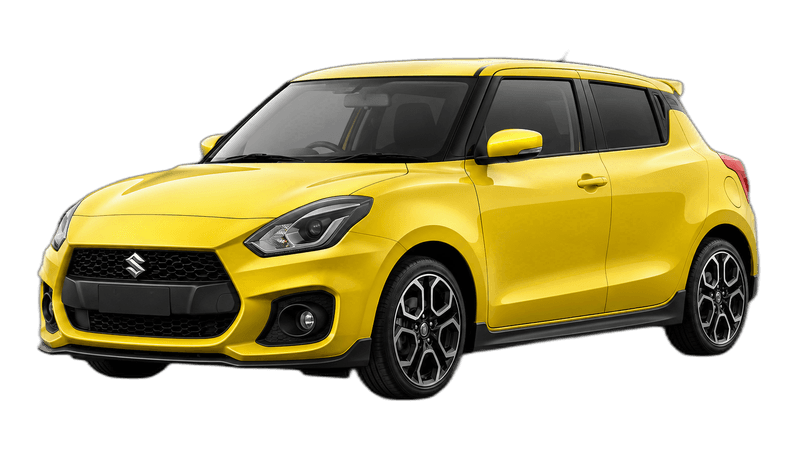
Suzuki Swift Sport (ZC33S)
£15,000
usedIndicative market price, updated periodically.
138bhp
Power
8.1s
0-100 km/h
209km/h
Top Speed
£15,000
Price Used
How hard it pulls.
Peak g-force the instant you bury the throttle, estimated from the car's 0–100 time and drivetrain.
Suzuki Swift Sport (ZC33S)Estimated peak launch g from the 0–100 time and drivetrain: an honest approximation, not a measured figure.
The Suzuki Swift Sport (ZC33S) is a 5-door hatchback by Suzuki, with 138 bhp, 230 Nm of torque, a 0-100 km/h time of 8.1 seconds and a top speed of 209 km/h. Indicative used value: approximately £15,000. Actual values vary with specification, condition and history.
Dream Car Garage Editorial · Last updated 2 November 2026
Overview
We have not driven this car. This review is based on published specifications and the sources listed below.
The light, front-wheel-drive turbo Swift
The third-generation Swift Sport is a small, light five-door hatchback with a turbocharged 1.4-litre engine and a six-speed manual gearbox, and it is the car most people mean when they say ZC33S. This guide is scoped to the pre-hybrid ZC33S Swift Sport, the 140 PS car sold from 2017 to spring 2020, and not to the 1.6-litre ZC32S that came before it or to the mild-hybrid car that replaced it. Our catalogue lists a 1.4L turbocharged Boosterjet inline-4 petrol engine (1,373 cc) producing 138 bhp and 230 Nm, with 0 to 100 km/h in 8.1 seconds, a top speed of 209 km/h, a six-speed manual gearbox and front-wheel drive. We have not driven this model for this article. This is a desk-researched ownership guide built from the Suzuki UK media site's Swift Sport press pack, a PistonHeads group test published in October 2018 and the government recall check, plus a few clearly named secondary reads where those three are silent.
A note on dates. Suzuki showed the car at the Frankfurt show in September 2017, and its UK press pack says it launched in Japan in late 2017 and went on sale in the UK and Ireland from June 2018. The same press pack says it was made for Europe at the Sagara plant in Japan. The hybrid version has been on sale in the UK since April 2020, so we list this guide's car as 2017 to 2020. Suzuki's own UK archive page for the hybrid is titled 2018 to 2025, which means the wider third-generation Sport ran for several more years than this guide covers.
Checking the figures
Suzuki UK quotes 140 PS, which is a metric figure. Suzuki Motor Corporation's launch release gives 103 kW at 5,500 rpm. Converted, 140 PS is about 138 bhp (140 x 0.986) and 103 kW is also about 138 bhp, which is the number in our catalogue. So an advert that says 140 PS, 140 hp, 103 kW or 138 bhp describes the same engine. PistonHeads prints 140hp in its 2018 test.
Torque is 230 Nm from 2,500 to 3,500 rpm, according to both Suzuki sources, and PistonHeads prints 162 lb ft, which converts to about 220 Nm, so that figure looks like a rounding or a slip and we use Suzuki's 230 Nm. Suzuki UK says that is 44 percent more than the previous Sport and quotes 160 Nm at 4,400 rpm for the older car.
Suzuki UK gives 8.1 seconds for 0 to 62 mph and a maximum speed of 130 mph, where permitted. We found no official 0 to 100 km/h time or top speed in km/h. 62 mph is almost exactly 100 km/h, so we treat the 8.1 seconds as the 100 km/h figure, and 130 mph converts to about 209 km/h. Those two values are our conversions, not numbers printed by Suzuki in metric units. PistonHeads prints 8.1 seconds and 130 mph too.
Weight is a small mess. Suzuki UK says 975 kg for the UK and Ireland car. Suzuki Motor Corporation's French launch release says 970 kg and its data table gives a kerb weight range of 965 to 970 kg without stop-start and 970 to 975 kg with it, so the figures agree within the range. Suzuki also notes that specifications vary by market. For example, the Japanese release gives a minimum turning radius of 5.1 m while the UK pack says 4.8 m.
Do not confuse this car with its neighbours. PistonHeads' used guide to the ZC32 lists a 1,586 cc four with 136hp, 118 lb ft, 8.7 seconds to 62 mph and 121 mph, and a second PistonHeads piece on the same generation gives 1,045 kg where the guide gives 1,050 kg. That car is normally aspirated and has a quite different character. The hybrid Sport is different again: PistonHeads prints 129hp, 173 lb ft, 9.1 seconds and 1,025 kg for it, Suzuki UK's 2023 press pack says 235 Nm from 2,000 rpm and 1,025 kg, and an Auto Express used review prints both 138 bhp and 127 bhp for the Sport on the same page. We could not read an official power figure for the hybrid, so we do not give one here. The row our catalogue used to carry (81 bhp, 112 Nm, 12.5 seconds, 165 km/h and a 1.2-litre naturally aspirated engine) matches none of the cars in any source we read, and we have replaced it.
A word on tuned or remapped cars. A PistonHeads readers' thread from January 2019 has owners claiming real output of 155 hp or more and a remap supplier quoting figures of about 150 to 167 bhp. Those are secondhand claims with no dyno sheet, so we treat Suzuki's 140 PS as the only verified number.
Engine and gearbox
The engine is Suzuki's 1.4-litre direct-injection Boosterjet turbo four. Suzuki gives a bore and stroke of 73.0 x 82.0 mm, 16 valves and a compression ratio of 9.9. The turbocharger bolts directly to the cylinder head, and the exhaust manifold is cast into the head to cut turbo lag, with boost pressure of 1.0 bar. The press pack says the wastegate stays closed under heavy load and open when cruising. PistonHeads called the engine "a corker" in 2018, with barely noticeable lag, but thought the 6,000 rpm limit felt low and suggested the older, lighter car might have been more fun with it.
Suzuki's UK pack quotes 50.4 mpg and 125 g/km of CO2 on the NEDC cycle. PistonHeads printed 50.4 mpg and 125 to 129 g/km, while owners in the PistonHeads thread reported about 44 mpg in use. The tank is 37 litres, so expect more frequent fill-ups than the official figure suggests. Owners also say the oil takes a while to warm up and that boost seems held back on a cold engine. That is anecdotal, so treat it as a reason to start cold and drive gently.
The sources we read give no engine code for the pre-hybrid car. The hybrid press pack calls its engine the K14D and says it has electric intake variable valve timing, new injectors and a higher-pressure fuel pump. Since parts can differ between the two, quote your registration or VIN when you order. The gearbox is a six-speed manual, an evolution of the previous car's, with a 10 percent shorter gear lever throw, triple-cone synchromesh on first and second and double-cone on third. The press pack says the clutch was uprated for the engine's low-speed torque. Ratios are 3.615, 1.955, 1.276, 0.943, 0.795 and 0.674, with a 3.944 final drive. We found no gearbox or clutch failure data in the sources we read, so test the clutch for slip and judder on a long drive, and ask for evidence of any replacement.
Chassis, brakes and wheels
The car sits on Suzuki's lightweight HEARTECT platform, with MacPherson struts at the front and a torsion beam at the rear. Both ends use Monroe dampers. Suzuki says front camber rigidity rose 15 percent, rear toe rigidity rose by a factor of 1.4 and rear camber rigidity by nearly three. The Sport is 3,890 mm long, 1,735 mm wide, 1,495 mm tall, with a 2,450 mm wheelbase and tracks of 1,510 mm front and 1,515 mm rear.
PistonHeads' 2018 group test says the car pitches around a lot for its low weight, that the steering and tyres lack the grip and feedback to inspire confidence, and that the driver aids allow scrappy wheelspin and limit how much grip you can use. It called the balance safe and predictable, but less agile than before. That is one reviewer's view, and it was a comparison against a Volkswagen Up GTI and a Mazda 2, so judge it yourself on a test drive.
The brakes were described as powerful in that test, and the Swift was the only car in it with discs all round. Suzuki says the front ventilated discs are 285 mm in diameter and 24 mm thick, and the rear discs are solid. Check for lipped or scored discs and uneven pad wear. The wheels are 17-inch flow-formed polished alloys fitted with 195/45R17 tyres per Suzuki Motor Corporation's data table. Auto Express lists corrosion on diamond-cut alloy wheels among the problems noted for the Swift generally. It does not say the Sport's polished alloys are affected, but look closely at the lacquer, particularly around the rim edge. Check all four tyres for even wear, which can point to alignment problems or kerb damage.
Body, interior and electronics
The Sport has an exclusive front bumper and honeycomb grille, black under-spoilers front, side and rear, a roof spoiler, a dual exhaust and carbon-fibre-effect trim. Suzuki Motor Corporation's release lists seven colours while the UK pack lists six, one solid and five metallic. Both include Champion Yellow, borrowed from its junior rally car. Boot space is 265 litres with the seats up, which Suzuki says is 25 percent more than the previous Sport, and the car seats five.
Inside, the Sport has semi-bucket front seats with embossed Sport logos, red accents, alloy pedals, a flat-bottomed steering wheel in dimpled leather with red stitching, and boost pressure and oil temperature gauges, which Suzuki's launch release lists as new. PistonHeads, writing about the hybrid car that shares this cabin design, found hard, scratchy plastics typical of a budget hatchback but solid build and switchgear, and supportive seats with a good driving position. Check seat bolster wear, because the side supports see a lot of use, and scuffs on the plastic sills.
The UK equipment list is generous: six airbags, automatic air conditioning, DAB radio, LED headlamps, keyless entry, a rear camera, navigation, adaptive cruise control, and Dual Sensor Brake Support with lane departure correction. Some of it is irritating to live with. In the PistonHeads readers' thread, one owner found the brake assist annoying and had to switch it off at every start, and another said the forward collision warning goes off at silly times. Auto Express reports Apple CarPlay and Android Auto dropping out at random across the Swift range. Test the touchscreen, the camera, the cruise control and every driver aid on a drive.
Recalls and history
We did not find a UK recall list specific to the Sport that we could read. Auto Express lists two Swift recalls: in June 2019, more than 22,000 cars had a software fault that could deploy the side airbags and seatbelt pretensioners unexpectedly, and in December 2022, 71,508 Swift, Baleno, Vitara and S-Cross models built from October 2017 to June 2019 were recalled for faulty brake servo valves. That page does not say whether the Sport was included in either campaign, so we cannot confirm it. Enter the registration in the DVSA vehicle recall service, and ask a Suzuki dealer to check the VIN for open campaigns. The Auto Express page also lists no Sport-specific faults, and the PistonHeads readers' thread reported no mechanical problems, but those owners had covered only 4,300 and 8,000 miles, so that is thin evidence either way.
Ask for the full service history, any accident repair evidence and a list of modifications. A car with a remap, an aftermarket intake or a different exhaust may no longer match the figures above, because the figures here are for a standard car.
Buying decision
The big choice is pre-hybrid or hybrid. The earlier car is the one this guide covers: 140 PS, 8.1 seconds, 975 kg and no hybrid hardware. The hybrid arrived in April 2020 with 235 Nm from 2,000 rpm, a 48V system that Suzuki says weighs 15 kg, 9.1 seconds to 62 mph and a kerb weight of 1,025 kg. Suzuki's 2023 pack says a higher standard safety specification was added in 2021 and lists blind spot monitoring, rear cross-traffic alert, traffic sign recognition and rear parking sensors as standard on the hybrid. PistonHeads found the hybrid hugely enjoyable but felt the turbo engine ran out of breath around 5,000 rpm and that a rival Ford Fiesta ST was sharper.
In our view, the pre-hybrid car is the simpler, faster and lighter choice, and the hybrid is the better-equipped one. Auto Express calls the Sport the most fun Swift but says its handling is too safe compared with the best hot hatches. Buy on condition: prefer a car with a full service record, a clutch that engages cleanly, undamaged alloys, matching tyres in good condition, a clean recall check and no unexplained modifications. Compare current adverts instead of relying on a price quoted here.
Specifications
Engine
1.4L turbocharged Boosterjet inline-4 petrol
Displacement
1.4L
Power
138 bhp
Torque
230 Nm
0-100 km/h
8.1s
Top Speed
209 km/h
Drivetrain
FWD
Country
Japan
Body Style
5-door hatchback
Years
2017–2020
Price Used
£15,000
Specifications are manufacturer-published figures.
Frequently Asked Questions
What are the specifications of the Suzuki Swift Sport (ZC33S)?
The Suzuki Swift Sport (ZC33S) is a 5-door hatchback by Suzuki, with 138 bhp, 230 Nm of torque, a 0-100 km/h time of 8.1 seconds and a top speed of 209 km/h. Indicative used value: approximately £15,000. Actual values vary with specification, condition and history.
How much does a Suzuki Swift Sport (ZC33S) cost?
Indicative used value: approximately £15,000. Actual values vary with specification, condition and history.
What drivetrain does the Suzuki Swift Sport (ZC33S) use?
The Suzuki Swift Sport (ZC33S) is configured with front-wheel drive.
What type of car is the Suzuki Swift Sport (ZC33S)?
The Suzuki Swift Sport (ZC33S) is a hot hatches manufactured by Suzuki in Japan. Production ran from 2017 to 2020.