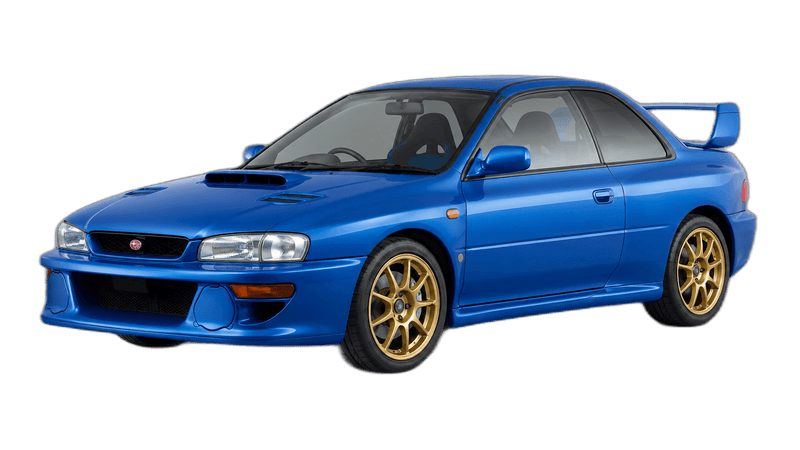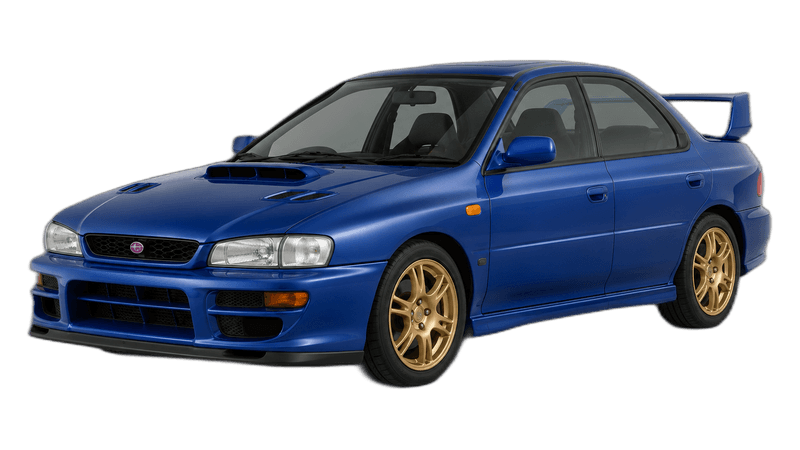
Subaru Impreza WRX STI (GDB)
£28,000
usedIndicative market price, updated periodically.
261bhp
Power
5.2s
0-100 km/h
238km/h
Top Speed
£28,000
Price Used
The Subaru Impreza WRX STI (GDB) produces 261 bhp, reaches 100 km/h in 5.2 seconds and has a top speed of 238 km/h. A representative example is worth about £28,000.
How hard it pulls.
Peak g-force the instant you bury the throttle, estimated from the car's 0–100 time and drivetrain.
Subaru Impreza WRX STI (GDB)Estimated peak launch g from the 0–100 time and drivetrain: an honest approximation, not a measured figure.
Dream Car Garage Editorial · Edited by José Teo Lorente Vallecillos · Last updated 2 November 2026
Overview
We have not driven this car. This review is based on published specifications and the sources listed below.
Scope and headline figures
This guide is scoped to the UK-market 2.0-litre Subaru Impreza WRX STI Type UK saloon (GDB), the car PistonHeads previewed in September 2001 and which went on sale in British showrooms in January 2002. It does not cover the Japanese-market STI, the US-market STI with its 2.5-litre engine, the limited Prodrive P1 or the 2.5-litre cars that later replaced the 2.0-litre engine in the UK range. Each of those is described below, so that you can tell them apart from the car in this guide.
The engine is a 2.0L turbocharged flat-4 petrol (1994 cc) with a bore and stroke of 92 by 75 mm and an 8.0:1 compression ratio. PistonHeads' launch article, dated 12 September 2001, quotes 265 PS, which it prints as 261.5 bhp (195 kW) at 6,000 rpm, and 253 lb ft, which it prints as 343 Nm, at 4,000 rpm. Converting 265 PS at the usual factor of 0.98632 gives about 261 bhp, so this guide uses 261 bhp and 343 Nm. The same article gives a top speed of 148 mph, which is about 238 km/h, and a 0-60 mph time of 5.2 seconds. Power goes to all four wheels, so this is an all-wheel drive car.
These are launch claims relayed by the press, not measurements. We have not driven this model for this article. Everything below comes from the sources listed at the end, from further pages that we name in the text, and from general inspection advice that we label as ours.
Checking the figures
The first thing to know about the STI is that its figures depend on the market, and the headline numbers that circulate for it are often a blend. Several different readings of the same UK car appeared within weeks of each other. The PistonHeads launch article gives 265 PS, 261.5 bhp and 253 lb ft. A second PistonHeads news item, dated 28 November 2001, opens with 260bhp and 253 lb ft but repeats 265 PS (261.5 bhp) in its engine section. The Car Enthusiast, writing in November 2001, quotes a claimed 262bhp and 253lb.ft. The RAC Drive used-car review, dated 12 September 2007, says the car was launched with 261bhp, yet also describes a 265bhp engine. These differ by a horsepower or two, which looks like rounding between PS and bhp, although none of the pages says so in as many words.
The bigger gap is to the Japanese-market STI. Wikipedia's article on the second-generation Impreza says STI output varied by market, from 265 PS (261 hp; 195 kW) at 6,000 rpm up to 280 PS (276 bhp; 206 kW) at 6,400 rpm, with torque between 343 and 373 Nm. The 276 bhp figure is 280 PS converted at 0.98632 and is a figure for the higher-output cars, not the UK launch car. If you see 276 bhp in an advert for a UK Type UK, treat it as a different specification or a mistake until a rolling-road sheet or the paperwork says otherwise.
The performance claims need care as well. The 5.2 seconds is a 0-60 mph time, and 60 mph is about 97 km/h, so it is close to but not the same as a 0-100 km/h time. We found no page that quotes 0-100 km/h for this exact car. The Car Enthusiast adds that it was unclear which version the 148 mph and 5.2 second claims referred to, because the two UK versions differ slightly in weight and aerodynamics. The RAC Drive review says the figures err on the conservative side and that the facelifted car reached 151 mph, about 243 km/h. None of the pages we read gives a kerb weight for the UK STI, so this guide does not quote one.
Engine and gearbox
The Car Enthusiast says Subaru claimed 80 per cent of the engine had changed from the ordinary WRX. The internal changes that PistonHeads lists are semi-closed-deck blocks, forged pistons, screw-in connecting rods, shimless valve lifters, sodium-filled exhaust valves and hollow intake valves, together with a larger intercooler and an uprated catalyst to meet Euro 3. Active Valve Control, a form of variable valve timing, is also listed.
The WRX it was compared with made 218 PS at 5,600 rpm and 215.4 lb ft at 3,600 rpm in PistonHeads' figures, so the STI added 47 PS and about 38 lb ft. The Car Enthusiast quotes the ordinary WRX at 215bhp. The RAC Drive review calls the STI's delivery toppy, with very little action below 4,500 rpm, which fits a high-revving boxer with a turbocharger rather than a torque-rich engine.
PistonHeads lists a new six-speed gearbox among the launch changes. The Car Enthusiast says the six-speed unit comes from the Japanese STI, has close ratios, and that the clutch was uprated to cope. In PistonHeads' 2013 guide to the 2003 to 2004 cars, Kev of the specialist Scooby Clinic says the engine already has a strong bottom end, strong heads and a very strong six-speed gearbox, which makes it ideal for tuning. That guide also mentions an unmodified gearbox in a time-attack STI that made 620bhp. That is a tuner's opinion about modified cars, not a promise about a standard one. It is a reason to ask what has been done to a car, not a reason to pay extra for modifications.
PistonHeads also describes a driver-operated intercooler water spray, with its tank in the boot, and a driver-presettable over-rev buzzer and light. A seller should be able to show you both working.
All-wheel drive, chassis and brakes
Subaru UK's history page says the company adopted the boxer engine in 1965, introduced Symmetrical All-Wheel Drive in the early 1970s and launched the Impreza in late 1992, adding that the turbo option redefined the performance saloon sector. It does not discuss the GDB STI or give figures for it, so we use it here for heritage only.
PistonHeads' launch list for the UK car includes Suretrac limited-slip differentials at the front and rear, a faster steering rack, uprated suspension with inverted struts, larger 17-inch Brembo brakes and 225/45 tyres on gold-coloured 17 by 7.5 inch spoked alloy wheels. The Car Enthusiast adds that the suspension bushes were uprated all round. Wikipedia says the driver-controlled centre differential, usually called DCCD, could be ordered on the Japanese STI from 2003 and reached the 2005 cars in other markets. The UK launch list names limited-slip differentials, not a driver-adjustable centre differential, so do not assume an early UK car has the dial. Ask the seller to show you which differentials the car actually has.
Wheels, brake discs and bushes will have been replaced on many of these cars by now, so the useful question for a seller is what is fitted and when, not what left the factory. The RAC Drive review warns about non-standard parts, resprays, kerbed alloys, spongy brakes and worn clutches, and that advice is as sensible on a twenty-year-old car as it was on a young one.
Body, interior and equipment
The car is a four-door saloon. PistonHeads describes smoked-glass projector-beam headlamps and blue suede-effect seats carrying STi logos, with red stitching on the steering wheel, gear knob and handbrake. Four colours were listed: WR Blue Mica, Blue Black Mica, Premium Silver Metallic and Pure White. The Car Enthusiast thought the headlamps the nicest interpretation of the new design yet, which is its opinion rather than a fact.
The Type UK name matters in the used market because it separates an official UK car from an import. PistonHeads' 28 November 2001 report headlines the car as Subaru's attempt to push out grey imports with the Type UK badge, and lists a three year, 60,000 mile warranty and enhanced rust proofing. The RAC Drive review also says the badging was meant to distinguish UK cars from grey imports. The warranty has long expired, so what remains useful to a buyer is the paperwork and badging that show the car was supplied new to the UK.
Versions that are not this car
Two UK versions were announced at launch: the standard STi and the STi Prodrive Style. PistonHeads says the Prodrive Style has Prodrive-designed spoilers, a grille and a deeper front bumper, plus a high-riding boot spoiler, newly designed sill spoilers and dark blue instruments with red needles. This guide covers both of them.
The front end changed during the car's life. The RAC Drive review dates a facelift to the 2002 Paris show and a further one in 2003 that replaced the bug-eye headlamps. PistonHeads' 2013 guides label the cars Bug Eye (2000 to 2002) and Blob Eye (2003 to 2004), while Wikipedia dates the Blob Eye 2002 to 2005. The dates differ between sources, so check a car's registration and build plate rather than relying on the label.
The Ice Blue WR1 was a 500-car limited edition. PistonHeads gives 316hp and 4.3 seconds to 60 mph, with a driver-controlled centre differential, bespoke Brembo brakes and uprated Prodrive suspension. Wikipedia gives 320 bhp, 420 Nm, 4.25 seconds and a limited top speed of 155 mph. The two sources disagree on power, and neither describes the 261 bhp car.
Prodrive also offered a performance pack. The RAC Drive review says it raised output to 305 PS (300 bhp) and torque from 253 lb ft to 299 lb ft, with a 155 mph top speed and a 0-60 mph time of 4.6 seconds, and that a 300 bhp STI Type UK became the top model in late 2004. We could not confirm from a second source whether that was a factory model or the pack, so a seller claiming 300 bhp should be asked to show it.
The Prodrive P1 is a different car. Octane describes it as a UK-specific run of about 1,000 cars built on the two-door Japanese WRX STI, on the earlier GC8 platform, with 276bhp for the Japanese-market engine remapped for UK rules. It is not a four-door GDB.
The 2.5-litre cars are a different guide. PistonHeads' 2013 Hawk Eye guide says the 2005 to 2007 UK cars used a larger 2.5-litre engine and quotes 281hp for the standard STI, or 320hp with the Prodrive pack. The RAC Drive review says the 2.0-litre was dropped for the 2006 facelift. Wikipedia describes the EJ257 as the 2.5-litre version of the EJ207 and links it to the US market, where Subaru announced in 2004 that it would sell the STI. The sources do not agree on exactly when the UK 2.0-litre engine ended, so confirm the engine size on any car labelled as a Type UK.
Recalls, history and what to check
We found no recall information for this model in the pages we read, and we do not know of a safety campaign that applies. Whether a particular car has an open recall can only be checked against the car. The GOV.UK page says to use the registration number on the MOT history service, which shows safety recalls that have not been fixed, or to use its vehicle recalls checker with the manufacturer, model and year of manufacture if there is no registration. Ask a Subaru retailer to check any outstanding work as well.
The RAC Drive review calls a full service history essential and lists non-standard parts, resprays, kerbed alloys, spongy brakes and worn clutches as things to look for. It warns that some sellers passed cosmetically modified WRX models off as STI versions at inflated prices, that sellers may misrepresent whether a car has the Prodrive engine upgrade, and advises background checks for theft, recovery or crashes. Our own advice, not a claim from a source, is to match the VIN on the car to the V5C and to ask for evidence of any engine tuning, because a remap changes the risk of buying the car.
Running costs and reliability
The RAC Drive review scores running costs 5 out of 10, says Subaru parts have a deserved reputation for being expensive, and also describes almost metronomic reliability, pointing to the Impreza's place at or near the top of J D Power surveys. That review was written in 2007, when these cars were young, so it describes a new car, not a prediction for one that has covered many miles. We have not repeated its parts prices because they are old.
We found no PistonHeads fault list for this exact car. PistonHeads' 2021 buying guide to the later 2.5-litre generations advises a compression test and frequent oil changes, and discusses piston ringland concerns on those cars. Those findings are for a different engine, so treat them only as a prompt to ask about oil, boost and tuning history. Fuel economy was not quoted in the pages we read, so budget for a thirsty car, and we have no verified figure for one of this age. Plan for a clutch, brakes, tyres and a specialist service rather than assuming a reputation for reliability means a cheap car to run.
Buying decision
Buy this car if you want an official UK Type UK STI with the 2.0-litre engine, a six-speed gearbox and all-wheel drive, and you accept that it is old, that it may have been modified, and that the real figures are around 261 bhp rather than the 276 bhp of some Japanese cars. Look for evidence that the car is a genuine STI, a documented service history and an engine whose tuning is on record. Be cautious of heavily modified examples and of anything whose paperwork does not match the car.
If you want the extra power of the WR1, the Prodrive pack or the 2.5-litre cars, treat them as separate purchases with their own checks. Be clear about which version you are looking at before you travel to see it.
Specifications
| Engine | 2.0L turbocharged flat-4 petrol (1994 cc) |
|---|---|
| Displacement | 2.0L |
| Power | 261 bhp |
| Torque | 343 Nm |
| 0-100 km/h | 5.2s |
| Top Speed | 238 km/h |
| Drivetrain | AWD |
| Country | Japan |
| Body Style | 4 door saloon, 5 seater |
| Years | 2002–2005 |
| Price Used | £28,000 |
Specifications are manufacturer-published figures.
Frequently Asked Questions
What is a Subaru Impreza WRX STI (GDB) worth?
A representative example is worth about £28,000. Actual values vary with specification, condition and history.
How much power does the Subaru Impreza WRX STI (GDB) have?
The Subaru Impreza WRX STI (GDB) produces 261 bhp and 343 Nm of torque.
How fast is the Subaru Impreza WRX STI (GDB) from 0 to 100 km/h?
The Subaru Impreza WRX STI (GDB) accelerates from 0 to 100 km/h in 5.2 seconds.
What is the top speed of the Subaru Impreza WRX STI (GDB)?
The Subaru Impreza WRX STI (GDB) has a top speed of 238 km/h.
What engine does the Subaru Impreza WRX STI (GDB) have?
The Subaru Impreza WRX STI (GDB) uses a 2.0L turbocharged flat-4 petrol (1994 cc).
When was the Subaru Impreza WRX STI (GDB) built?
The Subaru Impreza WRX STI (GDB) was built from 2002 to 2005.
Is the Subaru Impreza WRX STI (GDB) all-wheel drive?
Yes. The Subaru Impreza WRX STI (GDB) is configured with all-wheel drive.