
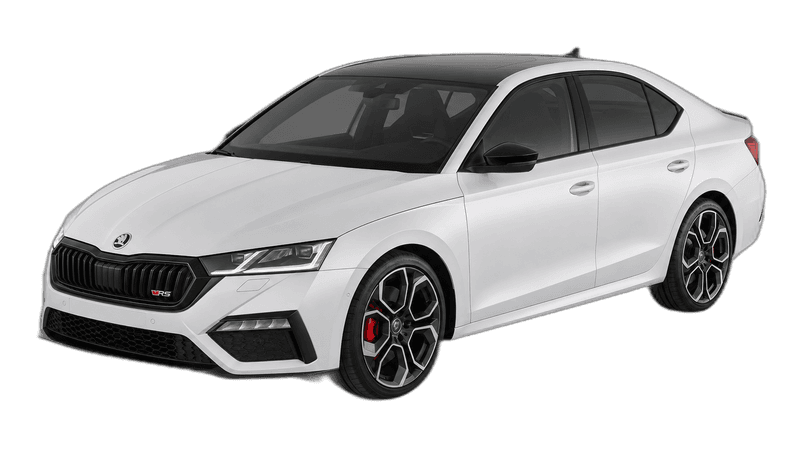
Skoda Octavia vRS (Mk4)
£28,000
usedIndicative market price, updated periodically.
242bhp
Power
6.7s
0-100 km/h
250km/h
Top Speed
£28,000
Price Used
How hard it pulls.
Peak g-force the instant you bury the throttle, estimated from the car's 0–100 time and drivetrain.
Skoda Octavia vRS (Mk4)Estimated peak launch g from the 0–100 time and drivetrain: an honest approximation, not a measured figure.
The Skoda Octavia vRS (Mk4) is a 5-door liftback by Skoda, with 242 bhp, 370 Nm of torque, a 0-100 km/h time of 6.7 seconds and a top speed of 250 km/h. Indicative used value: approximately £28,000. Actual values vary with specification, condition and history.
Dream Car Garage Editorial · Last updated 2 November 2026
Overview
We have not driven this car. This review is based on published specifications and the sources listed below.
The fast family liftback with a DSG
The Octavia vRS is Skoda's performance version of its family car, and the fourth generation is offered as a petrol, a diesel and a plug-in hybrid. This guide is scoped to the fourth-generation Octavia vRS 2.0 TSI, the 245 PS petrol car with front-wheel drive and a seven-speed DSG, in liftback (hatchback) form. It is not about the vRS iV plug-in hybrid, the 2.0 TDI vRS, the earlier generations or the 265 PS facelifted car. Our catalogue lists a 2.0L turbocharged EA888 inline-4 petrol engine (1,984 cc) producing 242 bhp and 370 Nm, with 0 to 100 km/h in 6.7 seconds, a top speed of 250 km/h, a seven-speed DSG and front-wheel drive. We have not driven this model for this article. This is a desk-researched ownership guide built from Skoda's German technical data sheet dated 25 March 2020, a PistonHeads used buying guide published in July 2024 and the government recall check, plus Skoda's UK launch page and its press kit chapter on the powertrain, which we read for context. We say where our figures are approximate or where sources disagree.
Skoda's UK page says the car was announced on 7 October 2020, with ordering opening on 27 October and first deliveries expected before the end of that year. PistonHeads, by contrast, says it was announced in late 2019, with deliveries slipping into early 2021, and lists it as a 2021 on car. We could not reconcile those statements, so our catalogue start year of 2020 is an approximation. In the UK the car is badged vRS, while Skoda's German and press material call it simply RS. PistonHeads notes that the V5C usually shows RS.
Checking the figures
Skoda's data sheet gives 180 kW, which it prints as 245 PS. PS is metric horsepower, and 245 PS converts to about 241.7 bhp, which we round to 242 bhp. Converting 180 kW directly gives about 241.4 mechanical horsepower, so a small rounding difference between sources is normal. PistonHeads and many UK adverts print 245 hp or 245 bhp, which is the metric figure used as shorthand, so an advert that says 245 PS, 245 hp, 180 kW or 242 bhp describes one engine. The data sheet quotes peak power from 5,000 to 6,200 rpm and 370 Nm from 1,600 to 4,300 rpm. PistonHeads prints 273 lb ft over the same band, which is the same 370 Nm.
For performance, the data sheet separates the two bodies. The liftback (Limousine in Skoda's German wording) is quoted at 6.7 seconds for 0 to 100 km/h and 250 km/h, and the estate (Combi) at 6.8 seconds and 244 km/h. PistonHeads and Skoda UK both print 6.7 seconds for 0 to 62 mph, and PistonHeads gives 155 mph, which is about 249 km/h and agrees with the 250 km/h figure. Skoda's press kit says the 250 km/h top speed applies to both gearboxes, and gives 6.8 seconds with the manual and 6.7 seconds with the DSG, without splitting the bodies. The data sheet is the only source we read that does, so we keep the catalogue to the liftback and do not mix in the estate figures. The data sheet gives a kerb weight with driver of 1,448 kg for the liftback, while PistonHeads prints 1,475 kg, so treat weight as approximate.
Do not confuse this car with its relatives. The earlier third-generation Octavia RS 245 carries the same 245 PS badge but is a different car, so do not take its figures as this car's. The facelifted fourth-generation RS, revealed in February 2024, has 265 PS, which motor1 describes as 20 PS more than its predecessor, with torque still 370 Nm. The plug-in hybrid vRS is also quoted at 245 PS, but PistonHeads says it is around 130 kg heavier, automatic only, without the VAQ differential and with 150 litres less boot space. The TDI vRS is a 200 PS diesel with 400 Nm according to Skoda's UK press kit and can be had with all-wheel drive, so do not read its figures against the petrol car. The German data sheet lists a 184 PS TDI instead, so the diesel output varies by market.
Engine and gearbox
The engine is the 2.0 TSI, which PistonHeads identifies as the EA888 and which Skoda's data sheet lists with engine code DKTB, a bore and stroke of 82.5 by 92.8 mm and a compression ratio of 9.6 to 1. It needs unleaded fuel of at least 95 RON. Skoda's press kit says it is based on the unit from the previous RS 245, with injection pressure of up to 350 bar, new piston crowns and a new crankshaft seal to reduce friction. PistonHeads says it was not the smoothest engine ever made but suits the car, especially with the DSG, and that its authors found no common problems in either the drivetrain or the chassis.
The gearbox in our scope is the seven-speed wet-clutch DSG, which the data sheet identifies as the DQ 381. PistonHeads says it shifts quickly on upshifts with a slight delay on downshifts. A six-speed manual was also offered, though PistonHeads suggests the DSG is the better match for the engine, and Skoda UK listed the manual as a later addition to the range. Real-world economy is described by PistonHeads as the low to mid 30s mpg, dropping towards 25 mpg in town, against an official 37.7 mpg. Skoda's data sheet gives 6.2 litres per 100 km combined for the liftback. Check the service book carefully: PistonHeads describes an annual service with an extended scope service at year three or 30,000 miles, then every two years or 20,000 miles, while Skoda's German sheet describes a variable interval, first after two years or 30,000 km. Ask which regime the previous keeper followed, and whether any DSG fluid service is recorded.
PistonHeads says Stage 1 tuning without hardware changes lifts the car to 340 hp, which would change every figure above. Ask whether a remap has been fitted, and check for fault codes. It also notes that the Soundaktor sound generator can be switched off each drive or removed, so a car with a different exhaust note may simply have had that change made.
Chassis, brakes and wheels
Skoda's press kit says the sports chassis is standard and lowers the car by 15 mm, with a multi-link rear axle. The electronic limited-slip differential uses a sixth-generation multi-plate clutch with a maximum lock-up torque of 1,600 Nm, and Skoda UK calls it VAQ. PistonHeads says it can send up to 100 percent of the power to either front wheel and works well. Dynamic Chassis Control, the adaptive damping, was optional. PistonHeads calls it well worth seeking out for better comfort in Comfort mode and tighter control in Sport, and says the ride is firm on a standard car. The press kit says the screen has sliders for damping, steering and DSG behaviour. PistonHeads also says the steering is variable ratio and more predictable than the older hydraulic system, and that the car is good to drive but not quite as much fun as the Golf GTI.
Skoda UK describes 17-inch front discs as standard, and the data sheet lists ventilated front discs with single-piston floating calipers. PistonHeads calls the brakes adequate. PistonHeads lists 19-inch wheels with 225/40 tyres on the car it describes, so confirm what a given car wears. Check tyres for uneven wear, which can point to alignment problems or hard use, and inspect the alloy wheels for kerb damage and the discs for lipping. If the car has adaptive dampers, test them in each mode on a rough road and listen for knocks.
Body, interior and electronics
Skoda UK lists LED Matrix headlights, a Virtual Cockpit with a Sport layout, a large 10-inch touchscreen, heated sports seats with integrated headrests, aluminium pedals and carbon-effect trim as standard. PistonHeads mentions a double-slat grille, SKODA lettering across the tailgate, gloss black aero details and special paints such as Hyper Green and Race Blue. It also says some cars have suffered fuel filler flaps freezing shut in cold weather. The data sheet quotes 590 litres of boot space for the liftback and 1,580 litres with the seats folded, while PistonHeads quotes about 600 litres, so use the manufacturer's figure when comparing.
The cabin is roomy and well laid out, but PistonHeads calls the touchscreen-heavy infotainment the car's weakest feature. It lists Bluetooth popping and crackling, lost climate and radio settings, CarPlay icon problems, an over-bright navigation map at night, location errors, unprompted SOS messages, slow screens and complete blackouts, especially on early cars, and says software updates addressed some of them. It also criticises some budget-feeling materials, including the fake carbon trim and the plasticky gear selector, plus door rattles and more wind and tyre noise than a Golf GTI. Test every screen function, the phone connection, the navigation, the climate memory and the driver assistance. PistonHeads says the lane-keeping assistance is standard and has to be disabled at the start of every drive, so check that it works as expected.
Recalls and history
PistonHeads reports a 2022 recall for loosely attached engine covers and, in early 2024, a recall covering DSG Octavias and Superbs built between 2020 and 2024 for an incorrectly fitted heat shield, with a risk of fire and reduced braking performance. We did not find a Skoda UK campaign list we could read, so we cannot say whether either campaign applies to a particular car. Enter the registration in the DVSA vehicle recall service and ask a Skoda dealer to check the VIN for open campaigns, then ask for proof that any work was done. Ask for the full service history, any accident repair evidence and a list of modifications. Skoda's German warranty terms include 12 years against body perforation, but warranty terms differ by market and used cars may have expired cover, so confirm what applies in the UK.
Buying decision
PistonHeads calls the vRS a kind of automotive Swiss Army knife in either hatch or estate form, an easygoing Golf GTI in disguise, though it adds that it is not really a hot hatch because it lacks excitement. Its main negative is the infotainment, which it says can be lived with. Rivals it names are the Golf GTI, the 310 hp all-wheel-drive Cupra Leon and the Hyundai i30 N. In our view the petrol vRS with the DSG is a fast, practical and comfortable family car first and a driver's car second, so choose it for the combination of 242 bhp, usable space and everyday manners. Prefer a car with a full history, working screens, matching tyres in good condition, an adaptive damper option if you can find it, a clean recall record and no modifications, and compare current adverts instead of relying on a price quoted here.
Specifications
Engine
2.0L turbocharged EA888 inline-4 petrol
Displacement
2.0L
Power
242 bhp
Torque
370 Nm
0-100 km/h
6.7s
Top Speed
250 km/h
Drivetrain
FWD
Country
Czech Republic
Body Style
5-door liftback
Years
2020–2024
Price Used
£28,000
Specifications are manufacturer-published figures.
Frequently Asked Questions
What are the specifications of the Skoda Octavia vRS (Mk4)?
The Skoda Octavia vRS (Mk4) is a 5-door liftback by Skoda, with 242 bhp, 370 Nm of torque, a 0-100 km/h time of 6.7 seconds and a top speed of 250 km/h. Indicative used value: approximately £28,000. Actual values vary with specification, condition and history.
How much does a Skoda Octavia vRS (Mk4) cost?
Indicative used value: approximately £28,000. Actual values vary with specification, condition and history.
What drivetrain does the Skoda Octavia vRS (Mk4) use?
The Skoda Octavia vRS (Mk4) is configured with front-wheel drive.
What type of car is the Skoda Octavia vRS (Mk4)?
The Skoda Octavia vRS (Mk4) is a hot hatches manufactured by Skoda in Czech Republic. Production ran from 2020 to 2024.