
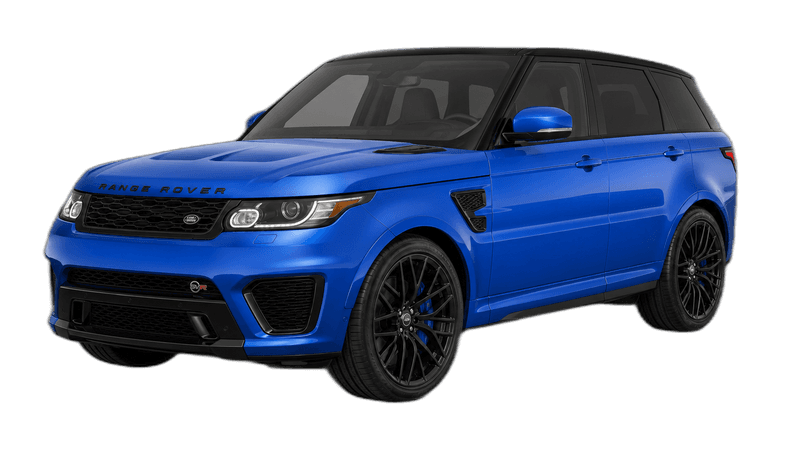
Range Rover Sport SVR (L494)
£65,000
usedIndicative market price, updated periodically.
567bhp
Power
4.5s
0-100 km/h
283km/h
Top Speed
£65,000
Price Used
How hard it pulls.
Peak g-force the instant you bury the throttle, estimated from the car's 0–100 time and drivetrain.
Range Rover Sport SVR (L494)Estimated peak launch g from the 0–100 time and drivetrain: an honest approximation, not a measured figure.
The Range Rover Sport SVR (L494) is a suv by Range Rover, with 567 bhp, 700 Nm of torque, a 0-100 km/h time of 4.5 seconds and a top speed of 283 km/h. Indicative used value: approximately £65,000. Actual values vary with specification, condition and history.
Dream Car Garage Editorial · Last updated 2 November 2026
Overview
We have not driven this car. This review is based on published specifications and the sources listed below.
A supercharged V8 in a family SUV
The SVR was the hottest version of the second-generation Range Rover Sport, built by Land Rover's Special Vehicle Operations team. This guide is scoped to the L494 Range Rover Sport SVR with the 5.0L supercharged V8, catalogued from the 2015 model year. It is not about the standard Range Rover Sport, the later L461 generation or its Range Rover Sport SV successor, although we say below where those differ. Our catalogue lists a 5.0L supercharged V8 petrol producing 567 bhp and 700 Nm, with 0 to 100 km/h in 4.5 seconds, a top speed of 283 km/h and all-wheel drive. We have not driven this model for this article. This is a desk-research guide built from a Land Rover press release, a PistonHeads used buying guide and the government recall page, so it tells you what those documents say and where they stop.
The most important point is that the SVR changed during its life. The figures above belong to the car as updated for the 2018 model year, not to the first cars sold in 2015. Read the next section before comparing this guide with an advert.
Checking the figures
Land Rover's August 2021 release gives the current SVR as 575 PS and 700 Nm, with 0 to 60 mph in 4.3 seconds, 0 to 100 km/h in 4.5 seconds and a top speed of 176 mph, which the release also states as 283 km/h. Land Rover quotes the power in PS, the metric horsepower, which is about 0.986 of a brake horsepower. 575 PS works out at roughly 567 bhp, so that is the figure we use. Several English-language releases print the same number as 575hp, which is why you will see 575 quoted as both PS and bhp. We treat it as PS, and 567 bhp as our conversion, not a number Land Rover printed.
The first cars were different. A Land Rover release from August 2014 gave the original SVR 550 PS, 680 Nm, 0 to 100 km/h in 4.7 seconds and a limited top speed of 260 km/h. We read that release but do not cite it. 550 PS converts to roughly 542 bhp. PistonHeads' specification table for the pre-facelift car agrees with it: 550hp, 502 lb ft (which at 1.3558 newton metres per lb ft is about 680 Nm), 0 to 62 mph in 4.7 seconds and 162 mph, which is about 261 km/h.
So the two sets of numbers belong to two versions of the same car. The 261 km/h and 4.7 second figures describe the 2015 to 2017 SVR. The 567 bhp, 700 Nm, 4.5 second and 283 km/h figures describe the car updated for the 2018 model year and sold after it. A listing that mixes the two, such as 575 bhp with 261 km/h, has copied from different sources.
Some further conflicts are worth knowing. PistonHeads' text gives 0 to 60 mph in 4.5 seconds for the early car, which does not match its own 4.7 second table. It also says the 2018 update cut the 0 to 60 mph time to 4 seconds, while Land Rover says 4.3. A March 2018 release for a record run on China's Tianmen Road, which we saw only as a search result, gives 174 mph (280 km/h) rather than 176 mph. We treat all of these as manufacturer or magazine claims, not measurements.
Years need a judgement call. Land Rover and PistonHeads place the launch in August 2014, but PistonHeads' table says on sale 2014 to 2019, which does not fit the August 2021 Ultimate edition release. Our catalogue starts at the 2015 model year. We found no source that states when the L494 SVR stopped being built, so we do not give an end year. Search results from Land Rover's press site show the next-generation Range Rover Sport being revealed on 10 May 2022, and PistonHeads reported in April 2023 that the SVR's replacement was a Range Rover Sport SV, but neither says when the last L494 SVR left the factory.
Engine and gearbox
The engine is a 4,998 cc supercharged V8 with 32 valves, mated to a ZF eight-speed automatic driving all four wheels. PistonHeads says the SVR "seems to have far fewer issues than other LRs" and found no evidence online of the ignition module software problems reported on some mid-2010s Range Rover Sports or of the crankshaft failures reported on the six-cylinder diesels. Those faults belong to other engines in the range, so do not assume they apply here, but they are the reason to ask for the exact engine and its history.
PistonHeads does mention that the odd owner has experienced random valve opening and closing, which it calls not a common fault. It praises the automatic as a brilliant partner to the engine. On fuel, it says an SVR will run fine on 95 petrol, though 98 may suit it better, and warns that hard or short-run driving can drop economy to 13 mpg. The pre-facelift car's official combined figure in the table is 22.1 mpg with 298 g/km of CO2, which you should treat as a laboratory number.
We read a PistonHeads piece from May 2023 about one example listed for sale. It gave no power figures, but it reported that the dealer said Land Rover had replaced the engine about six months before, and it listed brake and tyre advisories on the car's MOT history. That is one car, not a pattern, but it is a reminder to ask what was replaced and who did it.
Chassis, brakes and wheels
PistonHeads says the SVR sits 8 mm lower on air suspension. The dampers and bushes were recalibrated to stiffen the ride by 10 percent, and the electro-hydraulic active anti-roll bars can be decoupled for extreme off-roading. Steering assistance is reduced compared with the standard Sport. PistonHeads also says a carbon fibre front duct channels cooling air to the brakes, but that the disc sizes were not increased over the standard Sport. It lists the pre-facelift car at 2,335 kg, though it warns that weight and power data are hard to pin down and should be treated as relative.
Standard wheels are 21 inches, with 275/45 tyres. A 22 inch option with 295/40 Continental SportContact 5 tyres was available. Heavy cars with big wheels and a supercharged V8 use tyres and brakes quickly, and the May 2023 piece names both as ongoing costs. Check disc thickness, matching tyres with sensible date codes and any kerbing on the 22 inch wheels. PistonHeads also notes that off-road use risks damage to the bumpers and wheels.
A Land Rover release for the 2017 Los Angeles show, which we saw only as a search result, describes the 2018 SVR as having upgraded brakes, lighter seats and a carbon composite bonnet. We did not read it, and the pages we did read gave no brake sizes, so we cannot say what changed. Do not assume the brake advice for an early car applies unchanged to a later one.
Body, interior and electronics
PistonHeads is specific about the body. It says to check the door seals all round as they have been known to come adrift, and that panel gaps may look uneven on some cars. It also reports water leakage around the tailgate area, the tailgate scuffing the roof when opened, and leaks past the big panoramic glass roof. On a car this size, a damp boot carpet or a stained headlining deserves a proper investigation, not a quick glance.
Inside, PistonHeads says the piano black trim scratches easily, to the point where even new cars had scratches from the factory. It calls the early InControl system slow and notes it lacks Apple CarPlay and Android Auto support. Check that every button works as intended, that the reversing camera does not freeze, and that the air management menus on the 2018 Touch Pro Duo system are understood by the seller, because PistonHeads calls them complex. Factory options that matter to buyers include the 22 inch wheels, carbon fibre interior trim and the Meridian audio system.
Security is a real issue. PistonHeads says Sports are well liked by thieves, that some insurers refuse to cover them, and recommends a good immobiliser and parking somewhere awkward. Ask your insurer before you commit.
The exhaust is loud. PistonHeads describes an aftermarket exhaust as almost painfully loud close to the rear, and the May 2023 piece calls the exhaust of the car it describes very loud, enough to upset neighbours on early morning drives. Check a modified car's paperwork and its noise.
Model years and special editions
The 2015 to 2017 cars are the original specification: 550 PS and 680 Nm, per the sources above. For the 2018 model year, Land Rover's October 2017 release says the whole Range Rover Sport range gained new Matrix pixel LED headlights, a redesigned grille and bumper and the Touch Pro Duo system with two 10 inch screens. PistonHeads adds that the SVR gained silver quad exhausts, an optional carbon fibre bonnet and the power rise to 575hp. Land Rover calls the updated SVR the fastest Range Rover to date.
A Carbon Edition followed. We saw it only in search results describing a July 2020 Land Rover release: a 575 PS car with extensive carbon fibre detailing and 22 inch gloss black wheels. We did not read the release itself, so we do not describe it in more detail and we found no sign that its engine differs.
In August 2021 Land Rover announced an Ultimate edition from its SV Bespoke operation, with exclusive Maya Blue Gloss and Marl Grey Gloss paint, Fuji White lettering edges, a body-coloured vented carbon fibre bonnet, 22 inch gloss black forged wheels, black brake calipers and an Ebony and Cirrus interior. The release gives no change to power or performance for this edition and no production limit. It also says more than 20,000 SVRs had been sold since 2014. We found nothing that confirms any other mild changes for 2021, so we cannot say what, if anything, differed mechanically between a 2020 car and a 2021 one.
Recalls and history
The recall link in this guide is the government's general vehicle recall check, which shows unfixed safety recalls for a registration. We did not run a lookup for any particular car, and neither the Land Rover release nor the PistonHeads guide lists recalls, servicing intervals or warranty terms, so we claim none for this model. Before you buy, run the registration through the government tool, ask for the full service history and check what Land Rover or an approved specialist has done. Ask the seller where the car was first registered, so you know which market's specification you are buying.
Buying decision
Decide first which car you are buying. A 2015 to 2017 SVR has 550 PS and an early infotainment system. A 2018 or later SVR has the extra power, the new headlights and Touch Pro Duo, and in the later years the special editions above. PistonHeads reports solid residual values and says the SVR's reliability record looks better than the regular Sport's, which it calls far from brilliant. That is encouraging, but it comes from one guide and the absence of online complaints, not from a failure-rate study.
Prefer a car with a full and documented service history, a dry boot and roof, no exhaust modifications you do not want, matching tyres with recent date codes and brake discs with life left. Check every open recall, take a long test drive, have a Land Rover specialist inspect it and budget for tyres, brakes and fuel before you buy. We do not repeat dated used prices, because they go out of date quickly. Because we have not driven the car and found no long-term ownership source beyond the PistonHeads guide, treat this guide as a checklist, not a verdict.
Specifications
Engine
5.0L supercharged V8 petrol
Displacement
5.0L
Power
567 bhp
Torque
700 Nm
0-100 km/h
4.5s
Top Speed
283 km/h
Drivetrain
AWD
Country
UK
Body Style
SUV
Years
2015–present
Price Used
£65,000
Specifications are manufacturer-published figures.
More from Range Rover
Frequently Asked Questions
What are the specifications of the Range Rover Sport SVR (L494)?
The Range Rover Sport SVR (L494) is a suv by Range Rover, with 567 bhp, 700 Nm of torque, a 0-100 km/h time of 4.5 seconds and a top speed of 283 km/h. Indicative used value: approximately £65,000. Actual values vary with specification, condition and history.
How much does a Range Rover Sport SVR (L494) cost?
Indicative used value: approximately £65,000. Actual values vary with specification, condition and history.
What drivetrain does the Range Rover Sport SVR (L494) use?
The Range Rover Sport SVR (L494) is configured with all-wheel drive.
What type of car is the Range Rover Sport SVR (L494)?
The Range Rover Sport SVR (L494) is a suvs manufactured by Range Rover in UK. Production started in 2015.