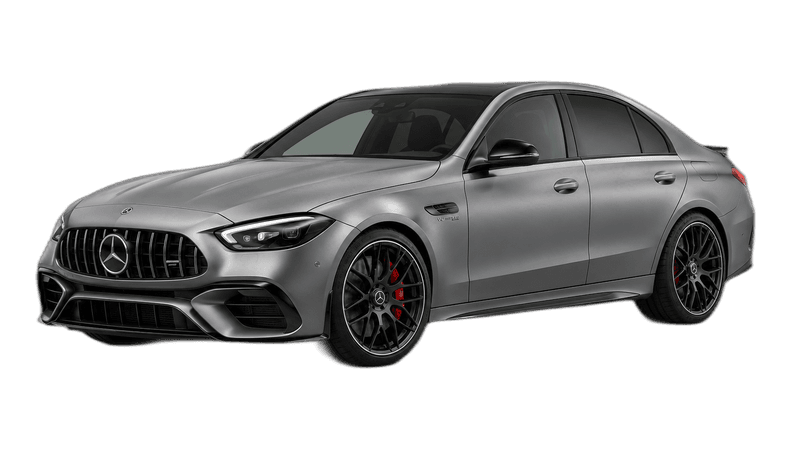
Mercedes-AMG C63 S E Performance (W206)
£78,000
usedIndicative market price, updated periodically.
671bhp
Power
3.4s
0-100 km/h
280km/h
Top Speed
£78,000
Price Used
The Mercedes-AMG C63 S E Performance (W206) produces 671 bhp, reaches 100 km/h in 3.4 seconds and has a top speed of 280 km/h. A representative example is worth about £78,000.
How hard it pulls.
Peak g-force the instant you bury the throttle, estimated from the car's 0–100 time and drivetrain.
Mercedes-AMG C63 S E Performance (W206)Estimated peak launch g from the 0–100 time and drivetrain: an honest approximation, not a measured figure.
Dream Car Garage Editorial · Edited by José Teo Lorente Vallecillos · Last updated 1 November 2026
Overview
We have not driven this car. This review is based on published specifications and the sources listed below.
A 63 badge with new arithmetic
The W206-generation Mercedes-AMG C63 S E Performance is one of the most argued-about cars AMG has ever built. Our catalogue lists it as a super saloon with a 2.0L turbocharged inline-4 plug-in hybrid drivetrain, 671 bhp, 1020 Nm, 0 to 100 km/h in 3.4 seconds and a 280 km/h maximum. We have not driven this model for this article. This is a desk-researched ownership guide drawing on the Mercedes-Benz USA pricing release, the PistonHeads W206 used buying guide and the DVSA recall service. The context matters. Where previous C63s were defined by V8 character, this car was engineered around electrified speed, and buyers should understand that trade before committing. PistonHeads is direct about the reception: the electrically turbocharged M139 four, boosted by a 201 hp electric motor, produced 670 hp and 752 lb ft, yet traditional 63 buyers largely stayed away. The same PistonHeads report says Mercedes acknowledged in September 2025 that the experiment had missed its audience, and that the next C63 was expected in mid-2026 without four-cylinder power. Treat that timing as reported guidance rather than a factory order. The stated reasoning centred on space for cooling and crash protection rather than simply the physical size of a V8, and the successor was expected to be another plug-in hybrid built around an M256 3.0-litre straight-six rather than a return to eight cylinders. A note on the numbers, because transparency matters here. The catalogue quotes 671 bhp and 1020 Nm; PistonHeads quotes 670 hp and 752 lb ft; the official US release quotes 671 hp combined and 752 lb ft. The torque figures align closely once units are considered, and the small power spread reflects rounding and quoting conventions rather than different hardware. Top speed needs the same care: the catalogue gives 280 km/h, while the US release quotes 155 mph or 174 mph depending on the package fitted, which is a market and equipment difference rather than a contradiction. Treat each figure as reported by its source.
The powertrain and the battery
The hardware is genuinely exotic. The 2.0-litre M139 was already the most powerful production four-cylinder in existence when the W206 launched in 2022, and AMG raised it further with a large electronically controlled Garrett turbocharger. PistonHeads notes the result delivered 236 hp per litre, more than the Ferrari 296 GTB on that measure. A two-speed electric motor on the rear axle lifts the combined output into supercar territory and is responsible for the low three-second acceleration claims. The battery was engineered for sustained abuse. PistonHeads reports 560 cells, each individually cooled by 14 litres of coolant circulating through the pack, with the aim of consistent temperatures and reliability under repeated fast running. Recuperation is strong enough that the car rarely needs plugging in, though the engine will start automatically once battery charge falls to roughly 20 per cent, whether the driver wants it or not. One driving mode, labelled B, holds the battery at a chosen state of charge, which suits drivers who want electric running reserved for specific parts of a journey. Cooling and heat management deserve real attention on a used car. PistonHeads observed that the real bonnet vent and the genuine vent at the rear of the front wings give an accurate impression of how much heat this powertrain generates, around the engine, the battery and the electric motor alike. By contrast, the vents above the Turbo E Performance badges on the trailing edges of the front wings are not functional, and the rear bodywork is not widened over a standard C-Class. An optional aero package added larger bootlid and rooftop spoilers. None of this affects reliability, but it tells you the thermal workload is real, and a car that has been tracked or drag-raced has been asking a lot of its cooling circuits.
What owners report
The encouraging news is that the M139 itself carries a good reliability reputation, and PistonHeads characterises the car as fast and dependable in service. The weak points reported so far are electrical rather than mechanical. Some 12V batteries have triggered low or critical warnings, and those warnings have affected door control modules among other functions. That echoes a wider pattern in modern cars, where the small auxiliary battery governs an expanding list of body electronics, but on the C63 a flat or failing 12V unit can produce alarming messages and dead door behaviour well before the main high-voltage pack is implicated. Check how the car behaves on first unlock. Do the mirrors fold and unfold, the doors present normally, the windows index correctly? Ask for a battery test result and any stored fault codes from a dealer-level diagnostic tool rather than a generic reader. The hybrid system adds a layer of complexity, so evidence that software updates and campaigns have been applied is worth more than a polished body. Running costs are not trivial: PistonHeads quotes a typical B service in the mid-hundreds of pounds depending on region, and the specialist knowledge required for a plug-in hybrid powertrain narrows the list of garages qualified to work on it.
Gearbox, chassis and the test drive
Unlike the A45 or the previous C63, the W206 uses a wet-startup MCT nine-speed automatic rather than a dual-clutch unit. The official US release confirms the MCT 9G transmission and 4MATIC+ all-wheel drive, and quotes a 0-60 mph estimate of 3.3 seconds against the catalogue's 3.4 seconds to 100 km/h; these are different test conventions rather than a discrepancy to reconcile. On the road, drive the car cold and fully warm. The gearbox should shift cleanly without flare or shudder, the transition between electric and petrol running should be close to imperceptible, and a full-throttle launch should complete without warning lights or thermal messages. The chassis was developed with unusual seriousness. PistonHeads reports that the simulator built to hone the AMG One hypercar was used for the C63, and AMG Dynamic Select offers a wide spread of modes from Electric and Comfort through Slippery and Race to Individual. Air suspension and rear-axle steering feature on many cars. Check that the modes alter the car's behaviour as intended, that the dampers switch without fault messages, and that the steering weights up naturally. Uneven tyre wear across the axles on an all-wheel-drive hybrid is a negotiating point at minimum, because this drivetrain is intolerant of rolling-radius mismatches.
Verdict
The W206 C63 S E Performance is a technological statement more than an emotional one, and its used values reflect that debate. Buy it for what it is: a hugely fast, carefully engineered plug-in hybrid saloon with strong reported reliability so far and a short, well-documented list of electrical niggles. Verify recall completion through the DVSA service and match it to invoices, insist on a full diagnostic scan covering both the 12V and high-voltage systems, and favour cars with disciplined servicing over cars with cosmetic appeal. Accepted on its own terms, it is a remarkable piece of engineering at a fraction of its original price.
Specifications
| Engine | 2.0L turbocharged inline-4 plug-in hybrid |
|---|---|
| Displacement | 2.0L |
| Power | 671 bhp |
| Torque | 1020 Nm |
| 0-100 km/h | 3.4s |
| Top Speed | 280 km/h |
| Drivetrain | AWD |
| Country | Germany |
| Body Style | Unknown |
| Years | 2023–present |
| Price Used | £78,000 |
Specifications are manufacturer-published figures.
Frequently Asked Questions
What is a Mercedes-AMG C63 S E Performance (W206) worth?
A representative example is worth about £78,000. Actual values vary with specification, condition and history.
How much power does the Mercedes-AMG C63 S E Performance (W206) have?
The Mercedes-AMG C63 S E Performance (W206) produces 671 bhp and 1020 Nm of torque.
How fast is the Mercedes-AMG C63 S E Performance (W206) from 0 to 100 km/h?
The Mercedes-AMG C63 S E Performance (W206) accelerates from 0 to 100 km/h in 3.4 seconds.
What is the top speed of the Mercedes-AMG C63 S E Performance (W206)?
The Mercedes-AMG C63 S E Performance (W206) has a top speed of 280 km/h.
What engine does the Mercedes-AMG C63 S E Performance (W206) have?
The Mercedes-AMG C63 S E Performance (W206) uses a 2.0L turbocharged inline-4 plug-in hybrid.
When was the Mercedes-AMG C63 S E Performance (W206) built?
Production of the Mercedes-AMG C63 S E Performance (W206) began in 2023.
Is the Mercedes-AMG C63 S E Performance (W206) all-wheel drive?
Yes. The Mercedes-AMG C63 S E Performance (W206) is configured with all-wheel drive.