
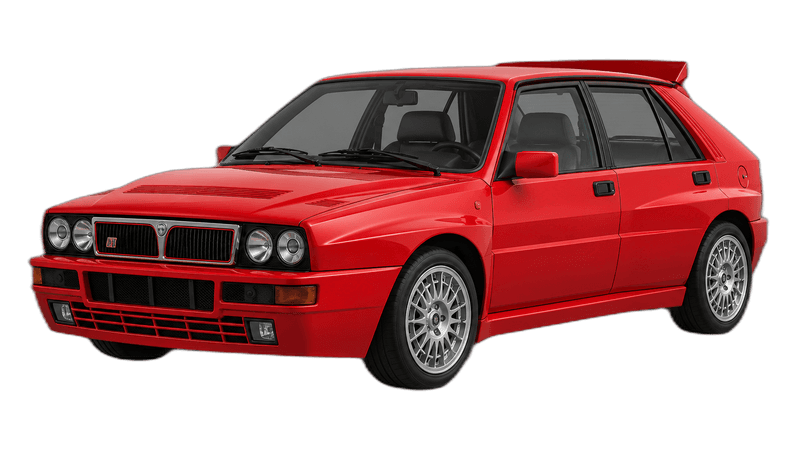
Lancia Delta HF Integrale Evo II
£85,000
usedIndicative market price, updated periodically.
212bhp
Power
5.7s
0-100 km/h
220km/h
Top Speed
£85,000
Price Used
The Lancia Delta HF Integrale Evo II produces 212 bhp, reaches 100 km/h in 5.7 seconds and has a top speed of 220 km/h. A representative example is worth about £85,000.
How hard it pulls.
Peak g-force the instant you bury the throttle, estimated from the car's 0–100 time and drivetrain.
Lancia Delta HF Integrale Evo IIEstimated peak launch g from the 0–100 time and drivetrain: an honest approximation, not a measured figure.
Dream Car Garage Editorial · Edited by José Teo Lorente Vallecillos · Last updated 2 November 2026
Overview
We have not driven this car. This review is based on published specifications and the sources listed below.
Scope of this guide
This guide is scoped to the Lancia Delta HF Integrale Evoluzione II, usually written Evo II, the final 1993 to 1994 version of the five-door hatchback with the catalysed 2.0L turbocharged inline-4 petrol (1995 cc) 16-valve engine and permanent all-wheel drive. It is not a guide to the earlier Evoluzione I, to the 8-valve and first 16-valve Integrales, or to the numbered limited editions, and we say below where each of them differs so you can tell which car an advert is really describing.
We have not driven this model for this article. Everything here comes from a German magazine road test with a data table, a PistonHeads used buying guide written for the whole Integrale family, and the government recall checker. We also read an Integrale history on Wikipedia and a model guide on the Supercar Nostalgia site for the production count, the equipment changes and the special editions, and we flag those points in the text. The Lancia website refused our request, so we did not use it and found no manufacturer data sheet to cite. Where sources disagree, or where a figure in our catalogue could not be confirmed, we say so.
The figures at a glance
- Engine: 2.0L turbocharged inline-4 petrol (1995 cc), 16 valves, intercooled, with a three-way catalyst and Lambda probe.
- Power: 215 PS (158 kW) at 5,750 rpm, which is 212 bhp after conversion.
- Torque: 308 Nm at 2,500 rpm in the road test table. Other sources print 314 Nm.
- Gearbox: five-speed manual only.
- Drive: permanent all-wheel drive with a viscous centre coupling and a Torsen rear differential.
- 0-100 km/h: 5.7 seconds, a claimed figure.
- Top speed: 220 km/h, about 137 mph by our conversion.
- Weight: 1,340 kg kerb weight in the road test table.
- Years: 1993 to 1994, with the last car leaving the Maggiora plant in November 1994 according to Supercar Nostalgia.
Why 215 is not 215 bhp
Lancia rated the Evo II at 215 PS. PS is the metric horsepower, and 215 PS converts to 212 bhp, or 158 kW. Our catalogue previously printed 215 as bhp, which mixed the two units, so we have corrected it. Wikipedia prints the same output as 212 hp. If a seller quotes 215 bhp, they are using the PS number with the wrong label. The Evo I was rated at 210 PS, so the Evo II gained 5 PS, a small step on paper.
Torque and what the sources say
The road test table in Auto Bild gives 308 Nm at 2,500 rpm, and we use 308 Nm. Wikipedia prints 314 Nm, and Supercar Nostalgia gives 232 lb ft at 2,500 rpm, which converts to about 314 Nm. Some auction descriptions go as high as 320 Nm. The previous catalogue value of 300 Nm matches none of these figures for the Evo II, so we have replaced it. The one thing the sources agree on is the peak engine speed: the Evo II reaches its torque peak at 2,500 rpm, where the Evo I peaked at 3,500 rpm, and Supercar Nostalgia calls this the most drastic improvement over the older car.
Performance claims and what they mean
Auto Bild lists 0-100 km/h in 5.7 seconds and 220 km/h, and Wikipedia lists the same two numbers for the Evo II. Supercar Nostalgia quotes 5.7 seconds as a 0-62 mph time, so the sources use slightly different benchmarks, though the gap between 62 mph and 100 km/h is a fraction of a second at this level of acceleration. These are manufacturer claims, not independent measurements, and Wikipedia gives the same 5.7 seconds and 220 km/h for the Evo I, so the claimed times do not separate the two cars. We read no measured test figure for an Evo II, and a car that has covered tens of thousands of kilometres should be expected to feel different from a factory claim.
Model years and production numbers
Wikipedia says the final Evo 2 was shown at the Geneva motor show in March 1993 and describes the model as presented in June 1993. We therefore use 1993 to 1994 for this guide.
The production figure most often repeated is 4,223 cars, all left-hand drive, which Supercar Nostalgia states. Other listings give about 2,500, and one market profile prints 2,481. We found no Lancia or Stellantis document that settles the matter, so we do not give a production count as a fact. Treat 4,223 as a widely quoted figure and nothing stronger.
How the Evo II differs from the Evo I, the 8-valve cars and the special editions
From the sources we read, these are the differences you will meet when you compare adverts:
- 8-valve cars: the first Integrale of 1987 used an 8-valve engine rated at 185 PS, with a flat bonnet. PistonHeads says its real-world performance is often close to the 16-valve car, and that it is simpler to maintain. A catalysed 8-valve Evo I is listed by Wikipedia at 177 PS.
- First 16-valve cars: PistonHeads lists 200 hp at 5,500 rpm for the 16-valve car launched in 1989, with a bulged bonnet.
- Evo I: 1991, with a restyled body, 210 PS and the torque peak at 3,500 rpm.
- Evo II: a catalysed, retuned 16-valve engine with a smaller Garrett T3 turbocharger, a Marelli engine management unit, knock sensors, a two-coil ignition and a red cylinder head. Supercar Nostalgia lists ABS, air conditioning and Recaro front seats as standard, 16-inch wheels and 40 kg more weight than the Evo I.
- Martini 5 and Martini 6: Wikipedia lists these as Evo I based cars from 1992, with 400 and 310 built respectively. They are outside this guide.
- Evo II special editions: Supercar Nostalgia lists Giallo Ginestra (220), Blu Lagos (215), Bianco Perlato (365), Edizione Finale (250, mostly exported to Japan), Dealer Collection (180), Club Hi-Fi (20) and Club Lancia (18). Wikipedia independently gives 250 and 180 for the last two. Naming varies between sources, and some call the Japanese cars Collezione, and the Final Edition is dated 1994 in some places and 1995 in others. Check any claimed special edition against the numbered plaque and the paperwork.
Engine and gearbox
Supercar Nostalgia gives a bore and stroke of 84 x 90 mm and a compression ratio of 8.0:1, and we have not checked those against a Lancia document. The engine is a development of the 16-valve unit originally designed by Aurelio Lampredi, and the sources agree on the turbocharger, a water-cooled Garrett with boost controlled by the engine computer.
PistonHeads did not write its guide for the Evo II, which appears there only in a timeline, so its advice is general to the Integrale range and may not apply car for car. It says the cambelt and the balance shaft belts should be changed every three years or 24,000 miles, with the water pump replaced at the same time, and that failures are more common on 16-valve cars than on 8-valve cars. It gives oil pressure as about 1 bar at idle when warm and about 3 bar at 3,000 rpm. Blue smoke on acceleration or on the overrun points to turbo seals, and an oil leak at the nose could come from the turbo or from the oil cooler assembly. A failing crank position sensor can cause stuttering or stalling, and the plastic fuel elbows on top of the tank can perish and let fuel run down the side when you fill up. Ask any seller for dated evidence of belt and water pump work.
Chassis, differentials and brakes
PistonHeads describes a viscous centre differential and a Torsen rear differential, says differential problems are rare, and says the clutch and gearbox should feel smooth and quiet. Supercar Nostalgia lists 281 mm front and 251 mm rear discs with four-piston calipers, attributing them to the original Evoluzione, while PistonHeads calls the brakes one of the weaker aspects and says the handbrake mechanism can stick. Worn bushes and bearings are the main suspension concern, and the guide advises a recent four-wheel alignment. It also warns that stiff aftermarket strut braces can stress the shell.
Body, rust and parts
PistonHeads says to look for cracking at the windscreen corners, around the bulkhead where the chassis legs attach and at the rear turret perimeters. Rust appears on the roof trailing edge, arches, doors and screen pillars, and underseal can trap moisture. Some interior plastics are brittle. Complete panels are scarce, though PistonHeads says repair sections exist for some. Auto Bild reported in June 2021 that Stellantis and its Mopar parts arm had reproduced new bonnets, front and rear wings and rear door skins for the Evo from original moulds, which helps if a car has accident repairs, but check current availability yourself.
Running costs and practicality
None of our sources gives running costs for the Evo II that we are willing to repeat. PistonHeads quotes parts prices, but they are from 2018 and for the general range. Auto Bild's 2022 article put an estimated value of 100,000 euros on a car with about 60,000 km, and values depend heavily on history, condition and edition, so check recent sales and ask a specialist. Expect a premium for a documented, unmodified car.
What to check before buying
- Confirm it is a genuine Evo II using the chassis number, the red cylinder head and the paperwork, and ask a Lancia specialist how to verify it.
- Because the cars were built left-hand drive, a right-hand drive car is a conversion, and PistonHeads says some used slower steering racks.
- Look for dated cambelt, balance shaft belt and water pump invoices.
- Check for blue smoke, oil on the nose, and oil pressure that matches the figures above.
- Inspect the bodywork for cracking, accident repair and rust, particularly around the screen and bulkhead.
- Check that the ABS, air conditioning, electrics and warning lights work.
- Ask whether the mileage can be proved, because PistonHeads warns that low-mileage imports with little history may have been clocked.
- Confirm every recall is closed using the check below.
Recalls and the DVSA check
We did not find a recall list for the Evo II in the sources we read, and PistonHeads does not list recalls. That does not mean there are none. Run the registration number or VIN through the GOV.UK vehicle recall check, and ask a Lancia specialist or Stellantis Heritage whether a car, especially an imported one, has any open campaign that the government service may not show.
Verdict
The Evo II is the last, most refined and most developed Delta Integrale, with a catalysed engine, ABS and a wider torque band, and its desirability is as much about history as speed. If you are shopping for one, confirm the exact version, the cambelt history, the body and the recalls, and treat the 212 bhp, 308 Nm, 5.7 seconds and 220 km/h figures as published ratings with the caveats above. We have not driven it, so use the sources and a specialist inspection to decide.
Specifications
| Engine | 2.0L turbocharged inline-4 petrol (1995 cc) |
|---|---|
| Displacement | 2.0L |
| Power | 212 bhp |
| Torque | 308 Nm |
| 0-100 km/h | 5.7s |
| Top Speed | 220 km/h |
| Drivetrain | AWD |
| Country | Italy |
| Body Style | 4/5 seater hatchback |
| Years | 1993–1994 |
| Price Used | £85,000 |
Specifications are manufacturer-published figures.
Frequently Asked Questions
What is a Lancia Delta HF Integrale Evo II worth?
A representative example is worth about £85,000. Actual values vary with specification, condition and history.
How much power does the Lancia Delta HF Integrale Evo II have?
The Lancia Delta HF Integrale Evo II produces 212 bhp and 308 Nm of torque.
How fast is the Lancia Delta HF Integrale Evo II from 0 to 100 km/h?
The Lancia Delta HF Integrale Evo II accelerates from 0 to 100 km/h in 5.7 seconds.
What is the top speed of the Lancia Delta HF Integrale Evo II?
The Lancia Delta HF Integrale Evo II has a top speed of 220 km/h.
What engine does the Lancia Delta HF Integrale Evo II have?
The Lancia Delta HF Integrale Evo II uses a 2.0L turbocharged inline-4 petrol (1995 cc).
When was the Lancia Delta HF Integrale Evo II built?
The Lancia Delta HF Integrale Evo II was built from 1993 to 1994.
Is the Lancia Delta HF Integrale Evo II all-wheel drive?
Yes. The Lancia Delta HF Integrale Evo II is configured with all-wheel drive.