
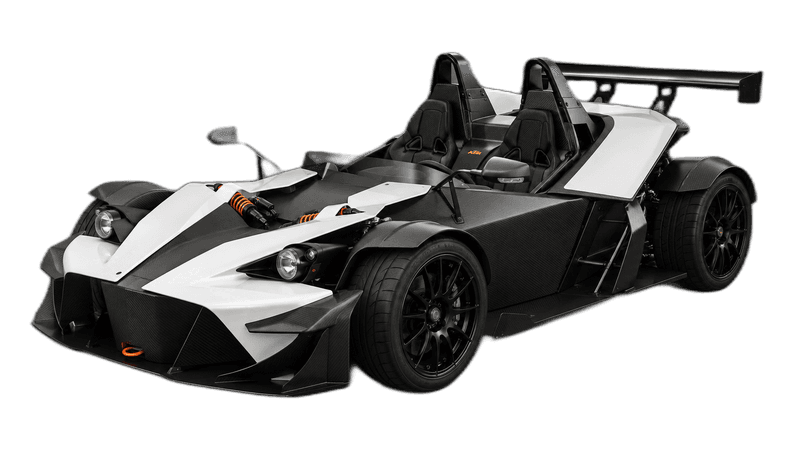
KTM X-Bow R
£95,000
usedIndicative market price, updated periodically.
300bhp
Power
3.9s
0-100 km/h
231km/h
Top Speed
£95,000
Price Used
How hard it pulls.
Peak g-force the instant you bury the throttle, estimated from the car's 0–100 time and drivetrain.
KTM X-Bow REstimated peak launch g from the 0–100 time and drivetrain: an honest approximation, not a measured figure.
The KTM X-Bow R is a open two-seater speedster by KTM, with 300 bhp, 400 Nm of torque, a 0-100 km/h time of 3.9 seconds and a top speed of 231 km/h. Indicative used value: approximately £95,000. Actual values vary with specification, condition and history.
Dream Car Garage Editorial · Last updated 3 November 2026
Overview
We have not driven this car. This review is based on published specifications and the sources listed below.
Scope of this guide
This guide is scoped to the KTM X-Bow R, the 2.0L Turbo Inline-4 car with 300 bhp that KTM of Austria introduced for 2011 as the more powerful road-legal version of its carbon-monocoque, mid-engine, rear-wheel drive open two-seater. It is not a guide to the original 2008 X-Bow with 240 PS, which was sold as the Street, Clubsport and Superlight and as a Dallara special edition. It is also not a guide to the RR cup car, the GT with a windscreen and glass doors, the GT4 race car, the longer GTX and GT-XR, or the track-only Comp R sold in North America. Several of those share a name and some hardware with the R, and an advert that says only "X-Bow" can describe any of them.
We have not driven this model for this article. Everything here comes from three cited sources: a KTM press information sheet from June 2016, which we read as a PDF copy on the Styrian state government website because we did not find the maker's own copy on a KTM host, PistonHeads' road test from 20 May 2011, and the government recall checker. We also read German coverage of the launch, a Wikipedia article, two car databases and a news report from 2025, and we say below which point rests on which. Prices are history, not valuations.
The figures at a glance
- Engine: 2.0L Turbo Inline-4, a 1984 cc Audi-sourced turbocharged direct-injection petrol four, mounted behind the seats and driving the rear wheels. KTM calls it the 2.0 TFSI, and PistonHeads describes it as an Audi 2.0-litre turbo.
- Power: 300 bhp. PistonHeads prints 300bhp, which it says is 60bhp more than the standard car, a 25 per cent increase. KTM's own sheet and the German press say 300 PS, which is about 296 bhp, so treat 300 as a rounded figure. Wikipedia lists 300 hp and 304 PS together, and those two cannot both be exact.
- Torque: 400 Nm. PistonHeads prints 295 lb ft at 3300 rpm, which converts to about 400 Nm (295 x 1.3558), and the German launch report also says 400 Nm. One car database lists 420 Nm for the R. We found no maker or press source for 420 Nm, so we do not use it.
- 0-100 km/h: 3.9 seconds. PistonHeads gives 3.9 seconds for 0-62 mph, which is within rounding of 0-100 km/h, and we treat it as such. It is a road tester's figure and we cannot tell whether it was timed or quoted.
- Top speed: 231 km/h. This figure comes from two car databases and the text of an AutoScout24 model page, not from KTM, and the same AutoScout24 page also shows 220 km/h in its table. PistonHeads did not state a top speed.
- Drive: rear-wheel drive, mid-engine, with a manual gearbox. PistonHeads says only "manual", and one car database lists six speeds, which we could not confirm elsewhere.
- Weight: 790 kg dry, according to PistonHeads and the German launch report.
Why the old catalogue row was wrong
Our own catalogue row for the R held 420 Nm, 3.9 seconds, 217 km/h and a production count of 2008, and each of those needed correcting. The 2008 was the year the X-Bow first appeared, not a number built. The 217 km/h and the 790 kg belong to the 2008 base car in the Wikipedia article, which lists 240 PS, 310 Nm and 217 km/h for that car. The 3.9 seconds appears for both the base car and the R in different places, so it is the figure most likely to be a shared rounding rather than a measured difference. We now give 231 km/h for the R and say clearly that it is second-hand.
What the 300 bhp car actually changed
PistonHeads says KTM strengthened the engine block, fitted a larger turbocharger, revised the injection system and revised the engine management. The German launch report adds that the block comes from the Audi S3 and TTS engine and that an engineering group reworked the electronics. The engine and gearbox unit was lowered by 19 mm, which KTM says lowered the centre of gravity by 15 mm. The torque tube that carries the engine now bolts to the carbon monocoque and not to the rear subframe, which makes the rear end stiffer. Springs were stiffened, the dampers were retuned and the wishbones received Teflon discs. KTM's June 2016 sheet says the 300 PS 2.0 TFSI first appeared in the R in 2011.
The monocoque itself is the reason the car matters. It was developed with the Italian race-car maker Dallara and, KTM says, Audi's help with the engine. KTM says it is made of four layers of carbon fibre and epoxy resin baked in an autoclave, weighs a little under 80 kg, and was the first full carbon monocoque on a series production car. The front suspension is pushrod operated with the springs on top of the tub. A flat three-part underbody with a diffuser gives a road-legal R almost 200 kg of downforce at 200 km/h according to KTM, and optional aerodynamic packages can raise that. Those numbers are KTM's claims from a press release, not measurements we could check.
How it was reported in 2011
Brett Fraser's PistonHeads test took place at the Spielberg ring in Austria, now the Red Bull Ring, and he drove a race-prepared version with full aero and slicks, a press demonstration car, a car without aero on trackday tyres and a standard R on treaded Michelin Pilot tyres. His verdict was "More power. More grip. More competence. More fun." He praised powerful, progressive brakes and a strong push between about 5000 rpm and the change-up light at about 6200 rpm. His main complaints were practical. Starting the car is a palaver, which involves removing the steering wheel, climbing over the undertray and pressing a mode button. Air flowing over the cockpit "roils madly" and can batter the driver's head. After spins, stones and dust collected in the undertray and footwells. He said a screen was being developed for launch the following year, and the GT with its fixed windscreen arrived in 2013.
Production and how many were built
We cannot give a build count for the R. KTM's June 2016 sheet says the 1,000th X-Bow of all types was completed on 7 June 2016, exactly eight years after production began in June 2008 in a purpose-built plant in Graz, and it says about 80 cars a year were then built across the R, RR, GT and GT4. That is a total for every version, so the catalogue shows no count for the R. The same sheet says the 1,000th car was the first R with a facelift, with body panels based on the GT, a gilled engine cover, narrower headlamp surrounds and a new front splitter, still with the 300 PS 2.0 TFSI plus detail improvements, at 74,900 euros before tax. So an R can be an early 2011 car or a later facelifted one, and the paperwork should say which.
On the end of the car, the picture is unclear. A news report updated on 31 July 2025 quotes KTM's chief executive saying the company was far into the process of selling the X-Bow and that 36 had been sold the year before. We did not find a date when the R stopped being built, so the catalogue shows no end year and the guide does not claim one. We also did not confirm who now supplies parts or support.
What to check before buying
- Confirm the car is an R with 300 PS. A 240 PS car, a 360 PS RR, a windscreen GT or a track-only Comp R can all be described loosely as an X-Bow.
- Ask whether it is a 2011 body or a 2016 facelift car, and ask for the build date and chassis number.
- Ask which aerodynamic and suspension options are fitted. PistonHeads says the winglets and reprofiled spoilers were options, not standard.
- Look at the undertray and footwells for stones, scrapes and cracks from track use, and ask for a record of any spins or off-track moments.
- Ask for evidence of the engine's service history, particularly the turbocharger, since the R runs a larger turbo and revised management than the base car.
- Check how the car is registered. AutoScout24 says it is road legal in the EU under small-series homologation and track-only in some other countries, and we could not verify that for your market.
- Sit in it with a helmet on. The buffeting PistonHeads describes is real for an open car with no screen, and the starting routine is unusual.
- Get an independent inspection by a specialist who knows carbon tubs. Anyone quoting running costs or parts prices is estimating, because we found no published schedule.
Recalls and the DVSA check
We did not run the government checker, because it needs a registration number, or a manufacturer, model and year, and we are not looking at a specific car. The page says it covers manufacturer recalls for a serious safety problem and that non-safety recalls come from the manufacturer directly. It does not say what happens for a low-volume car or a grey import that its database does not list. We found no recall notice for the X-Bow R in any source we read, but absence from our sources is not a clean bill of health. If the car has never been sold new in Britain, a clear result tells you little, so also ask KTM or a specialist whether any bulletin applies to the chassis number.
About the photograph
The picture at the top of this page is a studio image of a KTM X-Bow R supplied by KTM AG to Wikimedia Commons under a free licence. It shows a car in white and orange with the carbon tub exposed and no people or readable number plate. We have cropped and resized it. We did not confirm the year of the car, and its bodywork looks closer to the facelifted R than to the 2011 original, so use it for the shape and not as proof of any one specification.
Verdict
The KTM X-Bow R in this guide is a 300 bhp, 400 Nm, 790 kg turbocharged four in a carbon tub, rear-wheel drive and mid-engine, with a reported 3.9 seconds to 100 km/h and a 231 km/h top speed that we could only source second-hand. It is a stripped-out open car with no roof, no screen and a fussy start-up, and its appeal lies in its structure and its feel rather than in its headline figures. Before buying one, confirm which of the several X-Bow versions you are looking at, insist on a full history and a specialist inspection, and treat every published figure as a claim with the caveats above. We have not driven it, so use the sources and a proper look at the car to decide.
Specifications
Engine
2.0L Turbo Inline-4
Displacement
2.0L
Power
300 bhp
Torque
400 Nm
0-100 km/h
3.9s
Top Speed
231 km/h
Drivetrain
MR
Country
Austria
Body Style
Open two-seater speedster
Years
2011–present
Price Used
£95,000
Specifications are manufacturer-published figures.
More from KTM
Frequently Asked Questions
What are the specifications of the KTM X-Bow R?
The KTM X-Bow R is a open two-seater speedster by KTM, with 300 bhp, 400 Nm of torque, a 0-100 km/h time of 3.9 seconds and a top speed of 231 km/h. Indicative used value: approximately £95,000. Actual values vary with specification, condition and history.
How much does a KTM X-Bow R cost?
Indicative used value: approximately £95,000. Actual values vary with specification, condition and history.
What drivetrain does the KTM X-Bow R use?
The KTM X-Bow R is configured with a mid-mounted engine and rear-wheel drive.
What type of car is the KTM X-Bow R?
The KTM X-Bow R is a track focused manufactured by KTM in Austria. Production started in 2011.